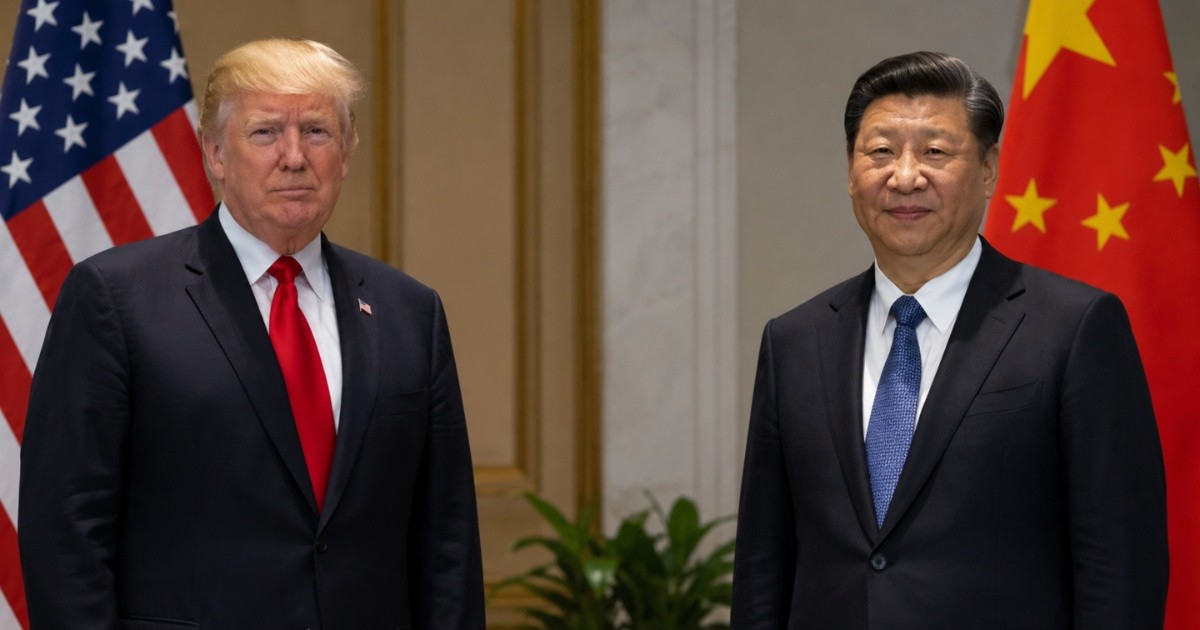
On Thursday, U.S. President Donald Trump will engage in a pivotal day of his state visit to China, highlighted by a bilateral meeting with President Xi Jinping. The agenda also features a state dinner and various ceremonial activities.
Trump arrived at Beijing Capital International Airport, where Han Zheng, China's vice president, along with Chinese Ambassador to the U.S. Xie Feng and Deputy Foreign Minister Ma Zhaoxu, welcomed him before he proceeded to the Four Seasons Hotel near the U.S. Embassy.
This marks Trump’s second visit to China, and it is the first by a sitting U.S. president since his own visit in 2017, nearly nine years ago.
Backdrop of Trade and Economic Talks
The summit occurs following a trade truce agreed upon by both leaders in October 2025 in Busan, South Korea. This agreement halted retaliatory tariffs, which had reached 145% by Washington and 125% by Beijing, and eased some Chinese restrictions on the export of rare earths and critical minerals.
Ahead of the bilateral meeting, delegations led by U.S. Treasury Secretary Scott Bessent and Chinese Vice Premier He Lifeng wrapped up economic and trade negotiations in Seoul. The Chinese state news agency Xinhua described these talks as "constructive."
U.S. Business Leaders and Broader Geopolitical Issues
On Tuesday, Trump expressed from Air Force One his intention to urge Xi to "open" China to American businesses.
The president's delegation includes top executives such as Elon Musk (Tesla), Tim Cook (Apple), and Jensen Huang (Nvidia, who joined last minute during a stop in Alaska), alongside representatives from Boeing, BlackRock, Visa, Mastercard, Meta, and Goldman Sachs.
Beyond trade, the agenda tackles three major geopolitical issues: Iran, Taiwan, and technological rivalry.
Secretary of State Marco Rubio stated during the flight to China that Washington aims to persuade Beijing to take a more active role regarding Tehran, considering that the blockage of the Strait of Hormuz directly impacts Chinese energy interests.
Approximately 45% of China's gas and oil imports pass through this strait.
In April, Trump announced that China agreed not to send weapons to Iran in exchange for the U.S. keeping the Strait open, paving the diplomatic way for this summit.
Tensions Over Taiwan
Regarding Taiwan, Beijing urged Washington to "handle prudently" the issue and "stop" arms sales to the island, just hours before Trump’s arrival. This follows Trump’s statement that he would discuss arms sales to Taipei with Xi.
A pending arms sale package to Taiwan, valued at $11 billion and approved in December 2025, remains unexecuted.
Analysts from the Center for Strategic and International Studies (CSIS) and the Council on Foreign Relations (CFR) describe the summit as a meeting of "limited but choreographed agreements," where both nations aim to stabilize their relationship without resolving underlying structural tensions.
The agenda extends through Friday, with a working lunch planned before Trump returns to the U.S.
Key Insights on Trump and Xi's Meeting
What is the significance of Trump's visit to China?
Trump's visit is crucial as it aims to address trade disputes, enhance economic cooperation, and tackle major geopolitical issues such as Iran, Taiwan, and technological rivalry.
Who are the key business leaders accompanying Trump?
Prominent business leaders include Elon Musk (Tesla), Tim Cook (Apple), and Jensen Huang (Nvidia), along with representatives from Boeing, BlackRock, Visa, Mastercard, Meta, and Goldman Sachs.
What are the main issues on the agenda besides trade?
The agenda also covers significant geopolitical matters, including Iran's situation, Taiwan's defense, and the ongoing technological competition between the U.S. and China.