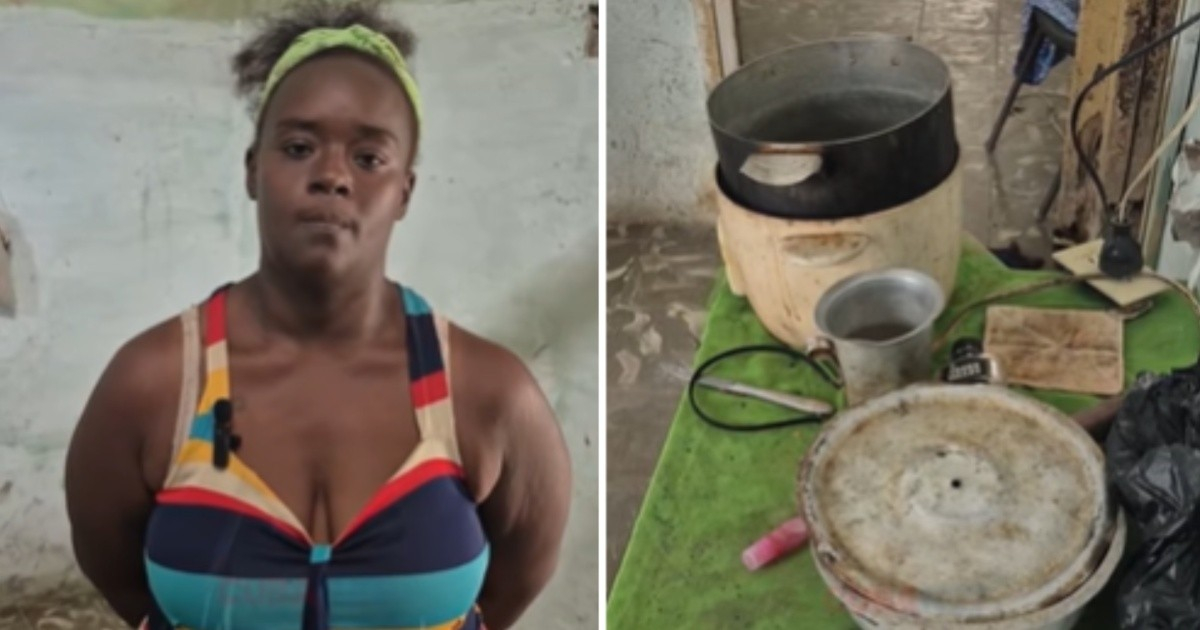
Yanelis Beatriz Torres Pedro, a 31-year-old single mother living in the Havana municipality of Guanabacoa, has brought attention to the dire circumstances she and her two young daughters face, highlighting a severe lack of support from the Cuban government. Speaking to CubaNet, Torres Pedro revealed that they are struggling with hunger and extreme poverty.
"Mothers are facing severe hardships; we're even going hungry," Torres Pedro shared. Left to care for her daughters, ages 10 and 13, alone after her mother's passing, she has been deprived of essential support.
"I don't have a place to cook; we had to throw away our beds because of bedbugs... This is how I live alone with my daughters. We've been going hungry since my mom died," she explained.
Approximately two years ago, the Guanabacoa Municipal Directorate of Labor and Social Security withdrew the modest pension of just over 1,000 pesos she had been receiving. Their reasoning? Her youngest daughter was now attending school, and they claimed she was "fit to work."
"It was a pension of over 1,000 pesos, which they took away when my mom died. They told me that since my youngest was in school, I could work," Torres Pedro recounted.
Nonetheless, employment is not an option for her as she has no one to care for her children. Her eldest suffers from vagal crises, while her youngest has an emotional disorder diagnosed after their grandmother's death, requiring treatment with carbamazepine.
When Torres Pedro presented her daughters' medical certificates to a Labor and Social Security official, the response was shocking: "She told me she didn't care about any of that."
"Many times, I've had to go without eating, just like the girls, because there's nothing," she lamented.
The family's survival largely depends on the kindness of neighbors. Torres Pedro often sends her daughters to neighbors' homes for food, like rice and other essentials.
Her younger daughter's teacher also helps by providing school snacks, and the Catholic Church offers milk and bread in the mornings so the child can attend school.
"The government hasn't come by at all, not even to ask how the girls are doing after my mom passed," Torres Pedro stated.
This isn't the first time she has reached out for help. In March 2021, amid the so-called "Tarea Ordenamiento," she publicly denounced her plight when authorities refused to assist her.
That plea resulted in a monthly pension of 1,300 pesos, but five years later, the state revoked this aid, worsening her situation.
"I'm here again to denounce the injustice being done to me and my daughters," she declared.
Torres Pedro's story underscores a historic food crisis in Cuba.
A survey conducted by the Food Monitor Program on May 6 revealed that 33.9% of Cuban households reported at least one person going to bed hungry during 2025, marking a 9.3 percentage point increase from 2024.
A staggering 79.7% of surveyed Cubans attribute the food crisis to poor government management, while only 6.4% primarily blame the U.S. embargo.
"It's true that over 1,000 pesos is not enough because everything is so expensive, but having nothing at all is far worse," Torres Pedro summed up, capturing the harsh reality faced by countless Cuban families.
Understanding Cuba's Food Crisis and Government Response
What has led to the food crisis in Cuba?
The food crisis in Cuba is primarily attributed to inefficient state management, as reported by 79.7% of Cubans surveyed. Additionally, economic challenges and resource scarcity exacerbate the situation.
How has the Cuban government responded to the crisis?
The Cuban government's response has been criticized as inadequate. Many citizens, like Torres Pedro, report a lack of support and assistance, leading to increased hardships.