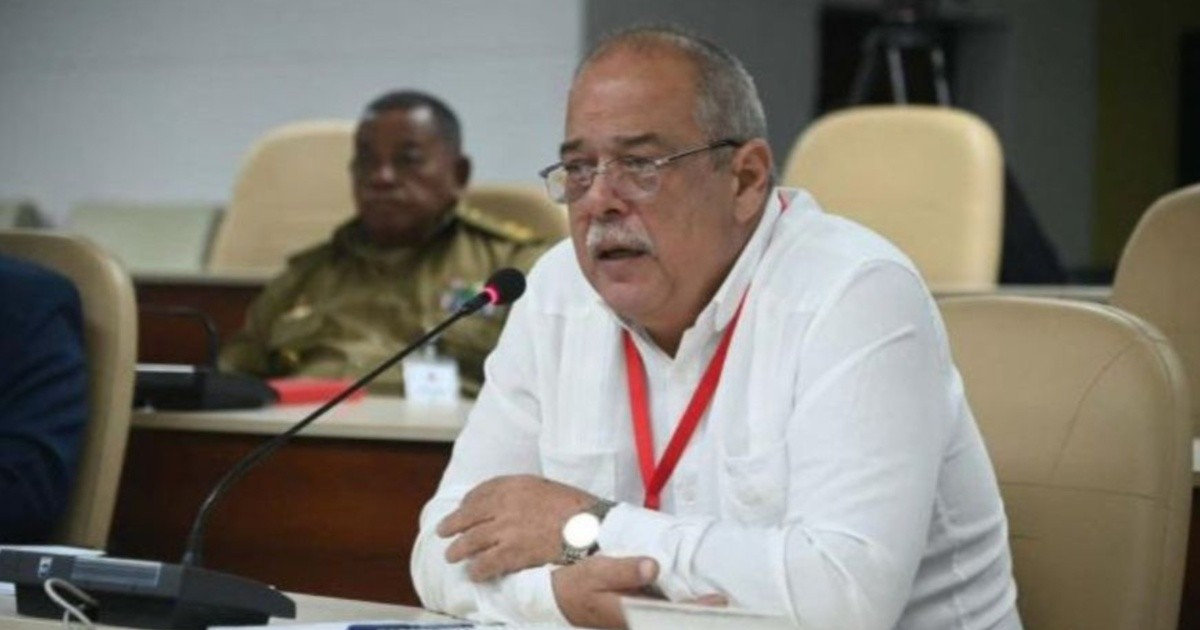
Cuba's Minister of Energy and Mines, Vicente de la O Levy, admitted on Wednesday that certain provinces endure significantly longer and more chaotic power outages than others. However, he declined to identify these regions and dismissed the possibility of an immediate solution, citing a lack of resources necessary for essential investments.
During a "special" press briefing, De la O Levy addressed the public perception that some areas manage to rotate blackouts every six to eight hours, while others experience extended periods without a clear pattern.
"I'm not going to name provinces; they are known," the minister stated, dodging the identification of the most affected areas.
Technical Factors Behind Power Disparities
The minister explained that these disparities are due to technical factors: each province has a different number of circuits, varying demand, and specific circuits that cannot be shut down.
He illustrated this by noting that in some provinces, hospitals are equipped with four power supply lines. This setup allows the electric company to rotate these lines, ensuring the hospital remains powered but impacting all residents connected to these circuits. "And this is done independently from the municipal rotation," he clarified.
In contrast, other provinces lack such flexibility, requiring investments that the government admits it cannot afford.
Fuel Crisis and Temporary Reliefs
"We return to the same issue: there is only one source of energy. The total value of generation and demand is singular. Therefore, distribution becomes extremely challenging," De la O Levy concluded.
The root of this challenge lies in the most severe fuel crisis in years. According to the minister, since December 2025, Cuba had not received any fuel shipments until a few weeks ago. "That happened nearly four months after no fuel ship arrived in Cuba," he emphasized.
A donation from Russia provided temporary relief: 100,000 tons of crude oil arrived on March 31 at Matanzas port, processed at the Camilo Cienfuegos Refinery, and distributed between April 17 and 19.
This supply allowed for a temporary improvement — including several days without blackouts in Havana — but was depleted by early May as temperatures rose and demand increased.
Current Power Supply Challenges
"Today, with higher temperatures, the electrical system is only operating with thermoelectric plants, Energás, and solar photovoltaic parks," admitted the minister.
The forecasted deficit for Wednesday night's peak was over 2,020 MW, with availability at just 1,245 MW against a demand of 3,200 MW. This meant that approximately 61% of Cuba could simultaneously experience power outages.
Compounding the issue is the shutdown of the Felton thermoelectric plant in Holguín, which the minister attributed to leaks in the boiler and a broken bearing in one of the regenerative air heaters. "If it continued operating like that, it would completely damage the unit," De la O Levy warned.
Matanzas has been identified as the most affected province, with circuits experiencing over forty continuous hours without electricity. The minister merely remarked that the "known" provinces are the hardest hit, without offering concrete solutions or timelines.
The National Electric System has experienced seven total collapses in the past 18 months, the most severe occurring on March 16, 2026, when the entire country was left in darkness for 29 hours and 29 minutes.
Understanding Cuba's Power Outage Crisis
Why are some Cuban provinces experiencing longer power outages?
The longer power outages in some provinces are due to technical factors, such as the number of circuits, demand, and specific circuits that cannot be turned off. Additionally, some provinces lack the flexibility in power supply management that others have.
What has been the impact of Cuba's fuel crisis on its power supply?
Cuba's power supply has been severely impacted by a fuel crisis, which left the country without fuel shipments for nearly four months. While a donation from Russia provided temporary relief, the situation remains critical as the demand for energy increases with rising temperatures.
What measures has the Cuban government taken to address the power outages?
The Cuban government has admitted its inability to invest in necessary infrastructure to address power outages, and currently relies on limited resources, including thermoelectric plants, Energás, and solar photovoltaic parks, to meet energy demands.