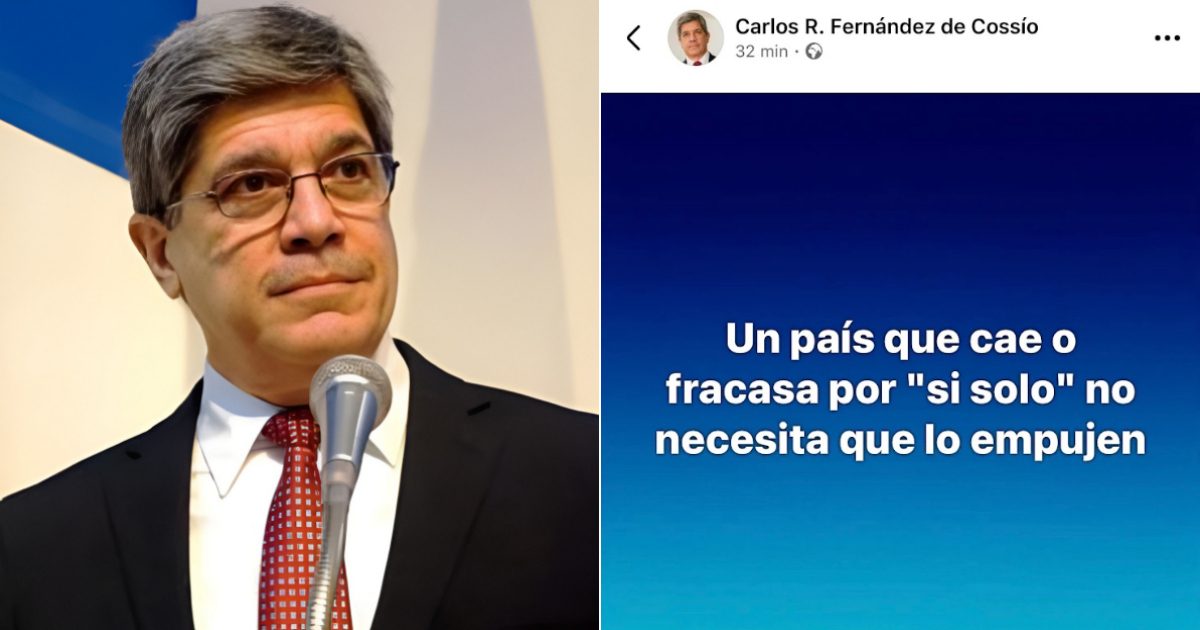
Carlos R. Fernández de Cossío, Deputy Minister of Foreign Affairs in Cuba, on Wednesday posted a revised version on Facebook of an argument he had deleted just hours earlier. This time, he included the regime's well-worn phrase: "ruthless economic war."
The initial post, swiftly removed, asserted: "A country that falls or fails on its own doesn't need a push." The statement, intended to counter Washington's predictions about the regime's collapse, inadvertently affirmed the very premise it aimed to refute by indicating that the country "falls or fails."
The updated version, which remains on his profile, reads: "Contrary to the anti-Cuban narrative, if a country were to fall on its own, as they claim, it wouldn't need to be pushed by a ruthless economic war."
The only significant grammatical adjustment between the versions is the shift from the indicative "falls or fails" to the conditional "were to fall," a change insufficient to mend the original rhetorical damage.
By incorporating the phrase "ruthless economic war," Fernández de Cossío attempts to anchor his argument in the regime's familiar ideological territory, which for decades has blamed external forces for its crises.
However, the logical structure of the statement remains flawed: For the sentence to make sense, one must accept as a premise that the country is indeed vulnerable to collapse, something Havana has been denying for months.
This is not the first instance of such blunders by the Deputy Minister. In late April, Fernández de Cossío cited the 1940 Constitution to justify the revolutionary expropriations of the 1960s, overlooking that the same document guaranteed private property and demanded compensation. The pattern is clear: arguments that, upon scrutiny, bolster the critiques they aim to dismantle.
The official is the most active voice of the Ministry of Foreign Affairs (MINREX) on social media. On Tuesday, he labeled those supporting U.S. intervention in Cuba as "accomplices" and recently declared that "Cuba poses no threat to that country" following new sanctions.
The dual missteps occur amid peak U.S. pressure. On May 1, President Donald Trump signed an executive order expanding sanctions against GAESA and other Cuban entities.
Soon after, Secretary of State Marco Rubio described the regime as a "failed state" governed by "incompetent communists," plagued by "extreme poverty, chronic energy crisis, runaway inflation, and lack of freedoms." Last Monday, it emerged that Trump pressured his cabinet, demanding quicker results amid Cuba's sluggish collapse.
Since January, Trump has reiterated his forecast multiple times. "Cuba will fail very soon. It is really a nation that is very close to failing," he stated on January 27. By late March, he was more explicit: "In no time, it will fail, and we'll be there to assist," characterizing the regime as "poorly led, very poorly and corrupt."
Understanding Cuba's Political Dynamics and External Pressures
What did Carlos R. Fernández de Cossío originally post on Facebook?
He initially posted a statement that said, "A country that falls or fails on its own doesn't need a push," which he later removed and revised.
How did the revised post differ from the original?
The revised post included the phrase "ruthless economic war" and altered the grammatical structure from indicative to conditional.
What is the significance of the phrase "ruthless economic war" in the context of Cuban political discourse?
The phrase is commonly used by the Cuban regime to attribute the nation’s crises to external forces, particularly blaming U.S. policies.