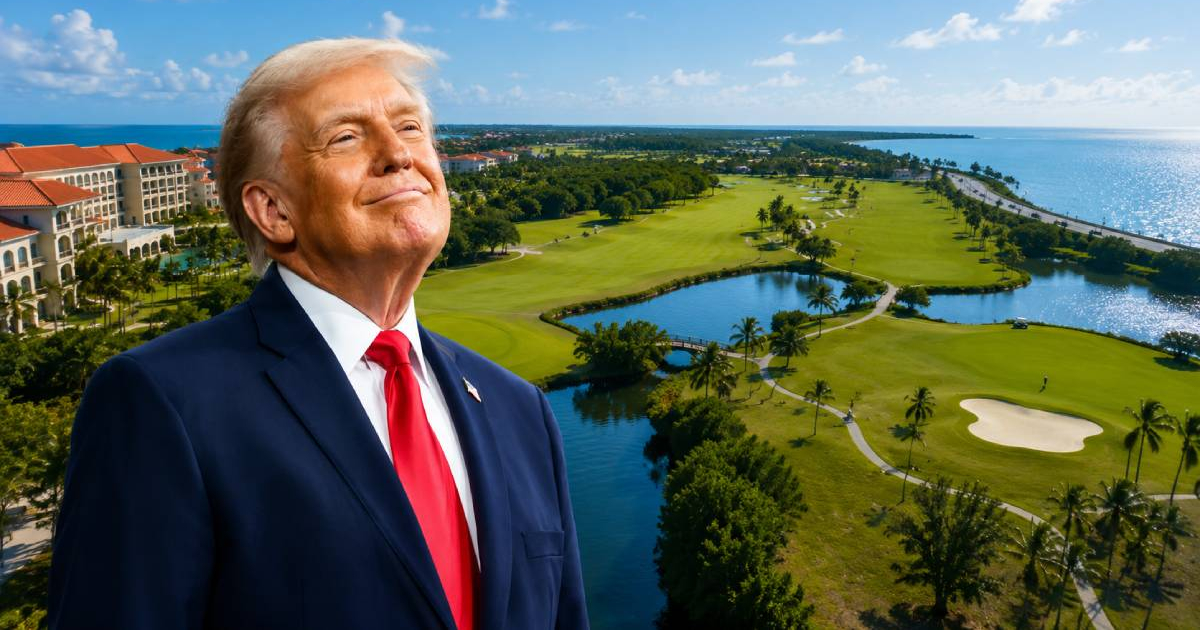
Amidst the unprecedented pressure exerted by Donald Trump on Cuba, emerging documents and testimonies reveal that the former president has long viewed the island as a potential investment hotspot.
A report by BBC Mundo highlights that Trump's early business interests in Cuba were focused on establishing luxury hotels bearing his name, along with coastal marinas and golf courses.
On Tuesday, Trump took to his social media platform, Truth Social, to state that "Cuba is asking for help," hinting at future dialogues with the Cuban regime, yet leaving unclear what his exact objectives are.
These comments follow a stream of increasingly bold statements. In March, Trump declared he could "do whatever he wants" with Cuba, and on May 2, he claimed the United States would "take Cuba almost immediately."
Trump's initial documented approach towards Cuba dates back to 1998. That year, Trump Hotels & Casino Resorts discreetly sent consultants to Havana, channeling at least $68,000 through Seven Arrows Investment & Development Corp., a consulting firm.
In 2016, Trump addressed the American media, asserting, "I never did anything in Cuba. I never closed a deal in Cuba."
Robert Muse, an attorney specializing in Cuban sanctions, notes that in 1998, a specific license would have been required to authorize such travel, and "OFAC would not have granted it if the trip's purpose was to explore business or investment opportunities in Cuba."
In 2008, Trump sought to officially register the "TRUMP" trademark with the Cuban Office of Industrial Property. Approved in 2010, this covered financial services, hospitality, casinos, golf courses, and beauty pageants. The trademark remained valid until around 2018-2019, during Trump's presidency.
Between 2012 and 2013, executives from the Trump Organization revisited Cuba to explore potential hotel, marina, and golf course projects along the island's coastline, as reported by Bloomberg Businessweek.
By 2016, Trump acknowledged Cuba's "potential" when asked about the possibility of opening a hotel under his name in Havana.
"There is no doubt Mr. Trump showed considerable interest in either branding a Cuban hotel with his name or even owning golf courses in Cuba," states William LeoGrande, a professor at American University, in an interview with BBC Mundo.
The potential business model for Cuba mirrors the strategy Trump has employed internationally: licensing his brand for luxury hotels and resorts without direct ownership.
Some analysts speculate that Trump's aim isn't to overthrow the regime but to replace its leadership and open the island to American enterprises, drawing parallels to Venezuela, where since January 2025, Chevron has been permitted as the sole oil export channel.
Economic Strain and Tourism Decline in Cuba
The economic pressure on Cuba is severe. Following the Executive Order signed on January 29, at least seven tankers bound for the island have been intercepted, exacerbating an energy blockade that has worsened a crisis marked by widespread blackouts. On May 1, Trump extended sanctions to the energy, defense, mining, and banking sectors.
The Cuban tourism sector, historically prioritized by the regime — with investments up to 14 times higher in tourism than in healthcare — saw a 29.7% drop in visitor arrivals in 2025 and hotel occupancy rates plummeting to 21.5% in the first half of that year.
Before 1959, Cuba was the leading destination for American tourism and investment in the Caribbean. The most iconic symbol of that era is the Hotel Habana Hilton, constructed by the Hilton chain and nationalized in 1960 by Castro's government, which renamed it Habana Libre. Trump has expressed interest in revisiting such business ventures "at the right time."
Exploring Investment Opportunities in Cuba
What were Donald Trump's early business interests in Cuba?
Trump's initial business interests in Cuba focused on building luxury hotels, coastal marinas, and golf courses under his brand.
What challenges did Trump's company face in pursuing business in Cuba?
Trump's company faced regulatory challenges, such as needing a specific license from OFAC, which would not have been granted for exploring business opportunities in Cuba.
How has the economic pressure from the U.S. affected Cuba?
The U.S. economic pressure has led to an energy blockade, worsening a crisis with widespread blackouts and impacting sectors like tourism, which saw a significant decline in 2025.