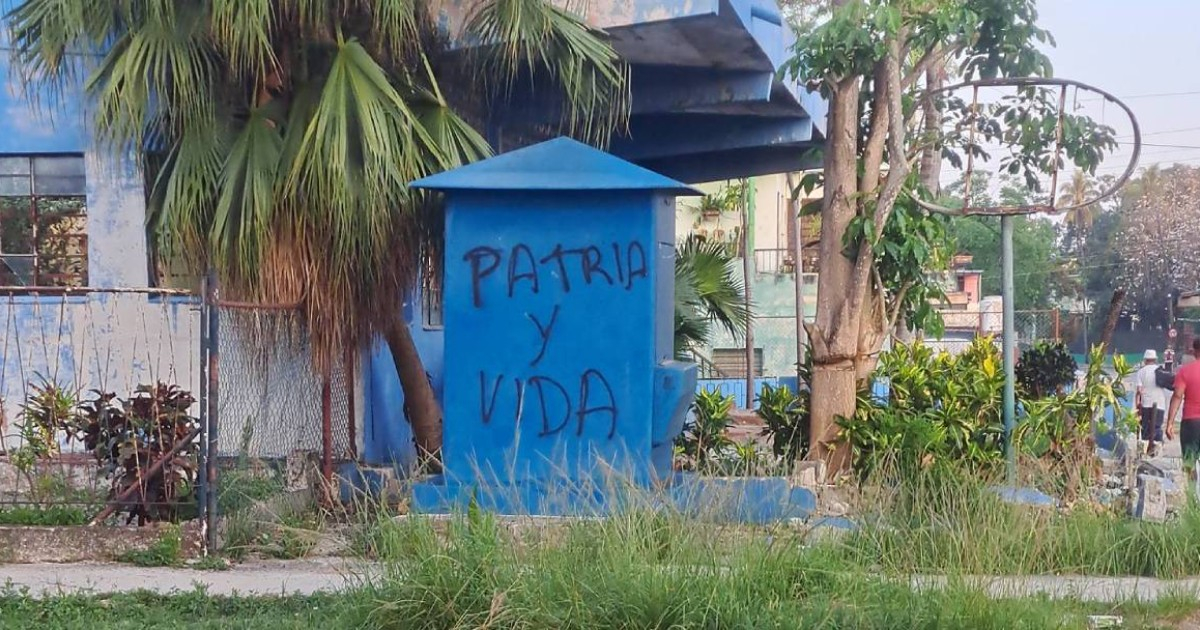
Early Wednesday morning, three anti-government graffiti messages were discovered on electrical structures and walls in the Arroyo Naranjo district, located in the southern part of Havana. These images, shared on Facebook, bore the caption "This is how Arroyo woke up today, May 13."
The photos depict the phrase "PATRIA Y VIDA" scrawled across a blue electrical box, "CANEL SINGAO" on an electrical transformer, and "CANEL PUTA" on a building wall, all directly referencing President Miguel Díaz-Canel.
These graffiti messages have emerged amid a wave of protests shaking Havana in recent days. In the early hours, residents of Marianao took to the streets with pots and pans, bonfires, and burning trash, while on Tuesday night, a similar protest erupted in the Reparto Bahía neighborhood with chants of "Down with the dictatorship!"
On Monday, another protest involving banging on pots and blocking streets took place in Luyanó, adding another Havana district to the protest map during a week marked by power outages. The Cuban Electrical Union projected a deficit of nearly 2,000 MW during the peak evening hours on Wednesday.
Arroyo Naranjo has a recent history of protests. On March 13, residents of Mantilla staged a pots-and-pans protest and street blockade, and the neighborhood of La Güinera—symbolic of the repression on July 11, 2021—held similar demonstrations on March 26 and April 11 of this year.
The phrase "Patria y Vida" carries significant symbolic weight in the Cuban opposition. The song of the same name was released on February 16, 2021, by Yotuel Romero, Descemer Bueno, Maykel Osorbo, El Funky, and Gente de Zona as a direct response to the Castro regime's slogan "Patria o Muerte." It won two Latin Grammys that year and became the anthem of the massive #11J protests.
Since then, painting this phrase in public spaces has become an act of defiance that the regime actively cracks down on. In 2024, artist Yasmany González faced charges of "enemy propaganda"—with a penalty of four to ten years—for painting protest slogans.
The "Pinta tu pedacito" campaign, which emerged in June 2025, spread anti-government graffiti to Santiago de Cuba, Holguín, Artemisa, the Isle of Youth, and multiple Havana neighborhoods, taking advantage of the darkness during blackouts to act.
According to data released earlier this month, more than 1,100 protests were recorded in April alone across Cuba, amid an energy crisis characterized by at least seven total system collapses in the past 18 months and blackouts lasting over twenty hours daily.
Understanding Cuba's Protest Movements
What is the significance of "Patria y Vida" in Cuba?
"Patria y Vida" has become a symbol of resistance against the Cuban regime. Originally a song by prominent Cuban artists, it challenges the state slogan "Patria o Muerte" and has become an anthem for protests.
Why are protests increasing in Cuba?
Protests have been escalating due to severe economic hardships, frequent power outages, and widespread dissatisfaction with the government, prompting citizens to express their frustrations publicly.
How has the Cuban government responded to these graffiti and protests?
The Cuban government has been actively trying to suppress these acts of defiance, often by arresting those involved and charging them with crimes like "enemy propaganda."