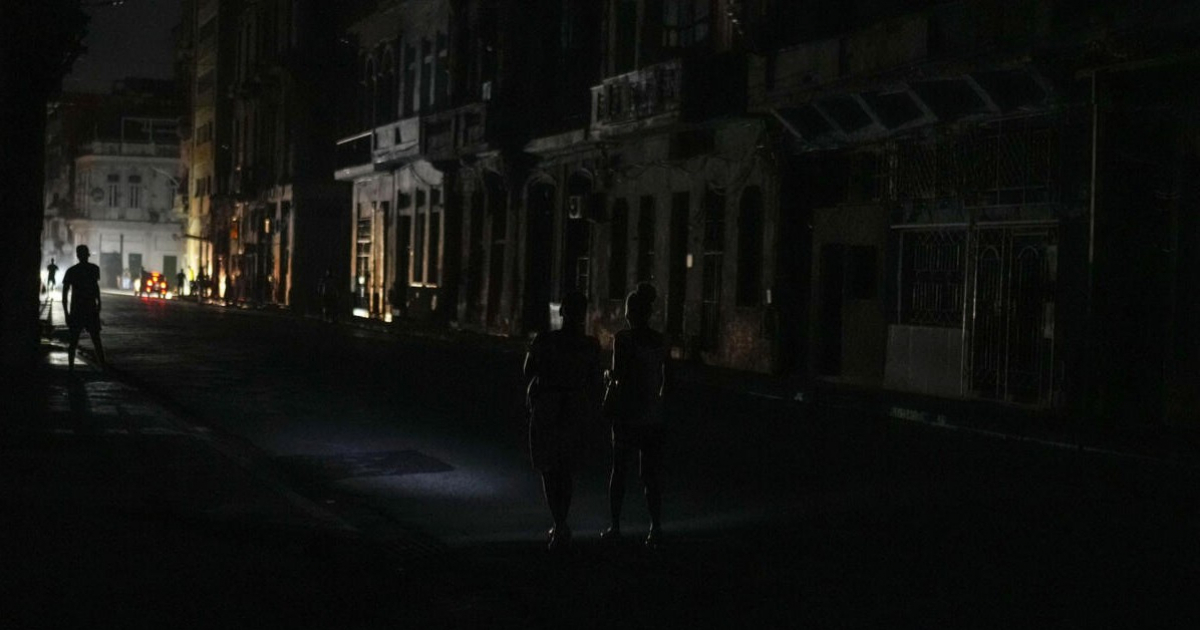
Cuba's energy crisis has reached a new critical point this Wednesday, with the Electric Union forecasting a nighttime peak disruption estimated at 2,050 MW. This marks the first time in 2026 that the official projection has exceeded the 2,000 megawatt threshold.
According to today's report from the Electric Union, the actual maximum impact on Tuesday was 2,113 MW at 8:40 PM, surpassing expectations due to an unexpected outage at the Energás Varadero plant.
The organization admitted that "yesterday, service was affected due to a capacity deficit throughout the entire 24-hour period, with disruptions continuing into the early morning hours."
By 6:00 AM today, the situation was already dire, with only 1,200 MW available against a demand of 2,860 MW, leading to 1,655 MW being affected early on.
Power Deficit Escalates
During peak hours, the Electric Union estimates availability at 1,230 MW against a maximum demand of 3,250 MW, resulting in a shortfall of 2,020 MW. "With this forecast, we expect an availability of 1,230 MW with a maximum demand of 3,250 MW, leading to a deficit of 2,020 MW. If conditions persist, a 2,050 MW disruption is anticipated during this period," states the official report.
The only planned addition to ease the peak is the entry of unit 1 from the Energás Varadero plant, contributing a mere 30 MW, which is negligible compared to the projected deficit.
Maintenance and Outages
Several units are currently out of service. The units two and three at the CTE Ernesto Guevara de la Serna, unit two at the CTE Lidio Ramón Pérez, and unit five at the CTE Antonio Maceo are experiencing issues. Meanwhile, unit one at the CTE Lidio Ramón Pérez, unit five at the CTE Mariel, unit six at the CTE Renté, and unit five at the CTE Nuevitas are under maintenance, with an additional 374 MW offline due to thermal generation limitations.
The 54 photovoltaic solar parks contributed 3,530 MWh yesterday, with a peak of 525 MW at noon. However, their output is insufficient to offset the thermal collapse during the high-demand nighttime hours.
Worsening Energy Crisis
The energy crisis has steadily worsened in May, following a temporary deficit drop to 1,012 MW on April 21. The previous annual record was 2,075 MW, recorded on March 6, just before the seventh total collapse of the National Electric System in 18 months, which occurred on March 16.
The structural background is devastating: Cuba has been without Venezuelan crude —interrupted since November 2025— and without Russian oil donations, which dried up at the end of April.
The cumulative humanitarian impact is severe. The UN declared the situation a humanitarian emergency in April, with over 96,000 surgeries postponed, a million people relying on tanker trucks for water, and nearly half a million children facing reduced school hours.
If tonight's forecast holds, Cuba will have surpassed the 2,000 MW disruption barrier twice within 48 hours, making May 2026 the most critical month of the year for the island's power system.
Understanding Cuba's Power Crisis
What is causing the power crisis in Cuba?
The power crisis in Cuba is primarily caused by a severe deficit in capacity due to unexpected outages at power plants, lack of fuel supplies from Venezuela and Russia, and ongoing maintenance issues.
How is the energy shortage affecting daily life in Cuba?
The energy shortage has led to extensive blackouts, postponed surgeries, reduced school hours for children, and dependency on tanker trucks for water supply, significantly impacting daily life.
What measures are being taken to alleviate the energy crisis?
Currently, measures are limited. The entry of a small unit from the Energás Varadero plant is planned, but it provides only a minimal contribution compared to the deficit.