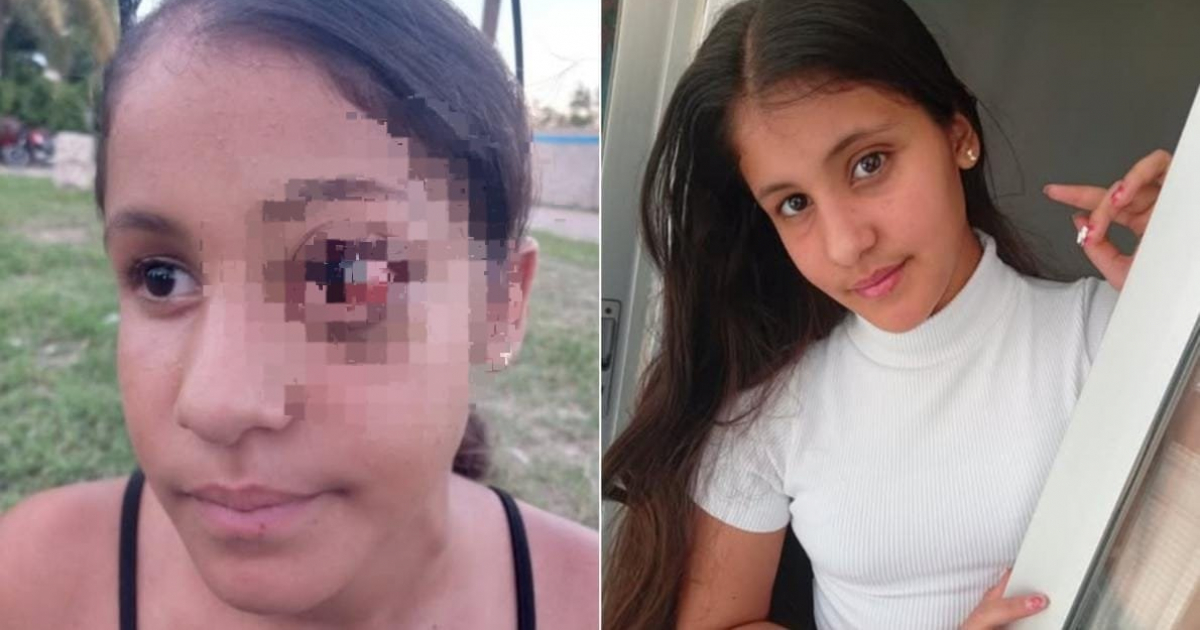
Rocío Bustamante Riverón, an 11-year-old Cuban girl who faced a challenging orbitary lymphangioma in her left eye since she was merely 11 months old, is now completely healed after receiving medical attention in Madrid.
Her mother, Adela Riverón Vega, joyously shared on Facebook that the latest MRI scan revealed excellent results.
"Today, from the bottom of my heart, I want to thank everyone who supported me in coming to Spain to give my daughter the chance to receive the treatment she so desperately needed to save her eye," Adela expressed.
She further added, "In Cuba, they told me there was no solution, but God placed wonderful people along my path, and Spain welcomed us in a very special way."
Mother and daughter arrived in Madrid on November 16, thanks to the efforts of exiled Cuban doctor Lucio Enríquez Nodarse. He managed to engage the Spanish healthcare system to assist the young girl. Rocío's treatment took place at the Jiménez Díaz Foundation in Madrid, where she was admitted intravenously and received specialized care.
The Struggles with Cuban Healthcare
The joyful outcome starkly contrasts with years of neglect by the Cuban healthcare system. From the age of four, doctors in Cuba stated they would only intervene if the tumor ruptured, without providing any active treatment.
In 2018, physicians at the Ramón Pando Ferrer hospital acknowledged in a report that treatment was "incomplete, risky, and difficult" in Cuba, and the technical conditions for surgery were non-existent.
By July 2025, the situation had become dire: Rocío had been experiencing continuous crises with recurring hemorrhages and severe headaches for three months, and no follow-up MRI had been performed in three years. The only treatment prescribed by Cuban doctors was hydrating drops, cold compresses, and rest.
The Role of International Support
Rocío went through the William Soler, Juan Manuel Márquez, Ramón Pando Ferrer, and Oncology Institute without receiving any treatment. The Cuban Ministry of Public Health (MINSAP) also failed to facilitate her treatment abroad, despite having a department dedicated to such cases.
It was then that Adela reached out to Dr. Enríquez Nodarse, known for his advocacy for Cuban patients, including the case of young Damir Ortiz, who tragically died in Miami in April 2025 due to sepsis contracted in Cuban hospitals.
"In the best scenario, Rocío was destined to lose an eye. In the worst, her life," wrote the doctor on Facebook while announcing the girl's recovery. He pointedly blamed the regime: "The dictatorship gives nothing 'for free.' The dictatorship takes away. The dictatorship snatches lives."
Hope for a Better Future
Rocío's case is part of a growing list of severely ill Cuban children who have only been able to receive proper care outside the island, in stark contrast to the regime's official narrative about the supposed excellence of its healthcare system.
Dr. Enríquez Nodarse concluded his post with a poignant reflection: "I hope that one day our country will have a robust, modern, and truly humane healthcare system where no child—or anyone—will ever die from neglect, negligence, or missed opportunities again."
Understanding Rocío's Medical Journey
What condition did Rocío suffer from?
Rocío suffered from an orbitary lymphangioma in her left eye, a challenging condition she had since she was 11 months old.
How did Rocío receive treatment outside Cuba?
Rocío's treatment in Spain was made possible through the efforts of exiled Cuban doctor Lucio Enríquez Nodarse, who engaged the Spanish healthcare system to assist her.
What was the state of Rocío's healthcare in Cuba?
In Cuba, Rocío faced years of neglect, with doctors only willing to intervene if the tumor ruptured. The Cuban healthcare system did not provide any active treatment or facilitate care abroad.