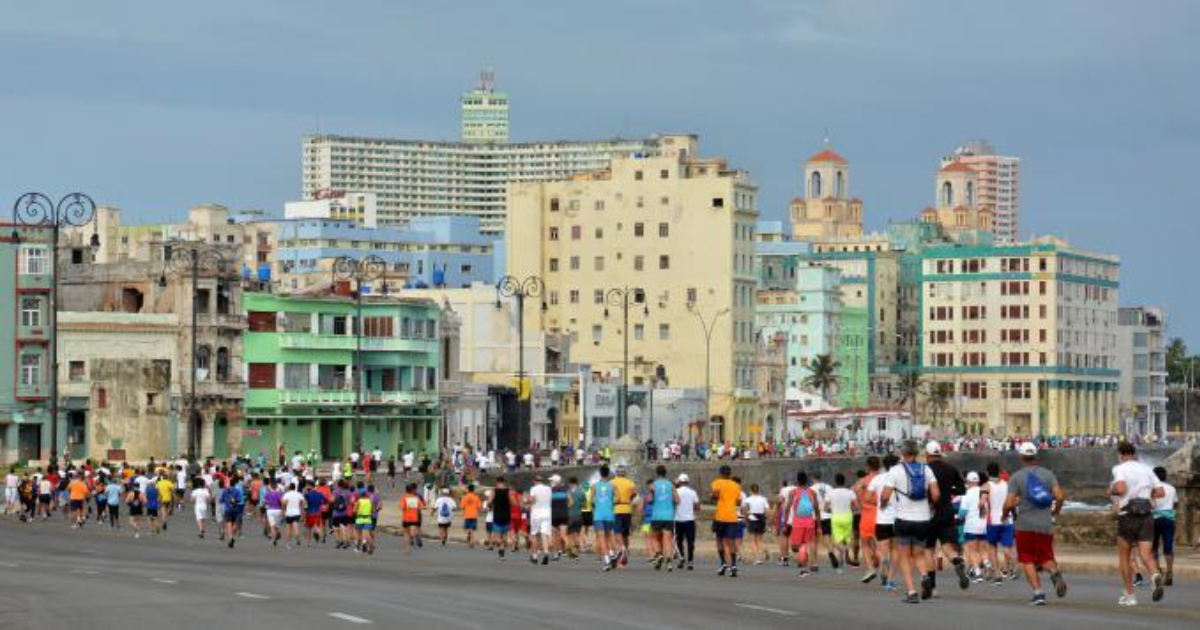
The Russian Embassy in Cuba held a press conference on Tuesday to announce the "Friendship Run," a popular marathon scheduled for Saturday, May 16, outside its diplomatic premises in Havana. This event serves as a piece of bilateral propaganda sharply contrasting with the severe food crisis plaguing the island.
This annual event, organized in collaboration with the National Institute of Sports, Physical Education and Recreation (INDER), commemorates Russia's Victory Day in World War II and marks the anniversary of the reestablishment of diplomatic ties between the two nations.
Russian Ambassador Viktor Koronelli led the press conference, stating, "The Friendship Run is a testament to the historical ties between our peoples. It is important for Russians and Cubans to celebrate Victory together."
Juan Carlos Mesa, the Deputy Head of the National Commission of Races and Walks MARABANA-MARACUBA, provided technical details of the event and acknowledged that the race would proceed "despite the country's challenging conditions," which he attributed to the so-called "criminal blockade" by the United States, echoing the regime's typical rhetoric.
Registration for the marathon begins at 8:00 a.m., with the race slated to start at 10:00 a.m. on Saturday.
As Moscow organizes sports festivities, one in three Cuban families faces hunger, according to the "In Cuba There Is Hunger 2025" survey by the Food Monitor Program (FMP), published on May 6.
The report indicates that 33.9% of Cuban households reported at least one member going to bed hungry during 2025, an increase of 9.3 percentage points compared to 2024.
By April 2026, 96.91% of the population lacked adequate access to food, 25% went to bed without dinner daily, and 29% of families had eliminated at least one meal a day.
The production collapse exacerbates the situation: pork production dropped by 93.2%, rice between 59% and 81%, eggs by 43%, and milk by 37.6%.
Adding to the woes are power outages, which in March 2026 lasted up to 25 hours a day. Eighty percent of Cuban households reported losing refrigerated food due to these blackouts, according to FMP data released on Monday.
Russia has shipped oil, granted loans, and promised an investment plan exceeding $1 billion in sectors such as energy, transportation, and food. However, despite Cuba's industries being handed over to Russian control, there has been no reversal of the economic collapse or the scarcity affecting the majority of the population.
The marathon invitation itself mirrors the regime's official narrative, blaming the U.S. embargo for the country's "complex conditions," while ignoring six decades of dictatorial management as the structural cause of the crisis.
Deaths from malnutrition in Cuba increased by 74% between 2022 and 2023, rising from 43 to 75 fatalities according to the National Office of Statistics and Information (ONEI). This figure highlights the extent of the race Cubans endure daily: not for medals, but for survival.
Understanding Cuba's Economic and Food Crisis
What is the "Friendship Run" in Havana?
The "Friendship Run" is a marathon organized by the Russian Embassy in Cuba, set to take place outside their diplomatic headquarters in Havana. It serves as a gesture of bilateral propaganda celebrating Russia's Victory Day in World War II and the anniversary of renewed diplomatic relations between Russia and Cuba.
How severe is the food crisis in Cuba?
The food crisis in Cuba is dire, with 33.9% of households reporting hunger in 2025. By 2026, nearly 97% of the population lacked sufficient food access, and many families have been forced to cut meals from their daily diet.
What role does Russia play in Cuba's current situation?
Russia has provided Cuba with oil, loans, and promised significant investments in various sectors. Despite these efforts, the economic collapse and scarcity issues continue to affect the Cuban population.