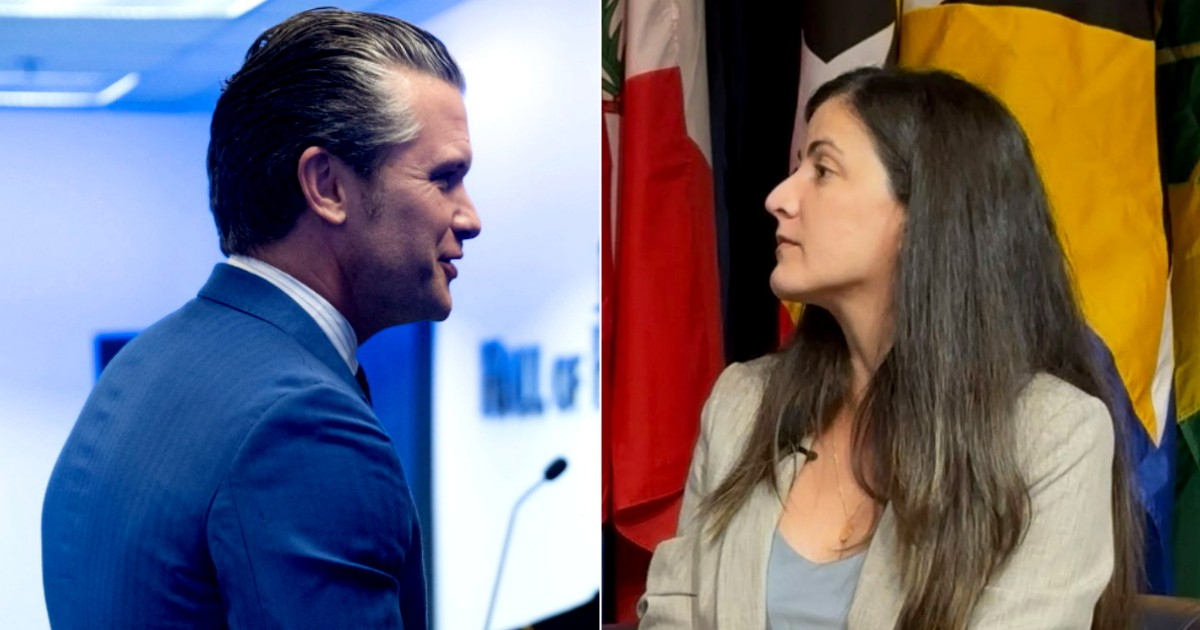
Rosa María Payá, a prominent Cuban activist and member of the Inter-American Commission on Human Rights, responded on her social media platforms this Tuesday to statements made by U.S. Secretary of Defense Pete Hegseth before Congress. She emphasized that "the Cuban regime poses a threat to U.S. national security."
Payá shared a video of the exchange between Hegseth and Republican Congressman Mario Díaz-Balart during a session of the House Defense Appropriations Subcommittee held the same day.
In her post, the activist pointed out that "the cross-border actions of the regime have fueled democratic instability in Latin America, threatening U.S. national security through organized crime, mass migration, and more."
The hearing, which primarily focused on the 2027 military budget, saw Díaz-Balart questioning Hegseth in detail about the threats posed by the Cuban regime.
The Secretary confirmed that Cuba harbors terrorists and fugitives from U.S. justice, and recalled that the Cuban Air Force shot down two civilian planes in international airspace, referring to the attack on the Brothers to the Rescue aircraft on February 24, 1996. "I don't remember the exact year, but I believe that's correct," Hegseth added.
Hegseth further confirmed that Russian warships, including the nuclear submarine Kazan, have used Cuban ports. He described the Russian signal intelligence complex in Lourdes as "very problematic" due to its proximity to U.S. shores. "We've long been concerned about a foreign adversary using such a location, which is very troubling," he stated.
Regarding Cuban personnel abroad, Hegseth noted being "well aware that Cubans have been all over the world, even attempting to defend Maduro in Venezuela." However, he mentioned not being aware of thousands of Cubans fighting for Russia in Ukraine, a number Ukrainian intelligence estimates at up to 25,000 individuals.
When asked about advanced Cuban espionage against the U.S.—highlighted by the Obama, Trump, and Biden administrations—Hegseth responded, "That all sounds very correct, sir."
Díaz-Balart's final question was straightforward: "Do you believe the Cuban regime poses a threat to the national security of the United States?" Hegseth's response was unequivocal: "Yes."
The congressman later shared the exchange on social media, noting that "previous administrations have overlooked the threat, but the Trump administration is taking it seriously."
Payá's reaction comes amid increasing pressure from Washington on Havana. Since January 2025, the administration has imposed over 240 sanctions against Cuba and reinstated the island on the list of State Sponsors of Terrorism.
Payá, the founder of Cuba Decide and daughter of dissident Oswaldo Payá, has long argued that the regime is not only a threat to Cubans but a destabilizing global actor linked to Russia, China, Venezuela, and Iran.
Last Sunday, she also praised the Department of Justice's progress in revoking the citizenship of Cuban spy Víctor Manuel Rocha, a former ambassador sentenced to 15 years in prison for betraying the U.S. over a span of 51 years.
Understanding the Cuban Threat to U.S. Security
Why is the Cuban regime considered a threat to U.S. national security?
The Cuban regime is considered a threat due to its involvement in organized crime, mass migration, and its harboring of terrorists and fugitives from U.S. justice. Additionally, its alliances with adversarial countries like Russia and China increase its threat level.
What actions has the U.S. taken against Cuba recently?
Since January 2025, the U.S. has imposed more than 240 sanctions against Cuba and has placed the island back on the list of State Sponsors of Terrorism, signaling a tougher stance on the regime.
Who is Rosa María Payá and what is her role?
Rosa María Payá is a Cuban activist and the founder of Cuba Decide. She is known for her efforts in advocating for democracy and human rights in Cuba, and she is a vocal critic of the Cuban regime's global influence.