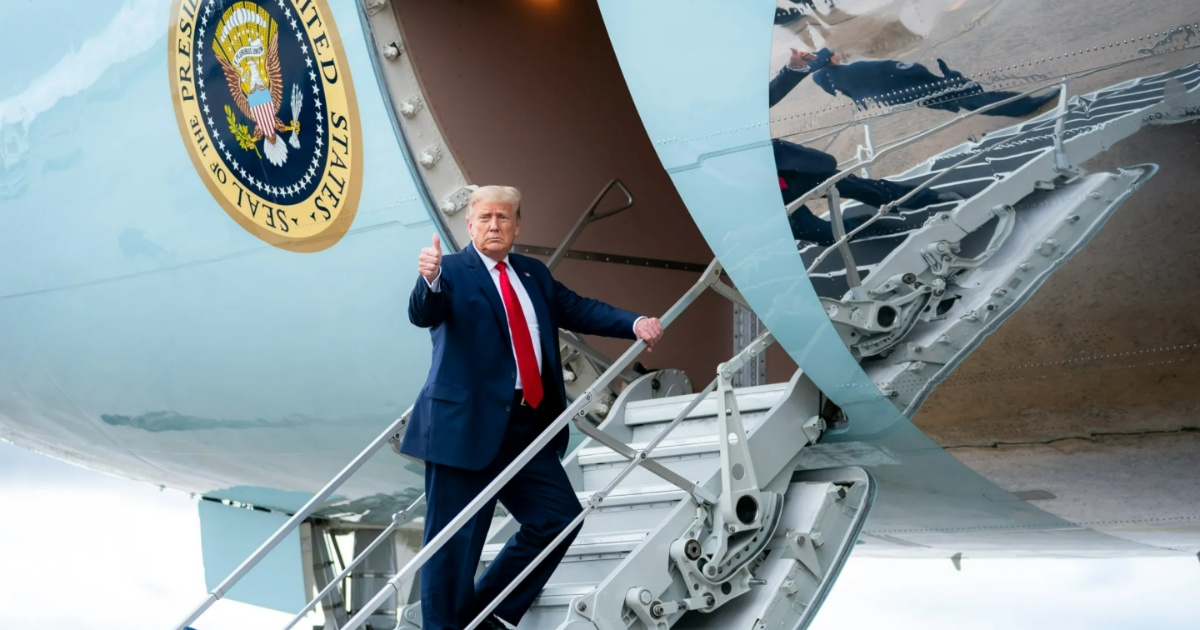
Just before embarking on his journey to China, President Donald Trump took to his social media platform, Truth Social, to make a bold statement regarding Cuba. He expressed confidence that the Cuban regime's downfall is imminent and indicated a willingness to engage in dialogue.
"No Republican has ever mentioned Cuba to me. It's a failed nation heading in just one direction: down! Cuba asks for help, and we're going to talk! Meanwhile, I'm off to China!" the President declared on his social media.
This announcement comes amidst heightened U.S. pressure on the Cuban government and just hours before Trump's state visit to Beijing, scheduled from May 13 to 15, where he will hold talks with President Xi Jinping.
Intensified U.S. Pressure on Cuba
The statement is part of a broader context. Since the start of his second term, Trump has pursued a maximum pressure strategy against Havana, combining tough economic sanctions with the prospect of conditional diplomatic engagement.
On January 29, 2026, Trump signed Executive Order 14380, labeling the Cuban regime an "extraordinary threat" to national security and imposing tariffs on countries supplying oil to the island.
Since then, the administration has imposed over 240 new sanctions on Cuba and intercepted at least seven tankers headed for the island. This has severely impacted Cuba's economy: energy imports have plummeted by 80% to 90%, over 55% of the country experiences power outages lasting up to 25 hours a day, and the projected economic contraction for 2026 is 7.2%, according to The Economist Intelligence Unit.
Continued Sanctions and Diplomatic Openings
On May 1, Trump signed Executive Order 14404, expanding the sanctions, and shortly thereafter, Secretary of State Marco Rubio announced a new round targeting GAESA, the military conglomerate controlling Cuba's economy, along with 12 officials, seven military entities, and three vessels.
Rubio described GAESA as an organization that "seizes all revenue-generating assets in Cuba and illegally funnels it into the pockets of a select few regime insiders," warning that sanctions will persist until the regime enacts "all necessary political and economic reforms."
Despite the pressure, Trump has left the door open for negotiations. On February 1, he confirmed high-level talks with Cuba from Mar-a-Lago, stating, "I believe we will make a deal."
In March, the White House stipulated that any progress would require the removal of Miguel Díaz-Canel from power, as reported by The New York Times.
Cuba's Defiant Stance and Geopolitical Overtones
The Cuban regime has publicly rejected any notion of surrender. Speaking to Fox News on May 4, Cuba's ambassador to the UN declared, "Surrender is not in our dictionary."
Trump's trip to China adds a geopolitical layer to his message. Recently, Beijing has urged Washington to lift sanctions on Cuba, making Trump's post a politically charged gesture aimed at multiple audiences: the American public, the Cuban regime, and Xi Jinping himself.
Key Questions on U.S. Policy Toward Cuba
What is the current U.S. strategy towards Cuba?
The U.S. strategy involves maximum pressure through economic sanctions and diplomatic engagement conditioned on significant reforms by the Cuban regime.
How has the Cuban economy been affected by U.S. sanctions?
Sanctions have drastically reduced energy imports and led to widespread power outages, severely impacting the Cuban economy, which is projected to contract by 7.2% in 2026.
What is GAESA's role in Cuba's economy?
GAESA is a military conglomerate that controls much of Cuba's economy, allegedly channeling profits to a small circle of regime insiders, according to U.S. officials.