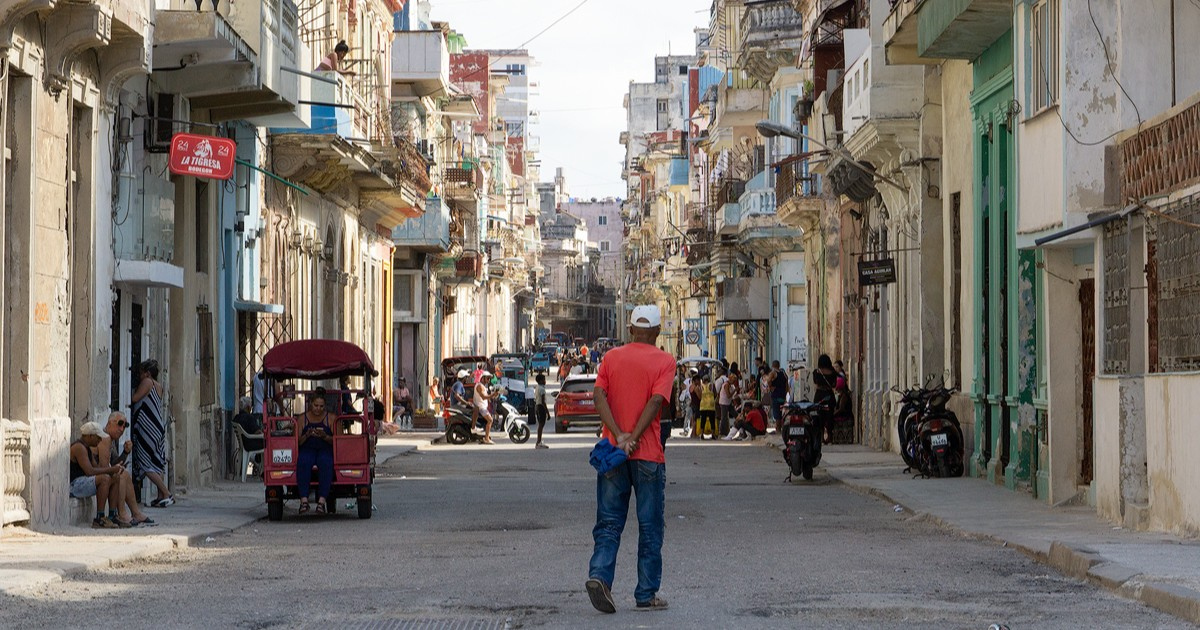
Cuban Christian activist David Espinosa took to Facebook to share a stark reflection on the harsh reality of surviving in Cuba today, where electricity, gas, water, and sufficient food are often out of reach for families.
"Imagine having no electricity—not just for a few hours, but since yesterday. Night is falling, and your apartment falls silent, weighed down by unbearable heat," Espinosa wrote on his Facebook page.
His words paint a picture familiar to millions of Cubans: struggling to cook without gas, resorting to charcoal in the backyard; going days without water; sitting at a table with just a meager serving of ground meat and rice; staring at a phone with a dead battery and no internet access.
"You glance at your phone... no charge. Even if it were charged, there's no connection. You can't write, call, or ask for help; it's not even useful as a flashlight," the narrative continues.
This post is far from fiction; it vividly captures what happened on May 10 in Cuba, when the country faced an electric power shortfall of 1,710 MW, with only 1,590 MW available against a demand of 3,300 MW, leaving up to 52% of the nation in darkness.
In Havana, power outages lasted up to 14 continuous hours that day, while other areas experienced blackouts exceeding 20 hours.
The following day, the projected shortfall escalated to between 1,955 and 1,985 MW during peak nighttime hours, with only 1,245 to 1,430 MW available to meet a 3,200 MW demand.
Over the past 18 months, Cuba has faced at least seven total collapses of its National Electric System, with a historic deficit peak of 2,075 MW recorded on March 6, 2026, when more than two-thirds of the country plunged into darkness.
Espinosa's post became a collective wall of sorrow, with comments pouring in. From Güira de Melena, a user reported six days without electricity due to transformer failures lacking replacement parts.
In Santa Clara, another mentioned electricity returning at 3:36 a.m. A Cuban woman recalled that Mother's Day passed in utter silence: "I didn't hear music from a single house; many people have nothing to eat or can't give their mom a gift."
The energy crisis also overlaps with a severe water shortage: only 18.3% of Cubans receive daily potable water, a sharp drop from 34.1% in 2024.
Regarding food, 33.9% of Cuban households reported that at least one member went to bed hungry in the past year, according to the "In Cuba, There Is Hunger 2025" survey.
The Cuban Human Rights Observatory reports that 89% of the Cuban population lives in extreme poverty, with an average monthly salary equivalent to about $13.
Espinosa is not an anonymous voice; he is an activist facing systematic pressure from the regime. On April 12, he and his wife Laidy García were summoned by the Ministry of the Interior.
The following day, during an interrogation by State Security, agents attempted to recruit him as an informant to report on a possible visit by the head of the U.S. Embassy mission.
On May 6, he was summoned again under the pretext of an "interview about possible illegality," a term nonexistent in Cuban criminal law, and ETECSA has coordinated phone line cuts as a form of repression.
Despite all this, Espinosa continues to publish and finds strength in his faith as the core of his public resilience.
"This writing isn't meant to evoke pity—Cuba doesn't need pity. Cuba needs the world to not look away. And perhaps, someone reading this will decide to do more than just keep reading. Today, all I have left is to lift a silent prayer," he concluded.
Understanding the Crisis in Cuba
What are the main challenges faced by Cubans today?
Cubans are struggling with a severe lack of electricity, gas, water, and food. The energy crisis has led to prolonged blackouts, while water shortages and food insecurity are widespread.
How has the Cuban government responded to the energy crisis?
The Cuban government has not effectively addressed the energy crisis, leading to frequent power outages and insufficient power generation to meet demand.
What impact does the crisis have on everyday life in Cuba?
The crisis severely affects daily life, with people unable to cook, access water, or communicate due to lack of electricity and resources. It also exacerbates poverty and food insecurity.