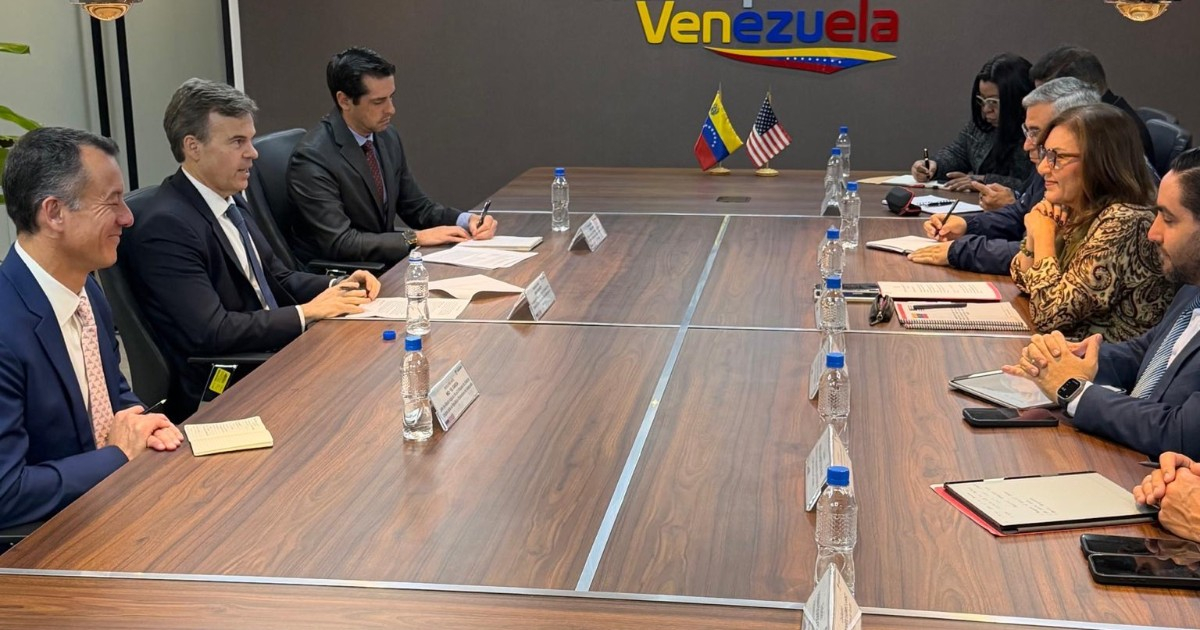
The United States Embassy in Caracas announced on Monday a significant meeting with Jacqueline Faría, the Minister of Transport for Venezuela's interim government. The focus of the discussions was the expansion of energy exports, marking another step in the robust diplomatic activity between the two nations since early 2026.
The embassy shared details of the meeting on its official X account with a post signed by the initials "JB": "I had a productive meeting with Jacqueline Faría, Minister of Transport for the interim authorities, regarding the expansion of energy exports. Today's economic progress lays the foundation for advancing the three-phase plan of @POTUS."
The meeting took place at the facilities of the Gran Misión Transporte Venezuela, with flags from both countries displayed prominently and officials from both delegations in attendance.
Political Shifts and Diplomatic Re-engagement
This engagement is set against the backdrop of significant political changes in Venezuela since Nicolás Maduro was captured by U.S. forces on January 3, 2026, during "Operation Absolute Resolution." Following this, Delcy Rodríguez was sworn in as acting president under the "forced absence" clause by the Supreme Court, and the U.S. reestablished diplomatic relations with Venezuela in March 2026.
The U.S. Embassy in Caracas officially reopened on March 30 after a seven-year hiatus, leading to a surge in both diplomatic and economic interactions between the two nations.
Energy: The Core of Renewed Relations
The energy sector is the cornerstone of this renewed bilateral relationship. Former President Trump announced that Venezuela would provide the U.S. with between 30 to 50 million barrels of crude oil—valued up to $2 billion—for refining and sale under U.S. supervision. Additionally, a $100 billion investment from private capital is anticipated to rejuvenate Venezuela's oil industry.
Chevron significantly increased its exports of Venezuelan crude from 100,000 barrels per day in December 2025 to 300,000 bpd by March 2026, and expanded its stake in Petroindependencia from 35.8% to 49% in April 2026.
High-Level Visits and Strategic Cooperation
In recent months, high-profile figures from the Trump administration have visited Caracas. Energy Secretary Chris Wright traveled to the Venezuelan capital on February 11 to sign a long-term energy agreement with Rodríguez. Southern Command Chief Francis L. Donovan visited Venezuela on February 18 and 19, and Interior Secretary Doug Burgum arrived in Caracas on March 4 to assess the mining sector.
The meeting with Faría—appointed Minister of Transport by Maduro in August 2024 and continuing in her role under the interim government—indicates that bilateral cooperation extends beyond oil to include the logistical infrastructure required to expand these exports, such as ports and maritime, rail, and air transport.
The three-phase plan for Venezuela—stabilization, recovery, and democratic transition—devised by the Trump administration, remains the framework guiding all diplomatic and economic strategies, as reiterated by Secretary of State Marco Rubio.
Key Questions on U.S.-Venezuela Energy Relations
What was the purpose of the U.S. Embassy's meeting with Jacqueline Faría?
The meeting aimed to discuss the expansion of energy exports between the U.S. and Venezuela, as part of ongoing diplomatic efforts.
How has Chevron's involvement in Venezuela's oil industry changed?
Chevron has increased its crude exports from Venezuela from 100,000 to 300,000 barrels per day and expanded its stake in Petroindependencia to 49%.
What is the three-phase plan for Venezuela?
The plan consists of stabilization, recovery, and a democratic transition, guiding the diplomatic and economic strategies between the U.S. and Venezuela.