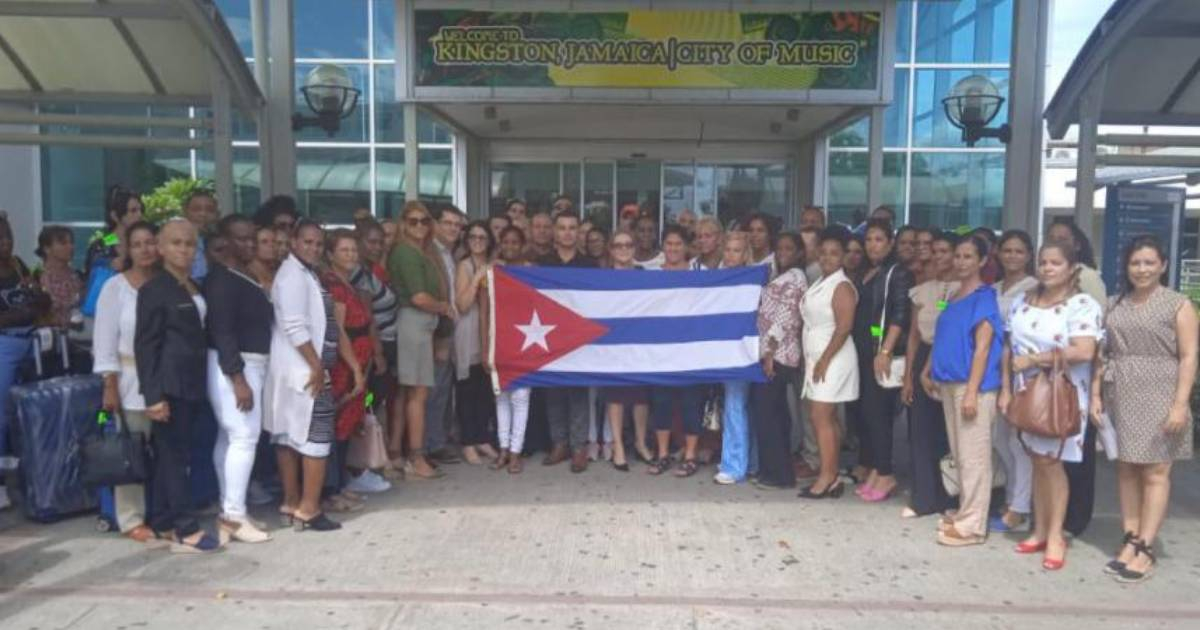
More than 40 Cuban healthcare professionals, previously part of a medical cooperation agreement between Jamaica and Cuba, have opted not to return to their homeland. Instead, they remain in Jamaica under individual contracts, as confirmed by Dr. Christopher Tufton, Jamaica's Minister of Health and Wellness, during a press briefing in Kingston.
According to Caribbean National Weekly, Dr. Tufton disclosed that of the roughly 278 Cuban doctors involved in the program prior to its termination, over 40 have chosen to stay. "Out of that number, more than 40 decided not to go back [to Cuba] and have been granted individual contracts, now working within the local [healthcare system]," stated the minister.
What makes this decision particularly noteworthy is that some of these medical professionals have been in Jamaica for five years or more and have taken a formal step by applying for permanent residency. "Some of those here on work permits have been in the country for a while and have expressed interest in obtaining permanent residency, which is permitted by law," Tufton explained.
The Jamaican government not only accepted those who stayed but also extended an open invitation to others. "Everyone was offered a letter indicating that if they were interested, we would be willing to re-engage them based on their own interests, but under individual contracts," the minister elaborated, adding that even some who had returned to Cuba expressed interest in coming back.
Termination of the Bilateral Medical Program
The bilateral program ended after nearly three years of unsuccessful negotiations to renew the framework agreement, which expired in February 2023. Jamaica identified structural irregularities within the Cuban scheme: doctors' salaries were directly transferred to the Cuban government in dollars — bypassing the professionals themselves — and many lacked access to their passports, violating local and international labor laws.
Cuba unilaterally withdrew its brigade of 277 professionals, attributing the decision to "U.S. pressures." The majority of the brigade returned to the island on March 27 during a ceremony touted by the regime as a "triumphant return." However, more than 40 of these professionals did not join the collective return, representing approximately 14% of the total program.
Impact on Jamaican Healthcare
The withdrawal of the brigade impacted specific services. At Kingston's St. Joseph Hospital, where the Cuban Ophthalmology Program was active, only six of the 18 assigned Cuban workers remained. Operations at this facility have merged with Kingston Public Hospital, with some Cuban employees working at both locations to sustain care.
Faced with a critical shortage of specialists, particularly in radiology and oncology, Jamaica has diversified its international partnerships. The government recently signed a memorandum of understanding with India for healthcare personnel cooperation and is in talks with India's Apollo health system for hospital expansion in the island's west. Jamaica also maintains an agreement with Ghana and is negotiating with Nigeria.
The situation in Jamaica is not unique. The experiences of Cuban doctors at the end of their overseas missions reveal a pattern seen in various countries. Antigua and Barbuda also terminated its agreement with Cuba by the end of 2025, hiring 120 professionals from Ghana as replacements.
Frequently Asked Questions About Cuban Doctors in Jamaica
Why did over 40 Cuban doctors decide to stay in Jamaica?
Over 40 Cuban doctors chose to remain in Jamaica due to the opportunity to work under individual contracts and, in some cases, apply for permanent residency.
What were the irregularities found in the Cuban medical program?
Jamaica found that doctors' salaries were sent directly to the Cuban government, and many lacked access to their passports, violating labor laws.
How is Jamaica addressing the shortage of medical specialists?
Jamaica is diversifying its international partnerships, including agreements with India and Ghana, to address the shortage of medical specialists.