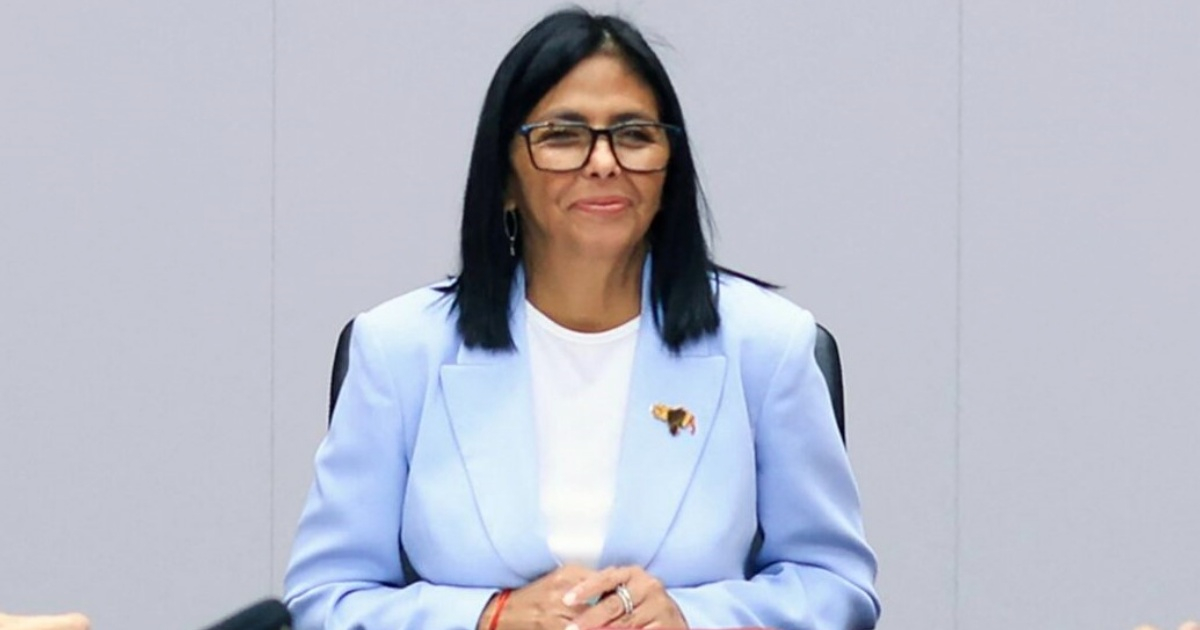
Delcy Rodríguez, acting president of Venezuela, arrived in the Netherlands on Sunday to lead the Venezuelan delegation in public hearings at the International Court of Justice (ICJ) concerning the territorial dispute with Guyana over the Essequibo region. The final session of these hearings is scheduled for Monday in The Hague.
Rodríguez touched down at Amsterdam-Schiphol International Airport, where she was met by Foreign Minister Yván Gil and Communications Minister Miguel Ángel Pérez Pirela, both integral members of the delegation alongside the legal team led by attorney José Manuel Rodríguez.
"On behalf of the Venezuelan people, we have come to the Netherlands to uphold the majesty and strength of the 1966 Geneva Agreement. Undoubtedly, the rightful owner of the Essequibo is Venezuela, and we will always assert our legitimate and historical rights over this territory," Rodríguez declared on Telegram.
In a statement from the Venezuelan presidency reported by Reuters, Rodríguez took a firmer stance: "Venezuela will vigorously defend its sovereignty over the Essequibo, a region that is historically and legally ours. This court lacks jurisdiction, but we are here to expose the colonialist conspiracy orchestrated by Guyana and its imperial backers."
The trip holds additional political significance as it marks Rodríguez's first major appearance on the international stage since assuming Venezuela's acting presidency on January 5, 2026, following the capture of Nicolás Maduro by U.S. forces.
Maduro was detained on January 3, 2026, as part of the so-called Operation Absolute Resolution and was taken to the United States to face narcoterrorism charges, leaving Rodríguez at the helm of the chavista government.
The Historical Dispute
The conflict revolves around the validity of the Paris Arbitral Award of October 3, 1899, which established the border between the then British Guiana and Venezuela. Caracas declared this ruling null in 1962, citing irregularities, and maintains that the only valid legal instrument is the 1966 Geneva Agreement, which sets forth a path for direct bilateral negotiation.
Guyana filed a lawsuit against Venezuela at the ICJ in 2018, and the court accepted the case on April 6, 2023. In December of that year, the ICJ issued provisional measures instructing Venezuela not to alter the status quo in the Essequibo; Caracas rejected these measures as non-binding.
Current Positions and Economic Stakes
Foreign Minister Yván Gil referred to Guyana's final arguments before the ICJ last Friday as "negationist and repetitive," reiterating that the dispute will conclude with direct negotiation without third-party intervention.
From the Guyanese side, Foreign Minister Hugh Todd responded that "the ICJ process is the only peaceful way forward" and warned that "Venezuela's aggressive stance threatens regional stability."
The disputed territory, spanning around 160,000 square kilometers, comprises nearly two-thirds of Guyana's current territory and is rich in oil, minerals, and biodiversity. Since ExxonMobil's discoveries in 2015, economic stakes have soared: Guyana now produces approximately 916,000 barrels of oil per day in the Stabroek block and recorded record revenues exceeding $761 million in the first quarter of 2026.
Regional Tensions and Future Outlook
Tensions around the Essequibo escalated in August 2025, when Trinidad and Tobago's Prime Minister Kamla Persad-Bissessar announced she would grant the U.S. access to her territory if Washington requested it to defend Guyana, and France deployed military forces in the Caribbean under the same circumstances.
Analysts caution that a definitive ICJ ruling could take years, making today's hearing just another step in what is shaping up to be one of the continent's longest-running territorial disputes.
Key Questions About the Essequibo Dispute
What is the main issue in the Venezuela-Guyana dispute over the Essequibo?
The central issue is the territorial claim over the Essequibo region, which Venezuela asserts is rightfully theirs based on the 1966 Geneva Agreement, while Guyana supports the 1899 Paris Arbitral Award as the valid border definition.
Why is the Essequibo region economically important?
The Essequibo region is economically significant due to its rich reserves of oil, minerals, and biodiversity. ExxonMobil's discoveries have intensified the economic stakes with significant oil production and revenue generation.
How has Venezuela responded to the ICJ's involvement?
Venezuela has rejected the ICJ's jurisdiction over the case, arguing that the court's provisional measures are non-binding and emphasizing a preference for direct negotiation with Guyana.