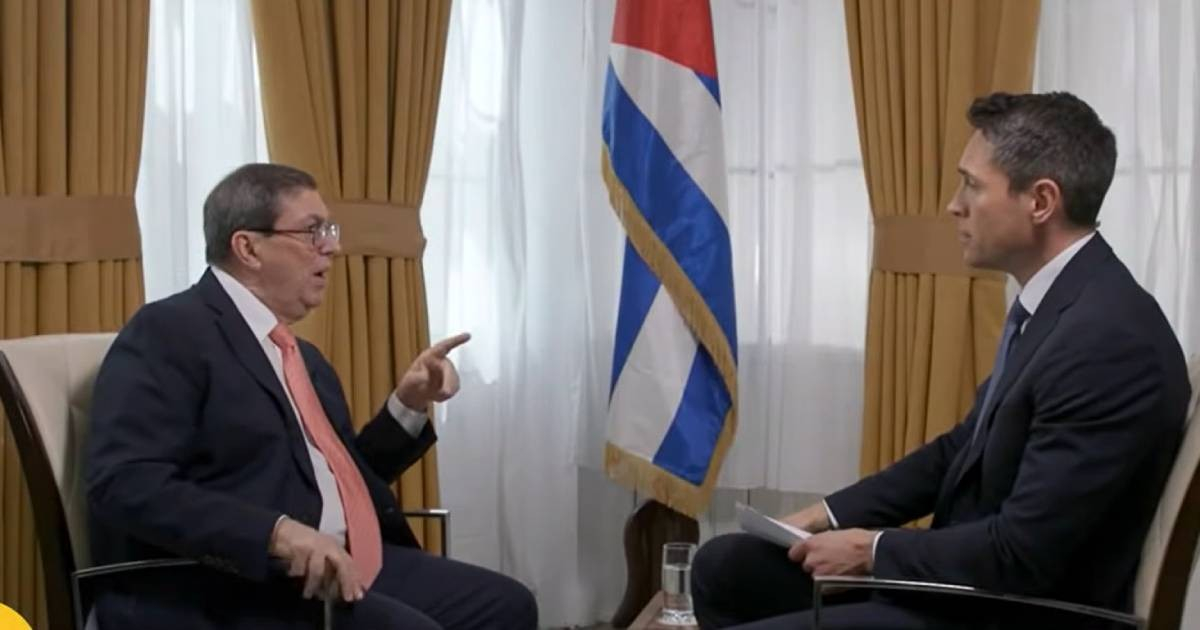
During a segment on ABC News' "Good Morning America," Cuba's Foreign Minister Bruno Rodríguez Parrilla found himself under intense scrutiny as he faced questions from journalist Whit Johnson about political prisoners, free elections, and government reforms. The interview, broadcast live from Havana, revealed the stark challenges and controversies surrounding the Cuban regime.
When pressed by Johnson on what might happen if Cubans were allowed to vote freely, Rodríguez deflected by accusing the reporter of having a "prejudice," offering no further explanation. Johnson, unfazed, pointed out to viewers that Rodríguez had failed to address the query directly: "He never answered that question."
Cuba's "Different Democracy": A Defense or Deflection?
Prior to this exchange, Rodríguez had portrayed Cuba as a "unique democracy," describing it as a nation with its own history and independence. However, Johnson countered by highlighting the reality of Cuban elections, where voters face a single candidate and one-party rule, largely under the control of the communist regime and a powerful family, for nearly seventy years.
Rodríguez also made the bold claim that "there are no political prisoners in Cuba," a statement immediately challenged by Johnson. The journalist cited human rights organizations, which estimate that hundreds remain imprisoned for political reasons, including participants from the July 11, 2021 protests. Groups like Prisoners Defenders report up to 1,250 political detainees, while Justicia 11J lists 775 as of April 17, with 338 directly related to the 11J demonstrations.
No Progress in US-Cuba Relations
Regarding diplomatic discussions with the United States, Rodríguez was unequivocal: there has been "no progress" in recent communications between the two governments. This statement comes amid a period of heightened tensions. Since January 2026, the Trump administration has imposed over 240 sanctions against the Cuban regime. Additionally, Secretary of State Marco Rubio recently announced new sanctions targeting GAESA, the military conglomerate controlling a substantial portion of Cuba's formal economy, and Moa Nickel S.A.
The Dire Economic Reality in Cuba
Reporting from Havana, Johnson painted a grim picture of everyday life in Cuba: a carton of eggs costs more than the average monthly salary, gas prices reach $40 per gallon on the black market, and gas stations remain closed due to unaffordable prices. The Economic Commission for Latin America and the Caribbean (CEPAL) forecasts a 6.5% contraction in Cuba's GDP by 2026, the worst in the region, with economist Pedro Monreal suggesting the decline could hit 15%, reminiscent of the worst year during the Special Period.
Cuban-American presenter Gio Benítez, who co-hosted the segment with Johnson, described the interview as "shocking" and shared that her own family "lost everything in communist Cuba." Johnson concluded the report with a poignant statement: "There is a growing sense of desperation, and many of the people we spoke to do want change."
Frequently Asked Questions on Cuba's Political Climate
What did Bruno Rodríguez say about political prisoners in Cuba?
Bruno Rodríguez claimed there are no political prisoners in Cuba, a statement refuted by journalist Whit Johnson, who cited human rights organizations that estimate hundreds are detained for political reasons.
How did the interview address Cuba's electoral process?
The interview highlighted the lack of choice in Cuban elections, where voters face a single candidate and one-party rule, challenging the notion of a "unique democracy" as described by Rodríguez.
What economic challenges is Cuba currently facing?
Cuba is experiencing severe economic difficulties, with essentials like eggs costing more than a monthly salary and gas prices soaring to $40 per gallon on the black market. The GDP is expected to contract significantly.