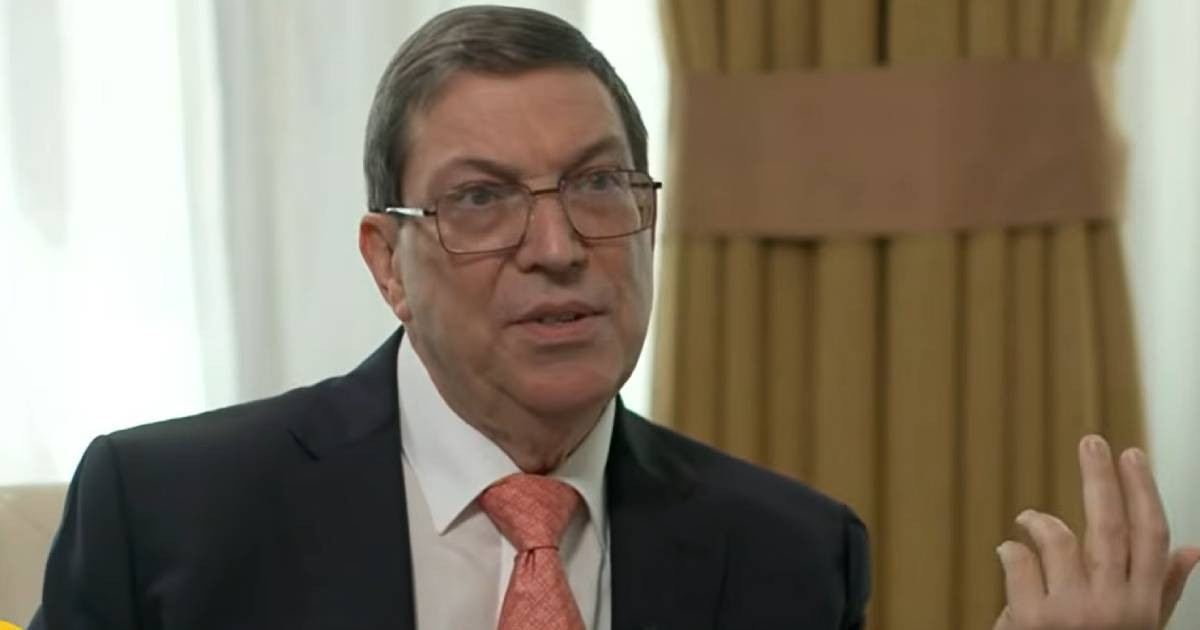
Last week, Cuban Foreign Minister Bruno Rodríguez Parrilla experienced a revealing moment on ABC News' "Good Morning America". During the segment in Havana, reporter Whit Johnson pressed Rodríguez on the topics of free elections, political prisoners, and reforms. The minister struggled to provide clear answers to the inquiries.
The interview, taped days before airing, comes amid the most severe crisis between Cuba and the United States in decades, following a new wave of economic sanctions announced by the Trump administration.
The Unanswered Question
The most tense moment arose when Johnson directly asked, "What do you fear would happen if there were free and fair elections in Cuba, if the people could truly choose?"
Rodríguez only replied, "You are presenting a prejudice," offering nothing further.
Johnson remarked on air, candidly noting, "He never answered that question."
Deflecting the Issue
Earlier, the foreign minister attempted to sidestep the issue by labeling Cuba as a "different democracy" and contending that it is "a country with its own history, with its peculiarities, and we are a free and independent nation."
The journalist reminded him that in Cuba, voters face a single candidate and a single party, with no real choice available.
Denial of Political Prisoners
Rodríguez also declared unequivocally during the interview that "there are no political prisoners in Cuba." Johnson countered this statement live, citing human rights organizations that estimate hundreds are detained for political reasons.
Groups such as Prisoners Defenders and Justicia 11J document between 775 and 1,250 political prisoners in Cuba so far in 2026, including 44 minors and many linked to the protests of July 11, 2021.
Stalled Negotiations with the U.S.
Regarding discussions with Washington, Rodríguez was equally blunt: there has been "no progress" in recent contacts between the two governments.
Cuban-American host Gio Benitez, who led the segment alongside Johnson, called the interview "shocking" and recalled that her own family "lost everything in communist Cuba."
Johnson described the dire economic situation he witnessed on the island with specific figures: a carton of eggs costs more than the average Cuban's monthly salary, gasoline reaches $40 per gallon on the black market, and gas stations remain closed because no one can afford it.
This crisis is backed by data. The Economic Commission for Latin America and the Caribbean (CEPAL) projects a 6.5% contraction of Cuba's GDP for 2026, the worst in Latin America and the Caribbean. Economist Pedro Monreal warns the decline could reach 15%, comparable to the worst year of the Special Period.
Since January 2026, the Trump administration has imposed over 240 sanctions against the regime, intercepting at least seven oil tankers, reducing the island's energy imports by 80% to 90%. On May 8, Secretary of State Marco Rubio announced new sanctions against GAESA and Moa Nickel after an ultimatum to the regime went unanswered.
Accusations Against the U.S.
In an earlier part of the broadcast, the Cuban foreign minister made other controversial statements. On that occasion, Rodríguez Parrilla accused the United States of having genocidal intentions and warned that an attack could lead to "a bloodbath in Cuba."
Johnson concluded his report with a summary of the negotiations' state: "There is a growing sense of desperation, and many of the people we spoke to do want change."
Questions About Cuba's Political Situation
What was the main topic of the interview with Bruno Rodríguez on ABC News?
The interview focused on free elections, political prisoners, and reforms in Cuba.
What did Bruno Rodríguez say about political prisoners in Cuba?
Bruno Rodríguez claimed that there are no political prisoners in Cuba, a statement refuted by human rights organizations.
What is the economic situation in Cuba as reported by Whit Johnson?
Whit Johnson reported that essential items like a carton of eggs cost more than the average monthly salary, and gasoline is extremely expensive, exacerbating the economic crisis.