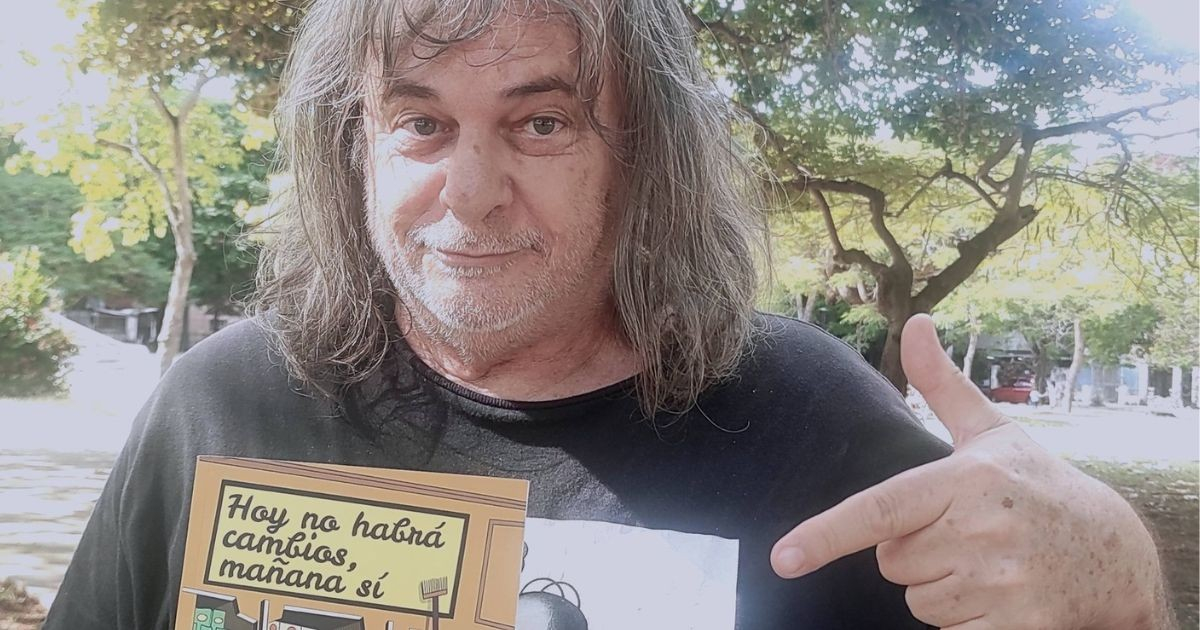
On Saturday, Cuban filmmaker and writer Eduardo del Llano took to his official Facebook page to release a piece titled "Answers to the Stupidest Questions I Get." True to his usual ironic style, he argues that the U.S. embargo is responsible for "at least seventy percent" of the challenges the country faces.
This argument isn't unfamiliar; it's the same one the Cuban regime has been repeating for decades, with little practical improvement for the people. Del Llano, however, presents it with more literary flair than Miguel Díaz-Canel.
Assigning Blame: A Convenient Narrative
Although Del Llano describes himself as "independent, even from the independents," he often aligns with the official narrative. He attributes the remaining 30% of Cuba's difficulties to "mistakes that have been made and continue to be made," quickly adding that these errors are "not inherent to the system." Thus, the system gets a free pass, while these errors float without a clear source or blame.
To those who ask if he would support a plebiscite on communism, Del Llano offers a polished response: yes, but "only if it's held twenty-five years after the embargo is lifted." Given Cuba's historical pace, this is almost equivalent to never.
Sarcasm as a Shield
When confronted with accusations that he has been bought, Del Llano uses sharp sarcasm: "Yes, I was bought. I have that two-story mansion with a pool in Miramar, and every day the Central Committee sends me a package of beef." The irony is clear, though in a Cuba where over 90% of the population lost adequate food access by 2025 and 25% go to bed hungry regularly, the jest about beef might carry an edge the author didn't anticipate.
The Broader Context of Cuba's Crisis
In his post, Del Llano also argues that communism "has worked" and "can work better," endorsing democratic elections, as long as they happen "within socialism." On the topic of U.S. intervention, he is unequivocal: "If you don't like communism, overthrow it yourself. If you can't or won't, don't expect someone else to do it for you."
However, he avoids discussing the systematic repression by the regime against those who peacefully attempt to change the system or express dissent in Cuba.
The reality of the island seems disconnected from Del Llano's post. Cuba's GDP fell by over 5% in 2025, accumulating a contraction of more than 15% since 2020, according to the University of Havana's Center for the Study of the Cuban Economy, which describes the model as "exhausted" and lacking "levers for structural changes." Blackouts left over 200,000 Cubans without water, with electric deficits reaching 1,945 MW in April 2026 and outages lasting up to 24 uninterrupted hours. The dollar has soared past the 500-peso mark in the informal market.
The Illusion of Functionality
Meanwhile, the Cuban regime exported tobacco worth hundreds of millions of dollars in 2025, while the population queued for basic necessities. Ration cards, which last only about ten days, are deemed "practically useless" due to empty shelves in state stores, as reported in January 2026.
In July 2024, Del Llano criticized the "monstrously excessive sentences" given to 11J protesters and the "shameless opportunism of the government of continuity." Despite being occasionally banned from Cuban television, he is not a typical regime spokesperson. He possesses nuance, criticism, and talent. Yet when asked if he might be wrong about everything, he responds that as a "theoretical possibility, yes," with the same odds as "winning a Nobel Prize or starring in a musical film."
This certainty, so literary and so convenient, is a luxury that Cubans enduring years of blackouts, scarcity, and repression cannot afford. Meanwhile, the system that "can work better" continues, with remarkable patience, not working.
Understanding Cuba's Challenges and Del Llano's Perspective
How does Eduardo del Llano view the U.S. embargo's impact on Cuba?
Eduardo del Llano argues that the U.S. embargo is responsible for at least seventy percent of Cuba's difficulties, a view he presents with his characteristic irony.
What does Del Llano say about Cuba's internal errors?
Del Llano attributes 30% of Cuba's difficulties to internal mistakes but clarifies that these are not inherent to the system, effectively absolving it of responsibility.
What is the economic situation in Cuba according to recent reports?
Cuba's GDP fell by over 5% in 2025, accumulating a contraction of more than 15% since 2020. The economic model is described as "exhausted," with significant blackouts and a steep devaluation of the peso.