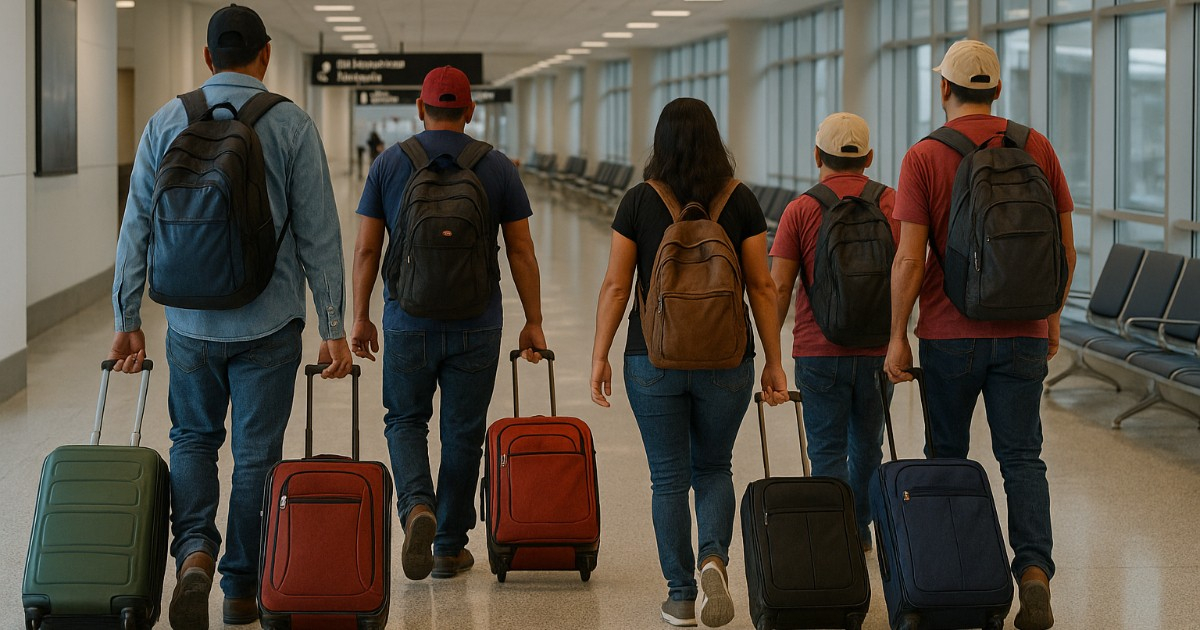
During the initial year of President Donald Trump's second term, there was a significant increase in the number of immigrants opting for voluntary departure from the United States. Over 80,000 orders were issued by immigration judges between January 2025 and March 2026, marking a historic high.
The Vera Institute of Justice provided data to The Washington Post indicating that this figure was at least seven times higher than the approximately 11,400 orders recorded in the 15 months before Trump's reentry to the White House.
Under Trump's administration, the monthly rate of these voluntary exits soared from about 750 during the latter half of President Biden's term to over 6,000 per month, as a result of heightened immigration enforcement raids.
The Mechanism of Voluntary Departure
Voluntary departure is a legal option allowing immigrants to leave the U.S. without a formal deportation order, potentially easing a legal return in the future. However, it requires relinquishing any pending claims, like asylum applications.
Under Trump's policies, more than 70% of these departures were granted to immigrants in detention, a stark contrast to the Biden era, where most who opted for this were not in custody.
Detention Conditions and Increasing Numbers
According to Ariel Ruiz Soto, an analyst with the Migration Policy Institute, "The trend is clear: more detainees are choosing voluntary departure as an alternative to detention."
In New York alone, 22% of those arrested by Immigration and Customs Enforcement (ICE) during Trump's second term chose voluntary departure, compared to less than 1% previously.
States such as Texas, Louisiana, Florida, Georgia, and California saw the highest numbers of cases.
Detention Capacity and Mortality Rates
The conditions in detention centers play a critical role in these decisions. ICE's detention capacity expanded from roughly 40,000 beds in January 2025 to over 70,000 by January 2026, with a daily peak reaching 73,400 detainees—a historic high.
Simultaneously, deaths in ICE custody reached their highest level in two decades, with at least 47 reported fatalities since the start of Trump's second term, as per a study published in the medical journal JAMA in April 2026.
Policy Incentives and Economic Encouragement
This surge in voluntary departures is part of a broader immigration policy that combines stricter interior enforcement with incentives for self-deportation. The "Homeward Bound Project," administered through the CBP Home app, offers free flights and up to $2,600 per person, alongside waiving civil fines.
The economic incentive started at $1,000 when Trump announced the plan in May 2025, briefly increased to $3,000 as a "holiday stipend" in December, and was set at $2,600 from January 2026.
Homeland Security Secretary Kristi Noem stated in August 2025 that "in less than 200 days, 1.6 million illegal immigrants have left the United States," a figure encompassing both voluntary exits and formal deportations.
Impact on Cuban Immigrants
The Cuban community has been particularly affected. ICE detentions of Cuban migrants surged by 463% from October 2024 to January 2026, while permanent residency approvals for Cubans plummeted by 99.8% during the same timeframe.
Since January 2025, more than 4,883 Cubans have been deported, including at least four direct flights to Havana in 2026, repatriating a total of 530 individuals by May.
According to the Center for Immigration Studies, the foreign-born population in the U.S. decreased by 2.2 million between January and July 2025, the largest six-month decline since systematic data collection began in 1994.
Understanding Voluntary Departure Under U.S. Immigration Policies
What is voluntary departure in U.S. immigration law?
Voluntary departure allows immigrants to leave the U.S. without a formal deportation order, which could simplify a legal return in the future, but requires giving up any pending claims, such as asylum requests.
How did Trump's policies affect voluntary departure numbers?
Under Trump's administration, the number of voluntary departure orders increased significantly, largely due to intensified immigration enforcement and policy incentives encouraging self-deportation.
Why are detention conditions important in the decision for voluntary departure?
The conditions in detention centers can be a major factor for immigrants opting for voluntary departure, as many prefer leaving the U.S. rather than facing prolonged detention under challenging circumstances.