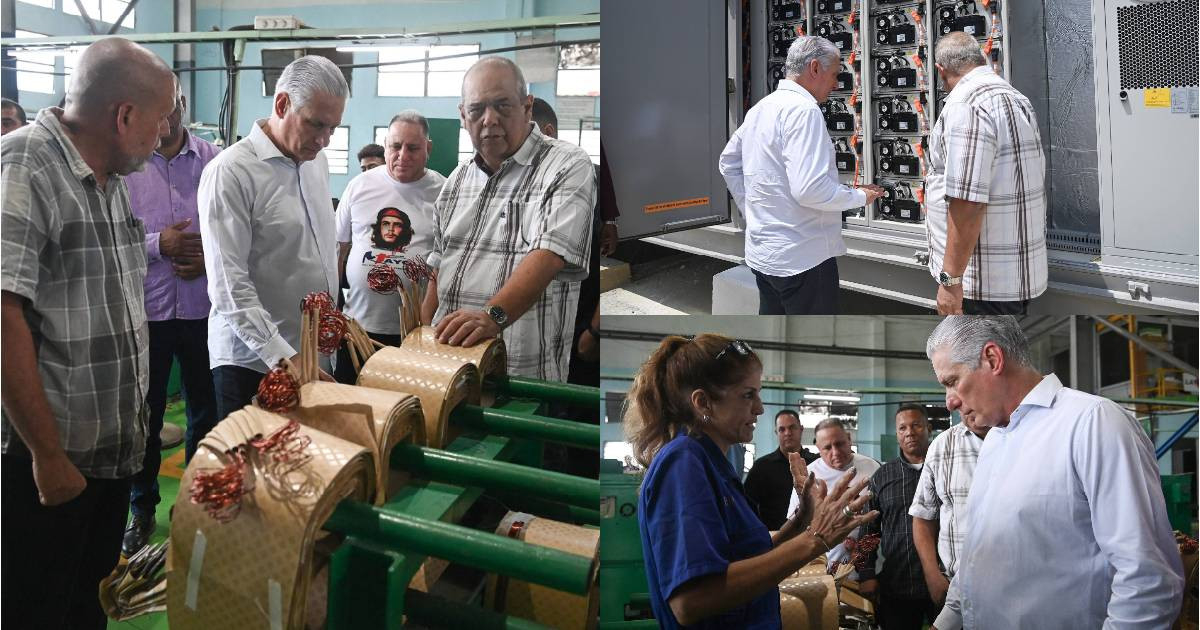
Miguel Díaz-Canel, the leader of Cuba, visited two key energy facilities in Havana on Friday. These visits included a stop at the Latino transformer factory and a battery storage system in Cotorro, both presented by the Cuban Presidency as part of a strategic initiative to revitalize the National Electric System (SEN).
At the Latino Transformer Factory, situated in the Boyeros municipality, Díaz-Canel engaged with officials from the Ministry of Energy and Mines, as well as the plant's 143 workers, 56 of whom are young employees. Established in 1987, the facility aims to produce 10,000 transformers by 2026—8,000 new units in Havana and 2,000 refurbished ones in Villa Clara and Manzanillo, according to reports.
"This year, we produced 8,000 transformers, each costing between $1,800 and $1,900. Producing them locally saves us around $1,500 to $1,200 per unit compared to the $3,000 import cost," explained a factory executive.
In 2025, the refurbishment efforts at this facility reportedly saved the country almost $20 million.
Later, Díaz-Canel toured the Battery Energy Storage System (BESS) at the Cotorro substation, constructed with Chinese technology and expertise, which is 93% complete. It is slated to become operational in the latter half of June. Additionally, three similar parks are under development in La Cujá (Havana), Cueto (Holguín), and Bayamo-Granma, each boasting a capacity of 50 megawatts.
A technical director noted that collectively, these four systems will contribute 200 megawatts, enabling comprehensive frequency regulation of the SEN, alongside a 2,000-megawatt solar photovoltaic park initiative.
This official tour coincides with one of Cuba's most severe energy crises. The country's electricity deficit continues to worsen, with a Mayabeque resident reporting 34 consecutive hours without power.
The Antonio Guiteras thermoelectric plant went offline on May 5 due to its eighth malfunction of the year, exacerbating the frequency of blackouts.
Adding to the turmoil is a fuel crisis. On May 2, Díaz-Canel acknowledged to international solidarity delegates the depletion of Russian oil supplies, with no clear timeline for new shipments.
"Our current oil supplies are running out, and we have no idea when more fuel will arrive in Cuba," he emphasized.
Public reactions on social media have been openly skeptical. One user commented, "The circus is touring the capital; there's fuel for that," while another sarcastically remarked, "It's like inspecting a frying pan without any fish to cook."
Yoanka Rodriguez bluntly stated, "That's why in my circuit 3665 in Mayabeque, I've been without power for 34 hours. It's embarrassing."
This pattern of presidential visits to energy facilities amid crises is not new. Díaz-Canel previously toured the Guiteras plant in September 2025 while the nation was plunged into darkness. Earlier, he visited thermoelectric plants in Cienfuegos in August 2025, consistently offering recovery promises without any visible structural solutions.
Understanding Cuba's Energy Crisis
What is the current state of Cuba's energy system?
Cuba is experiencing one of its most severe energy crises, characterized by widespread power outages and a significant electricity deficit.
How is Díaz-Canel addressing the energy issues?
Díaz-Canel is promoting optimism by visiting energy facilities and emphasizing strategic initiatives to recover the National Electric System, despite public skepticism.
What are the financial implications of local transformer production?
Local transformer production at the Latino factory saves Cuba approximately $1,500 to $1,200 per unit compared to importing them.