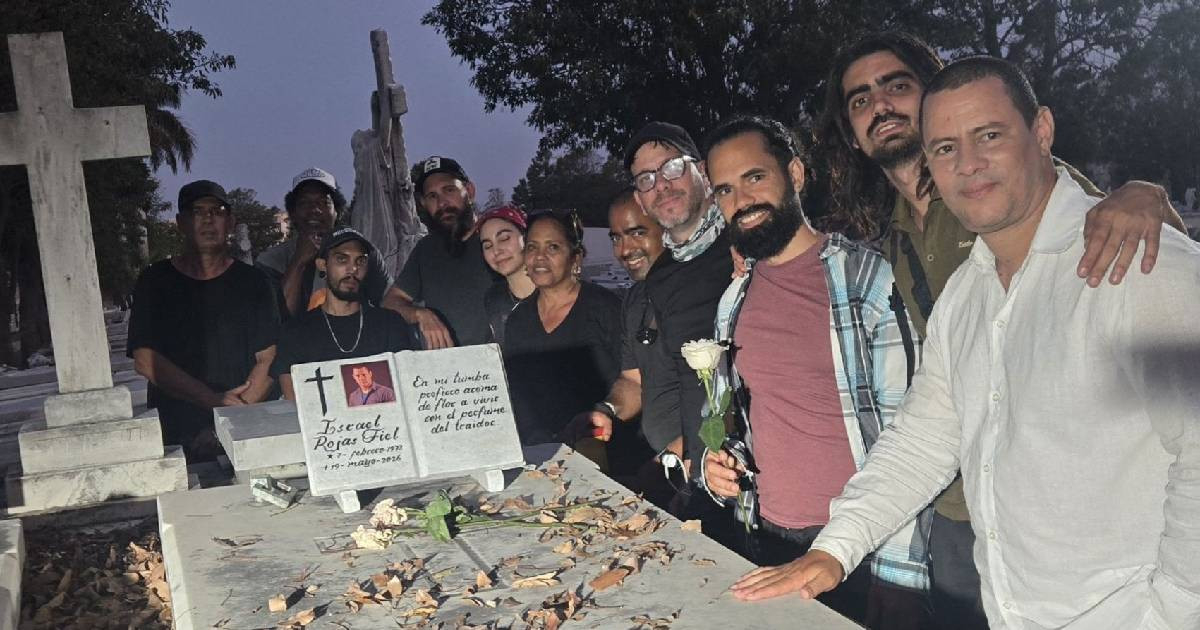
Israel Rojas, frontman of the duo Buena Fe, expressed his frustration on Thursday, stating that Cuban state media have been disregarding his latest music, sometimes completely ignoring it for being "suspicious." He made these remarks while announcing his work on a music video for the song "El perfume del traidor," part of his new album titled Trineo.
With a touch of irony, Rojas highlighted the scrutiny his work faces. "An 'historian' has already taken note of this material before it even came out. I find it fascinating that those who oppose me are more up-to-date with my creations," he remarked, alluding to the ideological oversight of his artistic output.
In the comments section, a follower informed Rojas that his music was aired on Cubavisión at 3:25 in the morning. He responded with sarcasm: "That's the 2019 album Carnal. They play it in the early hours to fill programming. At that time, the audience level must be about 0.1% of the population. But I can't complain. They play us a lot at that hour with a work from seven years ago. Thanks for the audience report."
His followers' reaction was strong. Mary Val commented, "We're waiting for the brave ones to broadcast Trineo on TV and radio. But no, not even the tip of the foot is visible."
Another user joked that the official media would need a "telescope" to find something of the new work, referencing "Catalejo" (2008), one of the group's most controversial songs.
The music video for "El perfume del traidor" was directed by photographer and filmmaker Claudio Peláez Sordo and shot in a cemetery, featuring a tombstone with Rojas's name, a symbolically charged image given his complaint.
As the new album Trineo remains absent from Cuban TV and radio, Rojas concluded his post with a phrase summarizing his predicament: "These are truly crazy times."
The situation is ironic, considering Rojas's history as an artist closely aligned with the Cuban regime. In February, he publicly supported leader Miguel Díaz-Canel and defended state secrecy, speaking of a "polycrisis."
That same month, he stirred controversy by stating he wouldn't sacrifice for "an elderly statesman, nor for his son or grandson, nor for his family," touching on a taboo regarding the Castro dynasty, prompting a public retraction.
In April, Buena Fe performed at the Piña Colada Festival in Morón, a city that had recently experienced violent protests over blackouts. Rojas shared videos praising solar panels as "resilience," echoing official narratives while ignoring the repression.
He also admitted that power outages impact his creative work, stating, "Producing music with EcoFlow is an odyssey."
In October 2025, Rojas acknowledged that speaking out against the crisis was "almost an obligation," marking the beginning of his public tensions with the cultural establishment.
This isn't the first time Rojas has voiced such concerns. In January 2023, he warned the official newspaper Girón of a "well-coordinated campaign to discredit us" and prevent his music from being heard.
Understanding the Impact of Censorship on Cuban Artists
Why is Israel Rojas critical of Cuban state media?
Israel Rojas criticizes Cuban state media for ignoring his latest music, labeling it as "suspicious," which he views as a form of ideological censorship.
What is the significance of "El perfume del traidor" music video?
The music video, directed by Claudio Peláez Sordo, carries symbolic weight as it was shot in a cemetery with a tombstone bearing Rojas's name, highlighting the censorship he faces.
How does Israel Rojas's previous support for the regime contrast with his current stance?
Despite historically aligning with the Cuban regime and supporting its leaders, Rojas's recent criticisms indicate a shift, as he now openly addresses the pressures and challenges he encounters.