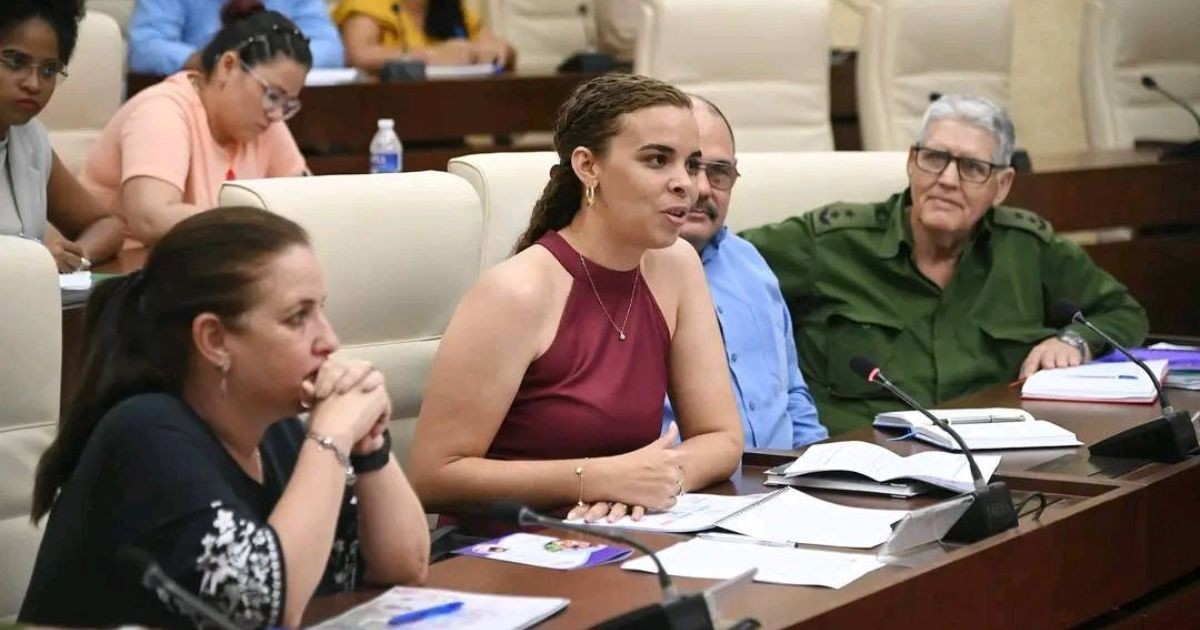
Meyvis Estévez, the national first secretary of the Union of Young Communists (UJC), recently took to Facebook to lavish praise on the Community Youth Network, a flagship program under Miguel Díaz-Canel's regime. She hailed the initiative as a "beautiful" and "monumental" effort to transform Cuban neighborhoods.
Estévez’s enthusiastic declaration emerges at a time when Cuba faces a bleak economic forecast, with the Economic Commission for Latin America and the Caribbean (ECLAC) projecting a -6.5% GDP contraction by 2026. This is compounded by power outages lasting up to 20 hours and an average monthly salary of just $16—figures she conveniently overlooks in the polished style of Cuban official propaganda.
“Certain things cannot be quantified solely by numbers, reports, or goals. They must be felt,” Estévez wrote, employing her characteristic "poetic" prose to sidestep the harsh realities of the island's economic collapse.
Political Rhetoric vs. Economic Reality
Recently, Estévez met with President Díaz-Canel to assess the progress of the Network's initial phase, quoting him in saying, “Every place has something to beautify, every institution something to improve.” In Cuba's current context, this statement seems more like an admission than an inspiration.
Indeed, nearly everything requires beautification, and most institutions need improvement. Yet, rather than reforming the system that led to this downfall, the regime opts to mobilize youth brigades to paint schools and organize community games.
The Community Youth Network: A Closer Look
Launched officially on April 7, 2026, the Community Youth Network is structured around seven projects under the motto "Innovate, Create, Lead," with operations extending across popular councils, municipalities, and provinces. One of its most revealing components is the "digital swarms," aimed at combating "fake news" on social media and turning youth communication into an "ideological battle weapon." A curious mix of mural painting and thought policing.
On April 3, Estévez also led the Anti-imperialist Youth Parade "Here, with Fidel," one of many tributes to the late dictator. She called for "resistance, innovation, and creativity amidst adversity," claiming in her post that "when the Network moves, the whole neighborhood moves with it." What she fails to mention is the direction in which most Cubans are moving: towards the exit.
Migration and Its Implications
Cuba's population has dwindled to 9,748,007, the lowest since 1985, following a negative migration balance of 251,221 people in 2024 alone. Over a million Cubans left the island from 2021 to 2025, with an estimated 30% of these migrants aged 15 to 34—the very demographic the Community Youth Network aims to "organize, commit, and fill with colors."
Even Díaz-Canel acknowledged the youth exodus as a "painful wound," blaming capitalism for "buying" the talent educated freely in Cuba. The irony was not lost on many Cubans, as they noted that his stepson is studying at a private university in Madrid, far removed from any digital swarm or neighborhood game session.
Expanding the Network's Mission
In May, the Community Youth Network broadened its mission: besides painting schools, its brigades began distributing the "Family Guide for Civil Defense" in neighborhoods as part of the regime's military preparations. Thus, to the list of "beautiful" tasks, one more is added: preparing the population for potential armed conflict, candles included.
Estévez concludes her post with a statement that, upon closer examination, is unintentionally candid: “Because you, young people, students, neighbors, friends, are immersed in countless battles. But these are not distant, abstract battles; they are lived in our neighborhoods, with our feet on the ground and hearts in hand.”
Indeed, the battles against hunger, darkness, and despair are the real challenges faced by Cuban youth in 2026. No amount of revolutionary enthusiasm painted on walls will solve them.
Understanding the Community Youth Network and Its Impact
What is the Community Youth Network's primary goal?
The Community Youth Network aims to transform Cuban neighborhoods through initiatives designed to engage and organize young people, using projects like mural painting and digital campaigns against misinformation.
How has the Cuban population been affected by recent migration trends?
Cuba's population has declined significantly due to a negative migration balance, with over a million people leaving the island between 2021 and 2025, many of whom are young adults aged 15 to 34.
What criticisms have been raised regarding the Community Youth Network?
Critics argue that the Network's initiatives focus on superficial tasks, like painting and organizing games, rather than addressing the systemic issues that have led to Cuba's economic and social challenges.