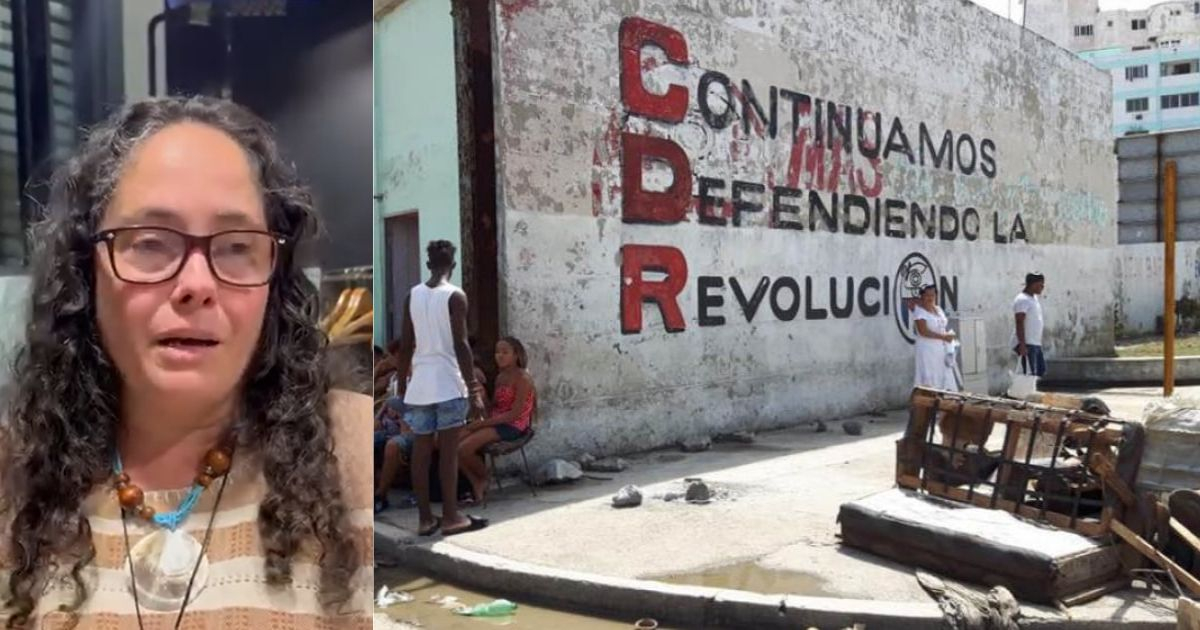
On Friday, Cuban essayist and researcher Hilda Landrove published an insightful essay titled "Cuba: the Totalitarian Grip and the Unyielding Desire for Change" in Rialta Magazine. This work dismantles the myth of a heroic revolution and scrutinizes the structures that have sustained the Cuban regime for over sixty years, amidst the unprecedented systemic crisis gripping the island in 2026.
The essay's origins are revealing: originally penned for a progressive European magazine, it was rejected for two reasons that Landrove uses as a starting point for her analysis.
Firstly, the publication demanded that any critique of the regime be prefaced by a condemnation of Donald Trump's policies. Secondly, editors feared that the Cuban government might feel "disrespected," potentially endangering individuals connected to the organization.
"Cubans are constantly pushed to first make a confessional acknowledgment of imperialism's evil before daring to critically examine the Cuban regime," Landrove writes, highlighting how such rejections reflect widespread self-censorship in global media and organizations. This, she argues, has helped maintain the revolutionary myth while denying its "long history of human rights violations."
The Distinction Between Revolution and Regime
One of the central themes of the essay is distinguishing between "revolution" and "regime." Landrove argues that what is currently failing in Cuba is not a revolution—a transformative event concluded decades ago—but a specific political regime solidified during the First Congress of the Communist Party of Cuba in 1975 and enshrined in the 1976 Constitution, mimicking the Soviet Stalinist model with its single party, centralized economy, and suppression of civil rights.
"2026 could mark the end of the Cuban regime," Landrove notes, as the nation faces an economic contraction of -23% since 2019, with power outages lasting up to 30 hours daily affecting 64% of the territory, and a projected GDP decline of -7.2% for the year.
Economic Dependencies and Their Downfall
The essay traces the history of external economic dependencies that have propped up the regime: first the USSR, whose collapse triggered the Special Period in the 1990s, followed by Venezuela from 1999, when Hugo Chávez's victory allowed a return to the model without democratization.
This second dependency ended abruptly on January 3, 2026, with the capture of Nicolás Maduro by U.S. forces. "The dependency on Venezuela seems to have ended suddenly [...] closing a second period of economic subordination that currently shows no signs of being replaced by any other," Landrove writes.
Venezuela once supplied Cuba with up to 100,000 barrels of oil per day; by 2025, this figure had fallen to 16,000. Following Maduro's capture, Trump declared: "There will be no more oil or money for Cuba - ZERO."
GAESA's Economic Monopoly
Simultaneously, Landrove points out how the 1990s saw the emergence of the Revolutionary Armed Forces conglomerate—GAESA—which became a state-controlled monopoly, accelerating the concentration of power within an elite tied to the Castro family. This created an extractive economy exploiting the diaspora's resources. Leaked documents in 2025 estimated GAESA's liquid assets at over 18 billion dollars.
Meanwhile, the regime responds to the crisis with triumphant rhetoric: Miguel Díaz-Canel claimed that the Revolution eliminated "all miseries" and granted "more rights than ever" while overseeing military maneuvers. Cubalex documented 246 rights violations with 540 repressive incidents in March 2026, affecting organizations like the Damas de Blanco, UNPACU, and the Frente Antitotalitario Unido.
The Enduring Desire for Change
Despite systemic repression, Landrove asserts that the Cuban society's desire for change—whose recent peak was on July 11, 2021—remains unbroken. This desire, though sabotaged, is what the essay's title upholds against those who prefer to look away rather than accurately name what is occurring on the island. Other analysts today debate the necessity of a radical decommunization as a path forward post-transition.
"The Cuban regime claims its right to exist without external intervention while denying its own society the right to exist and govern itself," summarizes Landrove in a statement that encapsulates the entire essay, which could serve as a foundation for many essential debates.
According to Rialta's website, the author is a Cuban cultural promoter based in Mexico. She holds a doctorate in Mesoamerican Studies from the National Autonomous University of Mexico (UNAM) and is a lecturer at the Monterrey Institute of Technology and Higher Education (Querétaro campus).
Key Insights into Cuba's Political and Economic Landscape
What is the central argument of Hilda Landrove's essay?
Landrove's essay argues that the current crisis in Cuba is not the failure of a revolution but the breakdown of a specific political regime established in the 1970s, which mimics Soviet Stalinist principles.
How has external economic dependency affected Cuba?
Cuba's reliance on external economies, first with the USSR and then Venezuela, has been crucial in sustaining the regime. The collapse of these dependencies, particularly with Venezuela's recent political changes, has exacerbated Cuba's economic struggles.
What role does GAESA play in Cuba's economy?
GAESA, a conglomerate controlled by the Revolutionary Armed Forces, acts as a state monopoly. It centralizes economic power within an elite associated with the Castro family, contributing to Cuba's extractive economy.