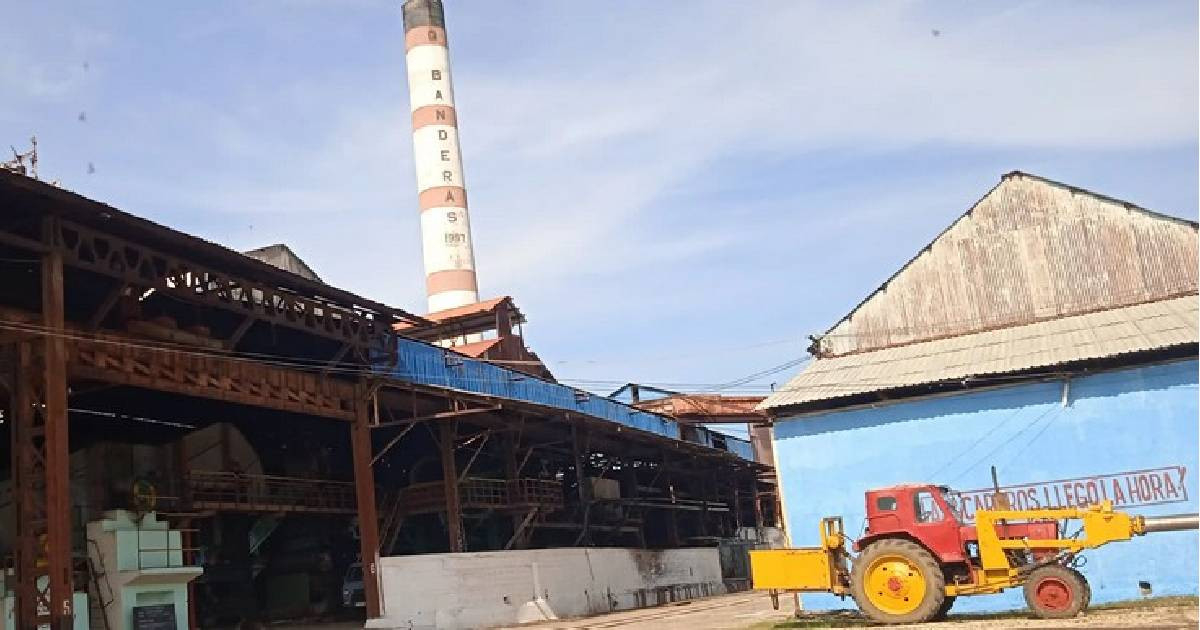
The Quintín Bandera sugar mill, located in the municipality of Corralillo within Villa Clara province, has failed to complete the 2025-2026 sugarcane harvest. Now, it's fighting for survival by turning to oxen and solar panels, according to a report from the official broadcaster CMHW on Friday.
This collapse is the result of a succession of setbacks. The mill began its operations on February 2, after several unsuccessful attempts and weeks of delays, with the goal of producing 11,000 metric tons of raw sugar within 75 days and supplying energy to the National Electroenergy System (SEN). However, this target was never reached.
Due to a shortage of fuel and agricultural supplies, the company was forced to innovate. The report indicates that they are progressing with the installation of solar panels to alter their energy matrix, while also resorting to animal traction, a skill that workers admit has faded over time.
"With the 'sweet gold' hit hard, unable to carry out the 2025-2026 harvest, the situation becomes increasingly challenging, necessitating innovative solutions, some of which are quite traditional, alongside the implementation of creative measures," the report stated.
Delayed Harvest Start and Ongoing Struggles
The commencement of the harvest had been repeatedly postponed. Onel Pérez González, the director of the mill, acknowledged in December that the delays were due to "the current energy situation and the lack of essential resources needed to complete the preparation tasks."
The energy crisis pushed the start date of the harvest from December 14, 2025, to December 26, and then further delayed it until February.
The failure at Quintín Bandera is not an isolated incident. Villa Clara has been missing its sugar production targets since 2019, as confirmed by Susely Morfa González, the province's first secretary of the Communist Party. "Since 2019, the production plan here has not been met," she admitted weeks ago.
Wider Implications for Cuban Sugar Industry
During the 2024-2025 harvest, both the Héctor Rodríguez and Quintín Bandera mills reported yields below 50% of their planned targets. Nationwide, Cuba's sugar production fell below 150,000 metric tons, the lowest level in over a century, compared to a state plan of 265,000 tons.
The collapse of the 2025-2026 harvest also impacted the production of by-products, such as alcohol, causing the Paraíso distillery in Tuinicú, Sancti Spíritus, to shut down just 22 days after starting operations.
The official media described the situation at Quintín Bandera as a "struggle for survival," emphasizing that the battle extends beyond economic concerns.
"This fight isn't just about sugar, cane, and food, but also about preserving the identity of a part of Villa Clara's geography," CMHW asserted.
Once the world's leading sugar producer throughout much of the 20th century, with harvests reaching seven and eight million tons in the 1980s, Cuba's sugar industry has now plummeted to levels not seen since before 1900. This decline is a direct consequence of 67 years of centralized management and flawed planning.
Understanding the Cuban Sugar Industry Collapse
Why did the Quintín Bandera mill fail to meet its production goals?
The failure was due to a combination of fuel and agricultural supply shortages, repeated delays in starting the harvest, and the broader energy crisis affecting Cuba.
How is the Quintín Bandera mill adapting to current challenges?
The mill is adapting by installing solar panels and utilizing traditional methods such as animal traction to cope with the lack of modern resources.
What is the broader impact of the sugar industry collapse in Cuba?
The collapse has affected sugar production nationwide, leading to a significant decline in output and impacting related industries, such as alcohol production.