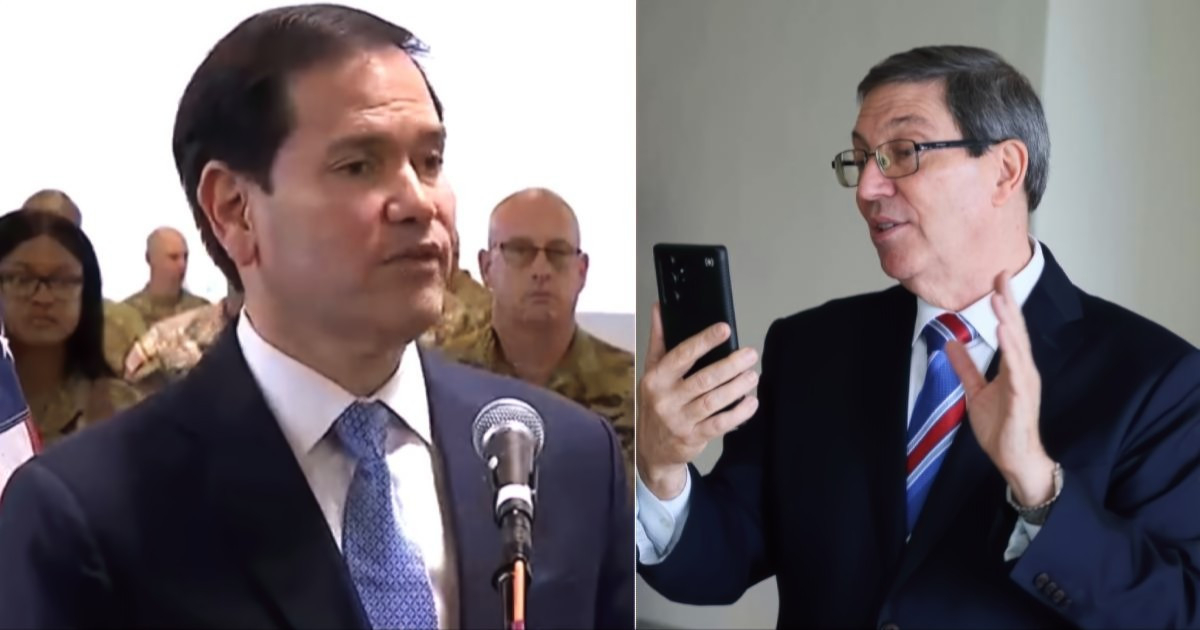
Bruno Rodríguez Parrilla, the Cuban Minister of Foreign Affairs, sharply criticized U.S. Secretary of State Marco Rubio on Friday, accusing him of concocting a "tale of a supposed $100 million or more aid offer" to mislead both the Cuban people and American citizens.
The Cuban diplomat's reaction on his X account came shortly after Marco Rubio announced from Rome that Washington had proposed $100 million in humanitarian assistance, which the Cuban regime has allegedly refused to distribute to its populace.
Rodríguez labeled Rubio as an "anti-Cuban politician" and directly questioned the truthfulness of his statements. "Was he being truthful in the Holy See?" he wrote, referring to the meeting Rubio had with Pope Leo XIV at the Vatican on Thursday, where discussions centered around Cuba and the expansion of humanitarian aid.
"The U.S. Secretary of State, fully aware that he needs to resort to lies to justify his criminal actions against the Cuban people, concocts the tale of a supposed $100 million or more aid offer, attempting to deceive both the Cuban populace and American citizens," emphasized Rodríguez.
The Cuban Foreign Minister further questioned the whereabouts of the funds. "Where did they go? What would they have been used for?" he added, noting the "high degree of cynicism" required to make such a deceptive statement about supposed assistance without any shame.
Meanwhile, Rubio clarified that six million dollars had already been distributed through Caritas and the Catholic Church, with Washington ready to extend even more aid. "We have offered the regime $100 million in humanitarian aid, which they have unfortunately not accepted to help the people of Cuba," he remarked.
Notably, Rodríguez did not mention in his message that U.S. humanitarian aid, specifically channeled through the Catholic Church to bypass state intervention, has reached tens of thousands of Cuban families affected by Hurricane Melissa, which devastated eastern Cuba on October 29, 2025.
On Friday, Caritas Cuba updated the status of the aid provided by the U.S. government, reporting that they have utilized 82% of the initial three-million-dollar donation, benefiting 8,800 families in Santiago de Cuba, Holguín, Las Tunas, Granma, and Guantánamo.
From the outset, the Cuban regime has adopted a hostile stance towards the aid. Cuban officials have publicly dismissed the assistance as a "dirty political business," "little bags," and "handouts," while the Foreign Ministry declared on Friday that the U.S. seeks to "provoke an upheaval" in Cuba.
This dispute unfolds amid a sustained escalation of U.S. pressure. On Thursday, Rubio announced new sanctions against the military conglomerate Gaesa and Moa Nickel S.A., warning that measures will continue "until the regime implements all necessary political and economic reforms."
Since January, the Trump administration has imposed over 240 sanctions against Cuba, intercepted at least seven tankers, and reduced the island's energy imports by 80% to 90%, according to dossier data.
The Economist Intelligence Unit predicts a 7.2% economic contraction for Cuba this year.
Key Questions About the U.S. Humanitarian Aid to Cuba
What was the proposed amount of U.S. humanitarian aid to Cuba?
The United States proposed $100 million in humanitarian aid to Cuba.
How has Cuba responded to the U.S. aid offer?
The Cuban regime has refused to distribute the aid and has dismissed it as a political maneuver.
How much of the aid has been distributed so far?
According to Caritas Cuba, 82% of the initial three-million-dollar donation has been distributed to 8,800 families.