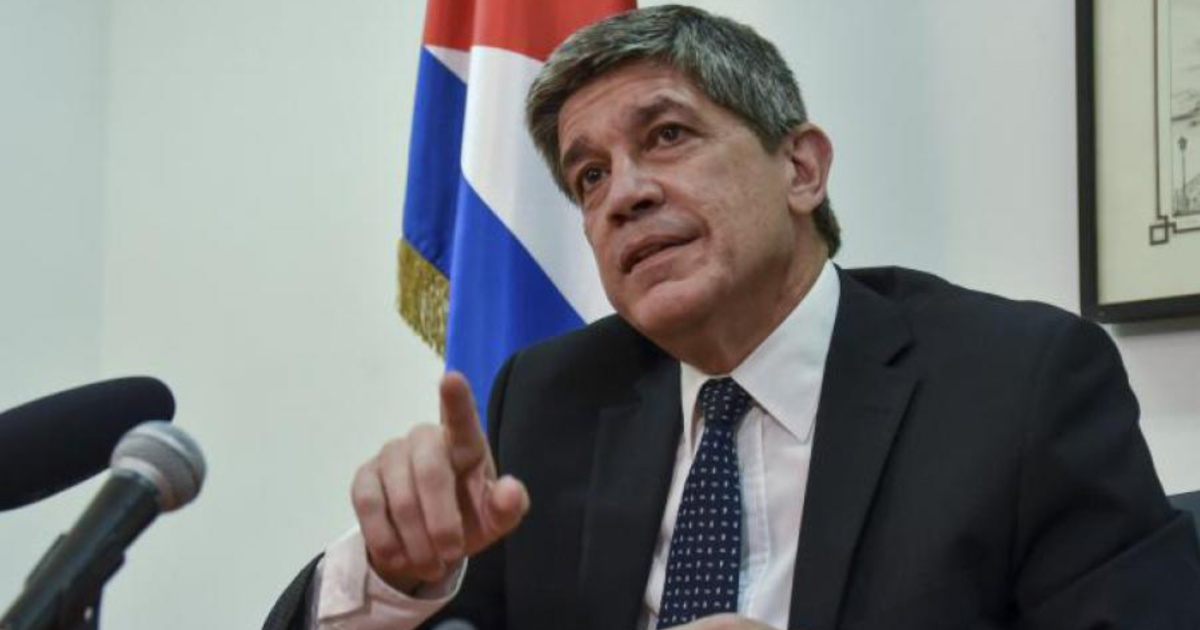
On Thursday, Cuban Deputy Minister of Foreign Affairs, Carlos Fernández de Cossío, addressed the latest sanctions imposed by Washington, stating on X that U.S. intelligence agencies have ample evidence proving that Cuba poses no threat to the United States.
He remarked, "Anyone truly leading the U.S. intelligence and national security agencies has ample evidence that Cuba is not a threat to that country, even if the deceitful arguments presented by top U.S. officials were credible."
This statement followed the U.S. Treasury Department's announcement of sanctions against the military conglomerate GAESA (Grupo de Administración Empresarial S.A.), its CEO Ania Guillermina Lastres Morera, and the mining company Moa Nickel S.A., a joint venture with Canada's Sherritt International Corp., which halted its Cuban operations that same day.
GAESA, managed by the Revolutionary Armed Forces, controls assets exceeding $18 billion and constitutes between 40% and 70% of Cuba's formal economy, according to the U.S. State Department.
Underlying Reasons for Sanctions
The measures are based on Executive Order 14404, signed by Trump on May 1, titled "Imposing Sanctions on Those Responsible for Repression in Cuba and Threats to U.S. National Security," which extends the national emergency declared in January 2026.
Washington's primary justification for this pressure is that Cuba hosts intelligence facilities for China and Russia just miles away from U.S. territory.
State Secretary Marco Rubio clearly stated on Fox News last Tuesday, "We will not allow U.S. adversaries to operate intelligence or military bases 90 miles from us."
The Center for Strategic and International Studies (CSIS) has identified at least 12 Chinese signal intelligence installations on the island, with documented expansions in 2025.
Cuba's Continued Defiance
Cossío consistently rejects this narrative, accusing the U.S. of using pretexts to mask what he describes as a policy of domination.
On May 5, he argued that Trump's executive order "removes any doubt about the domination objectives" that, in his view, drive U.S. pressure.
In March, during an appearance on NBC's "Meet the Press," Cossío stated that the Cuban military "is always prepared and, in fact, is currently preparing for the possibility of a military aggression."
Impact on Cuban Population
While the regime maintains its defensive rhetoric, the Cuban populace endures the fallout from the energy crisis: since January, a fuel boycott has cut 80% to 90% of the island's oil imports, leading to blackouts lasting up to 25 hours a day.
On Thursday, Rubio warned that the pressure is far from over: "Additional designations can be expected in the coming days and weeks," he declared while announcing the sanctions, as part of a campaign that, since January 2025, has amassed over 240 restrictive measures against the regime.
Understanding the U.S. Sanctions on Cuba
What are the recent U.S. sanctions on Cuba?
The U.S. recently imposed sanctions on the military conglomerate GAESA, its CEO Ania Guillermina Lastres Morera, and the mining company Moa Nickel S.A., citing threats to national security.
Why does the U.S. consider Cuba a threat?
The U.S. argues that Cuba hosts intelligence facilities for China and Russia, which are located dangerously close to American territory.
How has Cuba responded to the U.S. sanctions?
Cuba, through Deputy Minister Carlos Fernández de Cossío, denies posing any threat to the U.S. and accuses the American government of using false pretenses to justify domination policies.