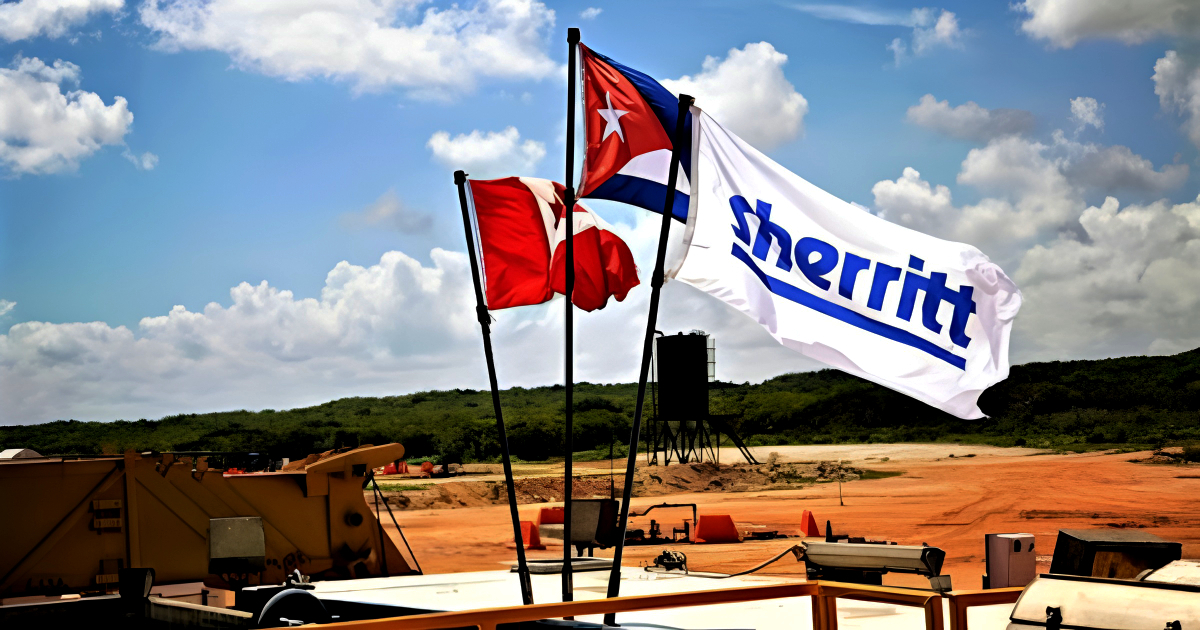
The halting of Sherritt International's operations in Cuba signifies more than just the withdrawal of a foreign company.
If this decision becomes permanent in the coming weeks, the regime stands to lose one of its main sources of foreign currency, a crucial support for electricity generation, and the backing of one of the few international investors still willing to bet on the island despite its economic and financial collapse.
The Canadian mining company, involved in Cuba since the early 1990s, has announced it is suspending its direct participation in joint ventures operating on the island following a new executive order signed by Donald Trump on May 1.
The secondary sanctions against foreign financial entities maintaining ties with blocked Cuban companies placed Sherritt in an untenable position: remaining in Cuba would mean risking access to the international banking system.
For Havana, the economic blow is substantial. The company co-operated the Moa mine in Holguín alongside the Cuban state, which is one of the country's principal sources of nickel and cobalt exports.
In 2025, production hit 25,240 tons of nickel and 2,728 tons of cobalt. Based on international prices reported by the company, this volume translates to approximately $490 million in gross annual metal revenue, before deducting operational costs and profit-sharing.
Although Cuban nickel was already suffering from energy issues, fuel shortages, and industrial decline, Sherritt's departure threatens to push the sector into a much more critical phase.
The company provided access to technology, refining, international logistics, and external financing—capabilities that the regime will find difficult to replace in the current environment.
The situation is even more precarious given that Sherritt had already warned in February of production disruptions at Moa due to fuel shortages supplied by the Cuban authorities themselves. Now, without foreign technical support and with increasing financial constraints, the risk of partial or sustained shutdowns grows significantly.
The Ripple Effect Beyond Mining
Sherritt's influence extended beyond mining. Through Energas S.A., the company also participated in electricity generation with plants powered by Cuban natural gas. Energas' installed capacity is around 506 megawatts, which is roughly 10% of the national electricity capacity.
In a Cuba where daily blackouts affect millions and the power grid is undergoing its worst crisis in decades, any further operational deterioration can have immediate repercussions.
While the plants won't vanish overnight, the departure of the Canadian company threatens maintenance, parts, technical assistance, and investment capacity. In an already collapsed system, even minor efficiency reductions can lead to more blackout hours.
Symbolic and Financial Impact
Sherritt's withdrawal also carries a particularly severe symbolic and financial blow for the regime. For over three decades, the Canadian miner was seen as the most significant example of stable foreign investment in Cuba.
It survived the Helms-Burton Act, U.S. sanctions, and years of Cuban payment defaults. In fact, Havana owes the company over $340 million.
If even Sherritt concludes that operating in Cuba is no longer feasible, the message to potential international investors is devastating.
The regime might attempt to partially maintain Moa's operations through Cubaniquel or seek alternate partners in Russia or China. However, replacing Sherritt's financial and commercial structure won't be quick or easy.
Furthermore, the new U.S. sanctions significantly increase the cost and risk for any foreign entity willing to get involved.
In an economy facing fuel shortages, a tourism collapse, rampant inflation, and mass emigration, Sherritt's exit could become one of the most severe external blows to Cuba in recent years.
Sherritt's Departure and Its Consequences for Cuba
Why is Sherritt International leaving Cuba?
Sherritt International is leaving Cuba due to secondary sanctions imposed by the U.S. against foreign financial entities that maintain ties with blocked Cuban companies, which jeopardizes its access to the international banking system.
What impact will Sherritt's exit have on Cuba's mining sector?
Sherritt's exit threatens to push Cuba's mining sector into a more critical phase, as the company provided essential technology, refining capabilities, international logistics, and external financing that the Cuban regime will find difficult to replace.
How does Sherritt's departure affect Cuba's electricity generation?
Sherritt's involvement in electricity generation through Energas S.A. means its exit could further deteriorate Cuba's already struggling power grid, which could result in more frequent and prolonged blackouts.