The International Relations Commission of Cuba's National Assembly of People's Power has claimed that over six million Cubans have pledged support for the "Socialist Revolution and Revolutionary Government." This figure is presented by the regime as representing 81% of the population aged 16 and older.
This statement was addressed to parliamentarians and interparliamentary organizations worldwide and is part of the "My Signature for the Homeland" campaign. This initiative was launched by the Communist Party of Cuba on April 19, coinciding with the 65th anniversary of the Bay of Pigs invasion.
Behind the Numbers
What the regime fails to mention is that the signatories were not merely endorsing the Revolution; they were also signing the Revolutionary Government's Declaration "Girón is Today and Always." This document explicitly commits to defending the homeland with weapons against what Havana describes as threats of U.S. military aggression.
The exact number of signatures announced by Cuba's Presidency is 6,230,973. Given the nation's population of under 11 million—including children and the elderly—this figure would account for more than 56% of all Cubans. This discrepancy raises questions about the population base used by the regime and casts doubt on the announced percentage's validity.
Allegations of Coercion
Reports of coercion have been widespread since the campaign's inception. State enterprise managers reportedly pressured employees to secure at least 80% of signatures under threat of termination, according to documented testimonies.
"Signing is mandatory at workplaces; if you don't sign, you're out," summarized an anonymous account from Matanzas. Pressure extended to local stores (bodegas), schools, universities, and Committees for the Defense of the Revolution.
Political Symbolism and Historical Context
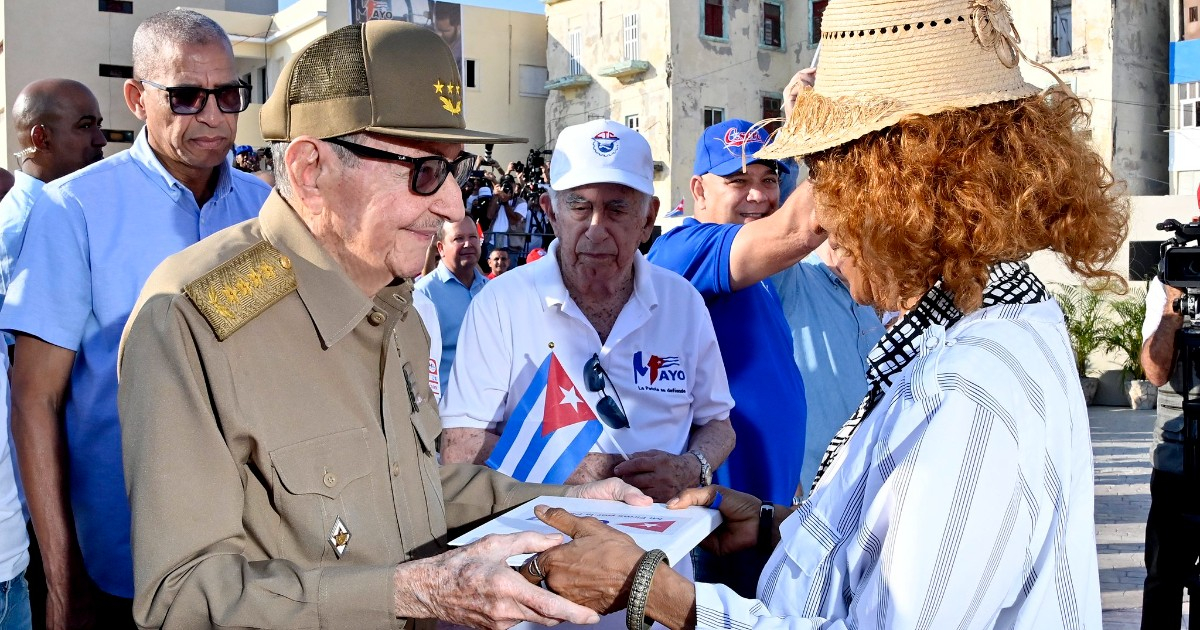
The official narrative of a spontaneous civic initiative was further undermined by a telling detail: the first visible signature in the books delivered on May 1 was that of Raúl Castro himself, followed by Díaz-Canel and other regime leaders.
These books were symbolically handed to Raúl Castro and Díaz-Canel during the May Day event, held in front of the U.S. Embassy on Havana's Malecón, instead of the Plaza de la Revolución, citing "austerity" as the reason.
Warnings of Military Threats
Last Saturday, Díaz-Canel warned delegates from 36 countries about the "imminence of a U.S. military aggression" and invoked the "War of All the People" doctrine, claiming that "every Cuban man and woman has a rifle."
This maneuver has a clear precedent: in 2002, Fidel Castro initiated a campaign to collect over eight million signatures to declare socialism "irrevocable" in the Constitution, as a response to opposition leader Oswaldo Payá's Varela Project, which had gathered over 11,000 signatures demanding democratic reforms.
An Overlooked Crisis
While the regime uses these supposed signatures as a propaganda shield, Cuba is enduring one of its worst crises in recent history. Independent estimates suggest the GDP has contracted by approximately 23% since 2019, several thermoelectric units remain out of service, and power outages can last up to 25 hours in various provinces.
Understanding the Implications of Cuba’s Signature Campaign
What is the "My Signature for the Homeland" campaign?
The "My Signature for the Homeland" campaign is an initiative launched by the Communist Party of Cuba, purportedly gathering signatures to support the Socialist Revolution and Revolutionary Government.
Why are there doubts about the 81% support claim?
Doubts arise because the claimed 81% support is based on a signature campaign that included coercion and pressure, and the demographic base used by the regime is unclear, raising questions about the validity of the results.
How does this campaign relate to past Cuban political strategies?
The campaign mirrors past strategies, such as Fidel Castro's 2002 campaign to cement socialism in the Constitution, which also used signature collection as a political tool against opposition demands for reform.