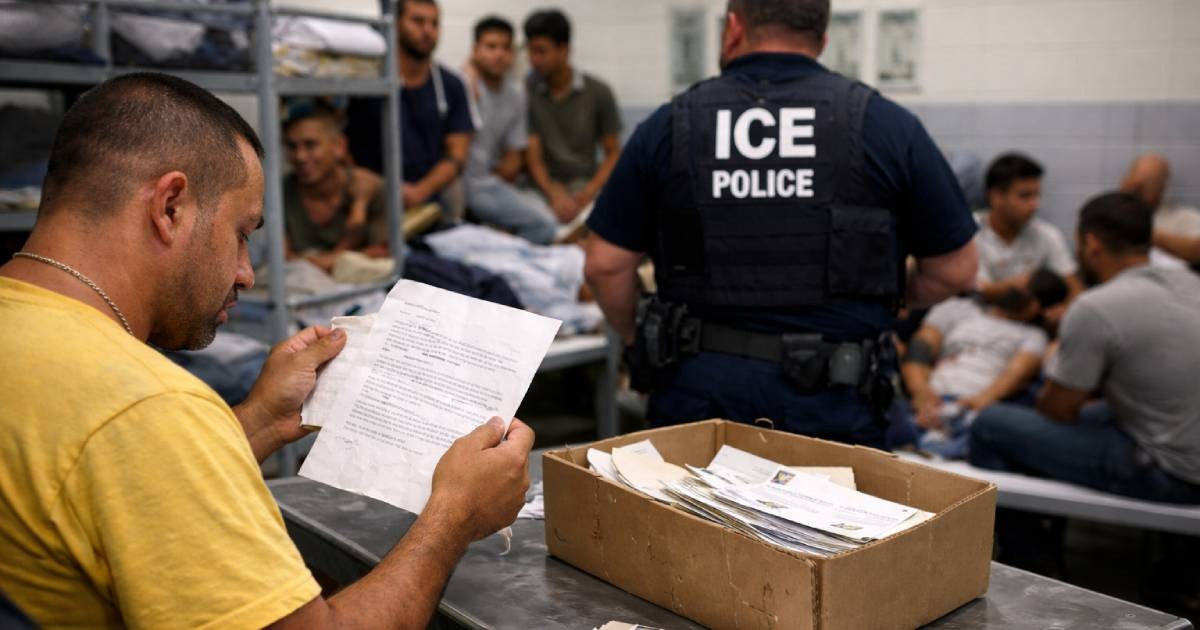
In a significant judicial decision, the United States Court of Appeals for the Eleventh Circuit, covering Florida, Georgia, and Alabama, ruled on Wednesday that migrants detained by ICE are entitled to a bond hearing. This ruling potentially affects tens of thousands of individuals currently in custody.
The court's decision directly challenges the Trump administration's policy, which labeled all migrants entering without authorization as "applicants for admission." This classification effectively denied them the opportunity to request bond, regardless of their length of stay in the country.
Case of Hernández Álvarez v. Warden
The 2-1 ruling stemmed from the case of Hernández Álvarez v. Warden, Federal Detention Center Miami (No. 25-14065). This case was initiated after the detention of two Mexican citizens living in Florida, following routine traffic stops in September of the previous year.
One detainee, Fidencio Hernández Álvarez, is the father of two U.S. citizen children and had no serious criminal record. The other, Ismael Cerro Pérez, has been residing in the U.S. since 2015 and is the father of three U.S. citizen children. Both men were sent to federal detention facilities in Miami and the Krome Processing Center, respectively, without the option to seek bond.
Majority Opinion and Legal Implications
The majority opinion from the court was clear: "Simply put, the language Congress has chosen does not give the Executive Branch unlimited authority to detain—without bond possibility—every non-admitted foreign national present in the country."
The ruling further stated that "nowhere in the text, structure, or history of the INA (Immigration and Nationality Act) is this interpretation firmly grounded."
Judge Barbara Lagoa, appointed by Trump, was the sole dissenter in the panel.
Due to conflicting decisions among circuits, it is anticipated that the legal battle will escalate to the Supreme Court of the United States, which will ultimately decide the constitutionality of mandatory detention without bond.
Backdrop of Controversial Detention Policies
The contested policy was enacted through a memorandum by acting ICE director Todd M. Lyons, dated July 8, 2025. This memo instructed that all migrants entering without inspection be treated as subject to mandatory detention without bond, with releases left solely to the discretion of the Department of Homeland Security.
This policy coincided with a $45 billion budget allocation for ICE, expanding daily detention capacity from 50,000 to 100,000 individuals.
The Eleventh Circuit's decision emerges amidst a sharp divide among federal appellate courts. The Fifth and Eighth Circuits upheld the policy with 2-1 rulings, while the Second Circuit unanimously rejected it on April 28, describing it as "the broadest in the nation’s history for millions of non-citizens."
On the same Wednesday, the Seventh Circuit came to a stalemate on the issue, and the Third Circuit is set for oral arguments the following Monday.
Historic Wave of Legal Challenges
The volume of legal challenges has been unprecedented: over 30,000 habeas corpus petitions were filed in federal courts by migrants unable to request bond in immigration proceedings. About 420 district judges rejected the government's stance; only 47 supported it.
Arrests of migrants without criminal records surged by 770% during the Trump administration, as of April 2026, according to available data.
Understanding the Eleventh Circuit Court Decision
What did the Eleventh Circuit Court rule regarding ICE detainees?
The court ruled that migrants in ICE custody are entitled to a bond hearing, challenging the policy that denied bond requests to those entering without authorization.
Why is the ruling significant for migrants in detention?
This ruling could potentially allow tens of thousands of detainees the chance to seek release on bond, reversing a policy that kept them detained indefinitely without this opportunity.
How does this decision affect the current legal landscape?
The decision highlights a significant split among federal appellate courts, increasing the likelihood that the issue will be resolved by the Supreme Court.