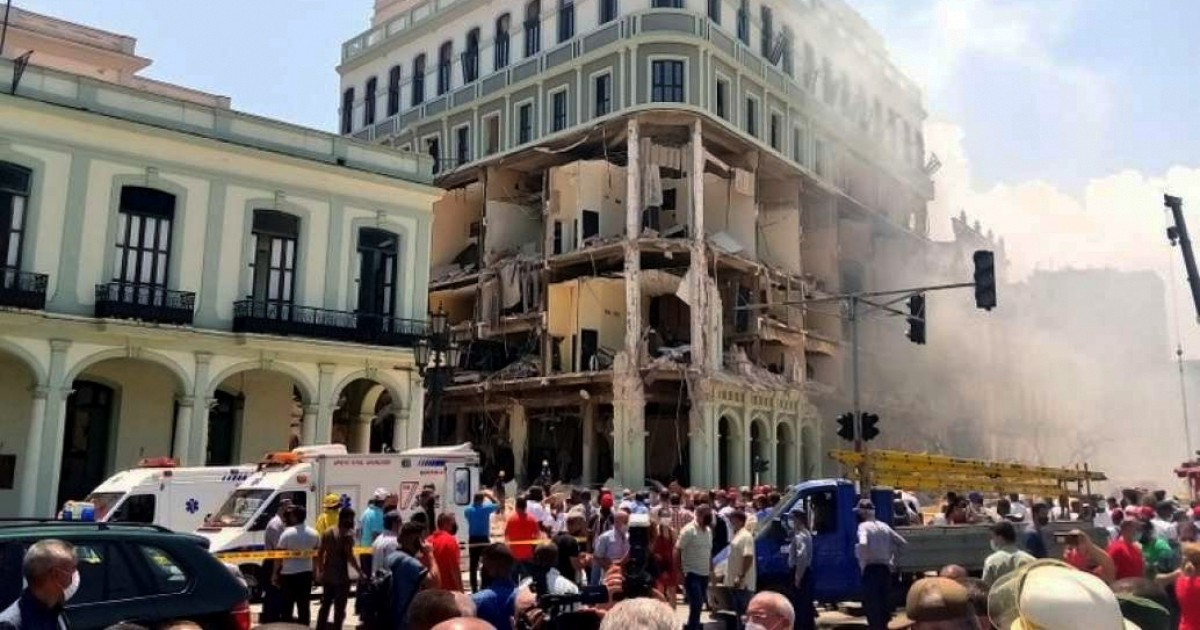
This Wednesday marks the fourth anniversary of the explosion that partially destroyed the Saratoga Hotel in Havana, a tragedy that resulted in at least 47 deaths, over 99 injuries, and the displacement of numerous families. The Cuban regime has yet to provide a public account of the investigation.
On May 6, 2022, at 10:50 a.m., a tanker truck delivering liquefied gas to the hotel—closed since 2020 due to the pandemic and under renovation—triggered an explosion that collapsed the building's facade and severely damaged nearby structures. Cuban authorities blamed a "gas leak" but never released a comprehensive official report or a formal list of those held accountable.
Among the 47 who perished were four minors, a pregnant woman, and 23 hotel employees. The explosion impacted the homes of 95 Cubans, with 38 properties suffering direct damage, and 22 families from the adjacent Prado 609 building were relocated to the Pan American Village.
One of the foreign casualties was Spanish tourist Cristina López-Cerón Ugarte, 29, from Viveiro (Lugo), who was caught by the blast while walking past the hotel. Her boyfriend, César Román Santalla, was seriously injured and underwent surgery at Calixto García Hospital. Spain's Ministry of Foreign Affairs confirmed Cristina's death the following day, and President Pedro Sánchez publicly expressed his condolences. Spain placed a floral offering outside the hotel days later as a sign of mourning.
Four years later, the regime's response is one of impunity. Cuban media reported in 2023—without public judicial details or official confirmation—that some officials might have been sanctioned for their role in the disaster, yet there was no public trial, transparent sentencing, or formal accountability to the families. No economic compensation mechanism is known for the bereaved, the injured, or the displaced residents.
In contrast, independent media reports highlighted that Adel de la Torre Hernández, a young rescuer and volunteer who assisted after the explosion, was sentenced to seven years in prison, not for the accident but for allegedly participating in the July 11, 2021 protests.
Institutional neglect has been documented. In April 2024, nearly two years post-tragedy, a mother reported her son's body had yet to be properly identified, preventing her from carrying out mourning procedures.
The Prado 609 building was demolished in May 2023. The government promised in October of that year that rehabilitation was a "priority" and the residents could return by August 2025. However, as of May 2025, construction was only in the foundational phase, leaving families without answers.
Families have written to the Havana Government, the National Assembly of People's Power, and GAESA—the military's business conglomerate that controls most of Cuba's hotel industry. GAESA replied that the case was "not their responsibility," while other entities offered no formal response. Many displaced residents have emigrated due to the lack of solutions.
Meanwhile, the new Saratoga Hotel's reconstruction progresses without public clarification on the project's funding or conditions, in a nation where institutional opacity turns every tragedy into a state affair without acknowledged victims or named culprits.
Four years after the explosion, the list of Saratoga victims remains the sole visible record of a catastrophe that the Cuban regime seems intent on burying alongside its deceased.
Key Questions About the Saratoga Explosion
What caused the Saratoga Hotel explosion?
The explosion was caused by a gas leak from a tanker truck delivering liquefied gas to the hotel.
How many people were affected by the Saratoga Hotel explosion?
The explosion resulted in at least 47 deaths, over 99 injuries, and the displacement of numerous families.
Has anyone been held accountable for the Saratoga Hotel explosion?
There has been no public trial or transparent sentencing. Some reports suggest that certain officials were sanctioned, but details remain unclear.