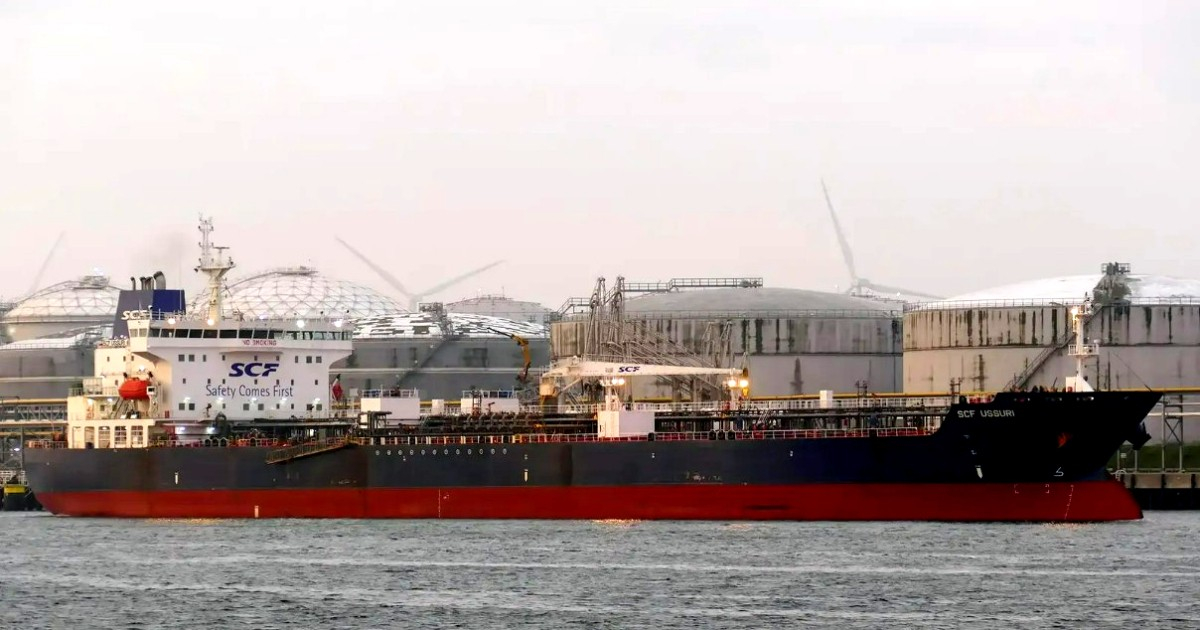
The Russian oil tanker Universal, targeted by sanctions from the United States, European Union, and United Kingdom, has been adrift in the Atlantic Ocean since mid-April. It remains stalled approximately 1,000 miles from Cuba's shores, carrying nearly 270,000 barrels of diesel, according to tracking data from Bloomberg.
Managed by Russian state-owned shipping company Sovcomflot, the vessel embarked from a Baltic Sea port in early April. On April 9, it navigated through the English Channel under the escort of a Russian frigate. The Universal was scheduled to reach Cuba by the end of April. However, it abruptly halted its voyage and failed to declare its destination through automatic identification systems.
Erratic Voyage Raises Questions
Beginning April 14, maritime tracking platforms indicated the Universal was about 15 days away from Cuba. From that point, the ship's movements became unpredictable.
On April 27, the tanker was moving northwest at a speed of 3.4 knots, straying from a direct path to the Caribbean and positioned 1,972 miles from Havana. Two days on, the Universal adjusted slightly to a west-southwest direction at just 2.2 knots, yet still without a declared destination.
Increasing Tensions and Regulatory Hurdles
The uncertainty surrounding the Universal's arrival is part of a familiar pattern. Several vessels have diverted courses away from Cuba, concerned about potential interception by U.S. naval forces. The latest precedent is the Sea Horse, which in March 2026 rerouted its Russian diesel cargo to Venezuela and Trinidad and Tobago, bypassing Cuba entirely.
Regulatory constraints further complicate any attempts at delivery. The OFAC General License 134A, issued on March 19, 2026, explicitly prohibits transactions with Russian oil under U.S. jurisdiction involving Cuba. Adding to the pressure, on May 1, Trump signed a new executive order intensifying sanctions against the Cuban regime, freezing assets tied to sectors like energy and defense.
Cuba's Dire Energy Crisis
In 2026, the only ship to successfully deliver oil to Cuba was the Anatoly Kolodkin, which reached the port of Matanzas on March 31 with 730,000 barrels of crude. This shipment, permitted temporarily by the Trump administration for humanitarian reasons, sufficed for only seven to ten days of consumption.
While the Universal remains stationary, Cuba faces its most severe energy crisis in decades. The island requires between 90,000 and 110,000 barrels daily but produces only about 40,000. As of May 2, the electrical shortfall surpassed 1,415 MW, leading to blackouts lasting up to 24 hours in eastern provinces like Granma and Holguín.
Cuban Energy Minister Vicente de la O Levy acknowledged on April 22 that the Kolodkin's reserves would deplete before month's end and stated that Cuba needs eight similar ships each month. Days later, Díaz-Canel warned that the Russian oil supply was dwindling without a replacement in sight.
In a partial response, Cuba's state oil company announced on Tuesday the replacement of equipment in two of its largest wells to boost production by 30%. However, experts warn that Cuba would need between $8 billion and $10 billion in investment to structurally overcome the crisis.
Russian Energy Minister Serguéi Tsiviliov had assured in April that Moscow would not leave the Cubans "in a bind." Nonetheless, Russian oil production experienced its most significant decline in six years that same month, casting doubt on Russia's ability to sustain these shipments.
FAQs about the Russian Oil Tanker Universal and Cuba's Energy Crisis
Why is the Russian tanker Universal adrift?
The Universal has been adrift due to sanctions and geopolitical tensions that have left its destination uncertain, compounded by regulatory restrictions and the risk of interception by U.S. forces.
What impact does the energy crisis have on Cuba?
Cuba's energy crisis has resulted in significant electricity shortages, with daily requirements far exceeding production capabilities, leading to prolonged blackouts and economic challenges.
How is the Cuban government addressing the energy shortage?
The Cuban government has announced measures to boost domestic oil production, such as upgrading equipment in major wells, though substantial foreign investment is needed for a long-term solution.