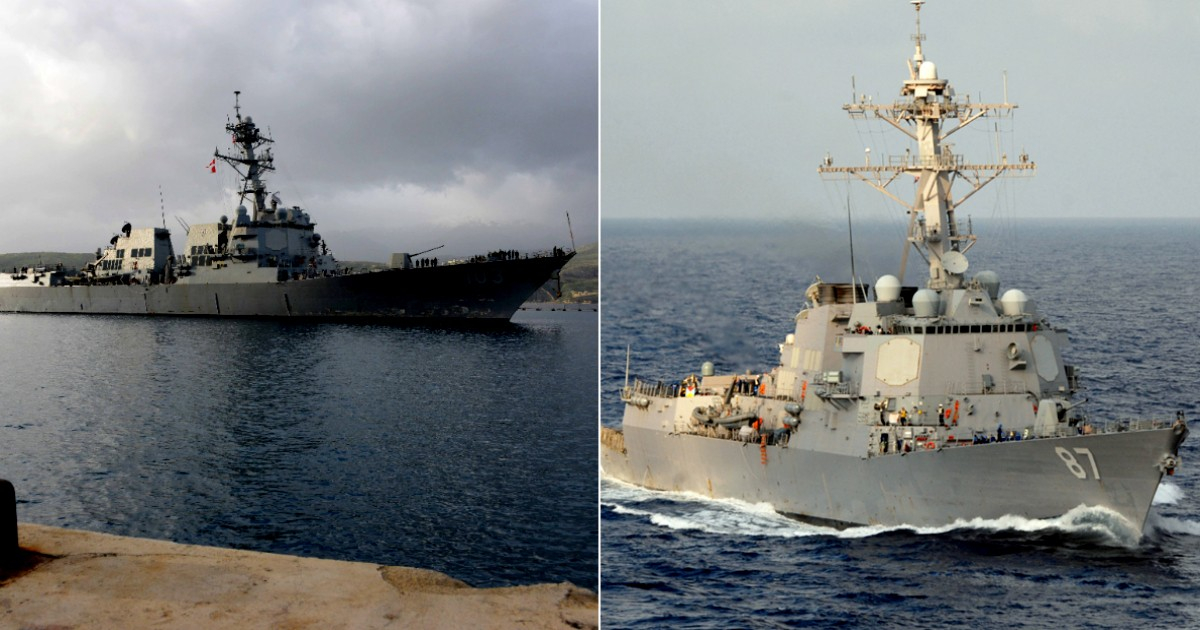
The USS Truxtun and USS Mason, both United States Navy destroyers, successfully navigated the Strait of Hormuz and entered the Persian Gulf unscathed, despite facing a coordinated Iranian assault involving missiles, drones, and small boats, according to defense officials cited by CBS News.
Iran unleashed what officials described as a "sustained barrage" against the two warships and accompanying commercial vessels, yet no projectile hit its mark.
Enhanced defensive measures, supported by Apache helicopters and other aircraft, either intercepted or deterred every incoming threat, confirmed U.S. military sources.
Admiral Brad Cooper, commander of U.S. Central Command (CENTCOM), verified that Iran initiated an attack on the naval and commercial vessels crossing the strait, prompting the U.S. to destroy six Iranian Revolutionary Guard speedboats attempting to disrupt their passage.
Iran refuted the destruction of its vessels, characterizing their actions as "warning shots" to reinforce their control over the strait.
This transit occurred within the framework of Project Freedom, launched by President Trump on Sunday to escort hundreds of merchant ships stranded in the Persian Gulf since the strait's closure.
CENTCOM labeled the operation as "inherently defensive," noting that two American-flagged commercial ships also successfully navigated the strait that same day.
On the same Monday, Iran fired missiles and drones at the United Arab Emirates and targeted an empty ADNOC state-owned oil tanker attempting to cross the strait, causing no injuries.
Iranian media claimed a U.S. warship was struck by missiles, a claim CENTCOM categorically denied.
Ebrahim Azizi, head of Iran's National Security Commission, warned that "any U.S. interference in the new maritime regime of the Strait of Hormuz will be considered a violation of the ceasefire."
The ceasefire, brokered by Pakistan and effective since April 8, has been marred by multiple incidents, including attacks on European ships and the downing of a U.S. drone.
The Strait of Hormuz is a crucial artery for global commerce, with 25% of the world's seaborne oil passing through it.
Since Iran closed it on March 4 with mines, drones, and missiles, the price of Brent crude skyrocketed from $67 to over $126 per barrel, leaving around 2,000 ships and 20,000 sailors stranded in the gulf.
Amid rising military tensions, diplomatic negotiations persist: Iran submitted a 14-point peace plan to the United States on May 1, structured in three phases, including the gradual reopening of the strait and deactivation of mines, while excluding the missile issue.
On May 2, Trump stated that "many of the 15 points were already agreed upon," as the U.S. maintains a naval blockade over Iranian ports, which Tehran deems a violation of the ceasefire.
Key Questions About the Hormuz Strait Conflict
What measures did the U.S. take to protect its ships in the Strait of Hormuz?
The U.S. employed enhanced defensive strategies, including Apache helicopters and other aircraft, to intercept or deter incoming threats, ensuring the safe passage of its ships.
How has the closure of the Strait of Hormuz affected global oil prices?
Since the closure on March 4, the price of Brent crude oil has soared from $67 to over $126 per barrel due to the disruption of a critical oil transit route.
What is the significance of the Strait of Hormuz in global trade?
The Strait of Hormuz is a vital chokepoint for global commerce, with approximately 25% of the world's oil traded by sea passing through it.