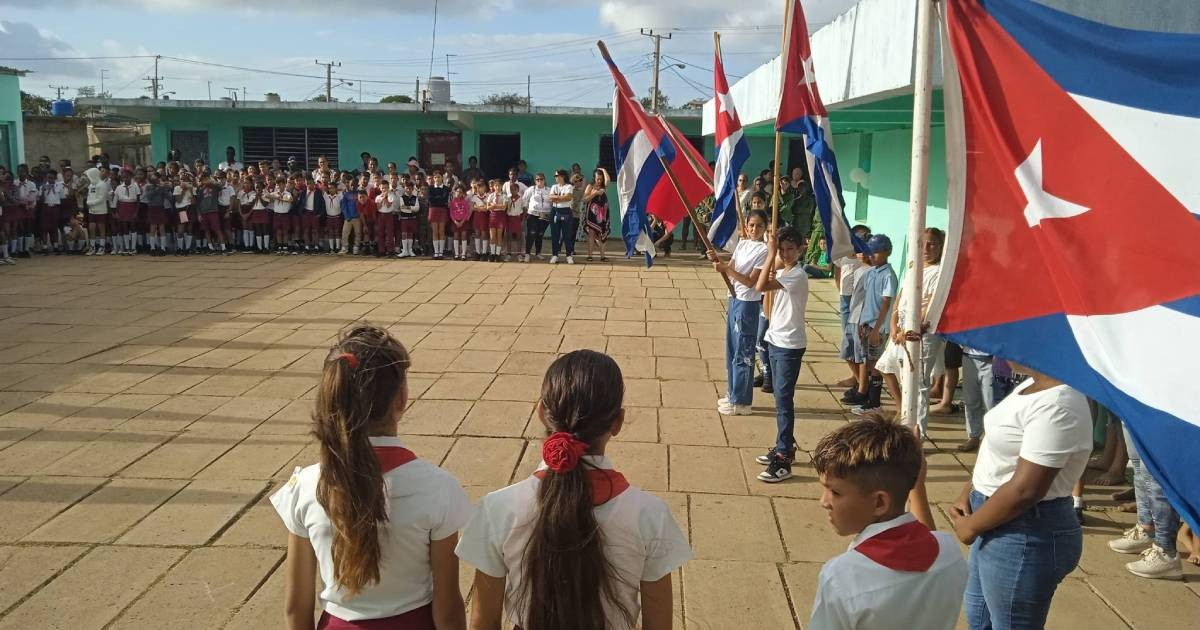
The Municipal Education Directorate of Cárdenas, located in the Matanzas province, issued an official statement on Facebook this Tuesday to refute circulating rumors among students, families, and the community about an early conclusion to the 2025-2026 academic year.
The announcement was clear: "The school year will conclude in July, as outlined in the academic calendar. There will be no advancement or extension beyond what has been planned."
Educational authorities in Cárdenas acknowledged that the year has faced numerous challenges, but they emphasized that the educational process remained uninterrupted: "Despite the constraints, education continued."
The statement also encouraged the teaching staff to end the year on a high note: "We urge the entire teaching faculty to close the year with quality, responsibility, and dedication."
Authorities assured the community that they would be informed of any future changes: "Should there be any other modifications, we will communicate through various channels."
This announcement comes amid a severe educational crisis affecting Matanzas since the beginning of the school year. The province began in September 2025 with a shortage of over 2,000 teachers, covering only 68% of the pedagogical needs for more than 98,000 students across over 500 schools.
In addition to these shortages, a severe fuel crisis since January 2026 paralyzed school transportation, necessitating a reorganization of final assessments for over 90,000 students in 504 educational facilities in Matanzas.
In elementary grades, the second and fourth grades eliminated verification tests, while the fifth and sixth grades replaced final exams with practical work or systematic evaluations.
The situation is not unique to Matanzas. In Pinar del Río, final exams in primary schools were suspended due to the energy crisis, and in Sancti Spíritus, students from the EIDE had to find their own transportation due to the halt in public transport.
Nationally, the Ministry of Education began the 2025-2026 academic year with a deficit of approximately 24,000 teachers, representing 12.5% of the required positions, driven by mass emigration and salaries ranging from four thousand to 9,400 Cuban pesos per month—equivalent to eight to twenty dollars at the informal exchange rate.
Despite the widespread collapse, the regime requested schools to continue the academic calendar with flexible measures such as attending classes without uniforms, adjusting schedules, and semi-presential modes.
It is within this context of uncertainty—with constant changes in evaluations, class suspensions, and halted transportation—that the rumors of a potential early end to the school year in Cárdenas emerged, prompting municipal authorities to publicly debunk them. The statement concludes with a promise that if any changes to the calendar occur, the community will be informed "through various channels."
Key Questions About the Education Crisis in Matanzas
Why did the rumors of an early end to the school year in Cárdenas arise?
The rumors emerged in the context of uncertainty due to constant changes in evaluations, class suspensions, and halted transportation, prompting authorities to publicly refute them.
How has the teacher shortage impacted Matanzas?
The teacher shortage has resulted in only 68% of pedagogical needs being met, affecting over 98,000 students across more than 500 schools in the province.
What measures have been taken to continue the academic year amid the crisis?
Schools have adopted flexible measures such as allowing classes without uniforms, adjusting schedules, and implementing semi-presential modes to continue the academic year.