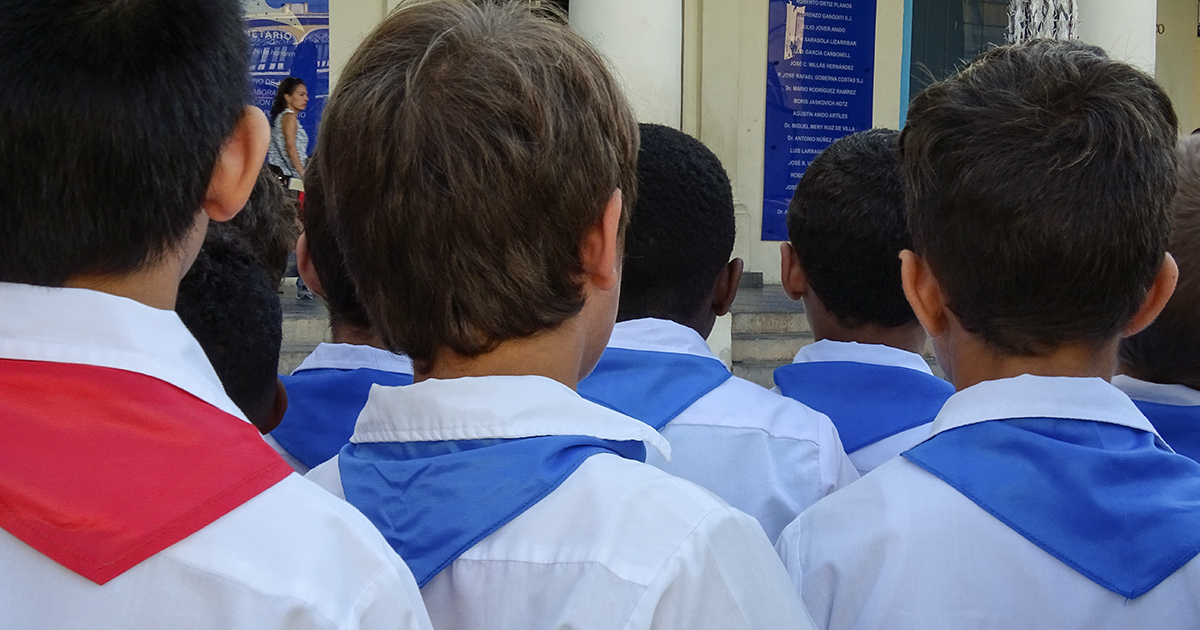
The Provincial Education Directorate in Pinar del Río has decided to eliminate final exams and assessment exercises for all elementary grades in the 2025-2026 school year. This decision is being framed as an adaptation to the "reality of each territory" and a way to better utilize the available time.
The announcement, signed by Claribel Rivera Leal, head of the Primary Education Department in the province, was published by Guerrillero, the official local newspaper. The report notably omits any mention of prolonged blackouts or shortages of fuel and transportation as direct causes of this decision.
According to the statement, students in the first through fourth grades will be evaluated solely through their daily work, using systematic assessments, without the need for a final exam or assessment exercise.
Alternative Evaluation Methods for Upper Grades
For fifth and sixth graders, the final exam will also be replaced with practical projects and partial assessments tailored to each subject. The final grade will be calculated by averaging the three terms of the school year, described in the statement as "a fair and simple calculation."
The official text implicitly acknowledges the challenging conditions by stating that if only one class session can be held on a certain day, it will be reported transparently to find solutions collectively.
Grim Reality Amid Euphemistic Language
The euphemistic language of the announcement contrasts sharply with the severity of the situation facing schools in Pinar del Río. Just days earlier, the energy crisis led to the cancellation of entrance exams at the IPVCE Federico Engels in Pinar del Río, replaced by a ranking based on academic records.
Evelio Herrera Padrón, the provincial director of education, described the situation as "complex" and acknowledged that the lack of transportation and electricity is overwhelming the system.
At the IPVCE Mártires de Humboldt 7, also in Pinar del Río, fuel is being reserved for staff, and students' passes have been extended to 21 days, according to reports this past Sunday.
Nationwide Educational Crisis
The educational crisis is not limited to Pinar del Río. On March 5, the authorities in Havana suspended classes in all educational institutions due to a nationwide blackout. In March 2025, Cuban children returned to schools without bread, hygiene, or electricity, while parents in Matanzas and Santiago de Cuba refused to send their children to classes.
Nationally, the teaching deficit exceeded 24,000 positions in the 2024-2025 school year and continues into the current year, with thousands of vacancies across several provinces.
The start of the 2025-2026 school year has been marked by power outages and shortages, with only 2.2 of 3.6 million uniforms produced.
Rivera Leal concluded her statement with a phrase that encapsulates the official narrative amid the system's collapse: "Even if things are lacking, what never lacks is the creativity and commitment of the teachers."
Understanding the Educational Challenges in Cuba
Why were final exams canceled in Pinar del Río's primary schools?
Final exams were canceled to better adapt to the challenging realities of each territory and to make more effective use of the limited available time.
What alternative methods are being used for student evaluation?
For grades one to four, evaluations will be based on daily work and systematic assessments. For grades five and six, practical projects and subject-specific partial assessments will replace final exams.
What broader challenges are affecting Cuban schools?
Cuban schools are facing severe challenges, including a nationwide teacher deficit, energy crises, and shortages of essential supplies like uniforms, bread, and hygiene products.