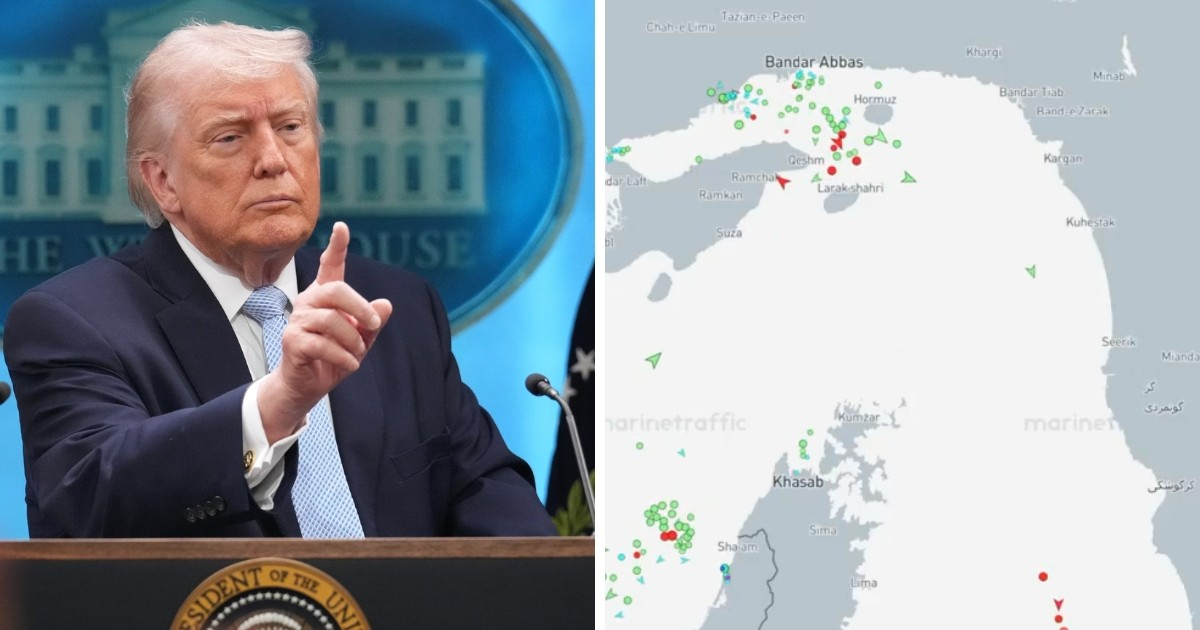
President Donald Trump has launched the "Freedom Project," a humanitarian military operation aimed at escorting foreign vessels trapped in the Strait of Hormuz due to Iran's blockade. This mission involves the deployment of over 100 aircraft, destroyers, drones, and 15,000 troops under the command of the Central Command (CENTCOM).
Trump made the announcement on Sunday via his Truth Social platform, noting that countries worldwide had requested assistance to free their vessels. He described these nations as "innocent bystanders" with no involvement in the conflict with Iran.
As a tangible outcome of the mission, CENTCOM reported on Monday that two U.S.-flagged merchant ships successfully navigated the strait and are proceeding safely, marking what the military command referred to as "an initial step" of the operation.
Trump emphasized, "For the benefit of Iran, the Middle East, and the United States, we have assured these nations that we will guide their ships out of these restricted waterways, allowing them to continue their activities freely."
The president also cautioned that any interference with this humanitarian process "will be dealt with firmly," urging Iran to participate in the operation as a gesture of goodwill.
CENTCOM highlighted that "our support for this defensive mission is vital to regional security and the global economy, while we also maintain the naval blockade" on Iranian ports and vessels, which has been in effect since April 13.
Admiral Brad Cooper, the commander of CENTCOM, reminded that the Strait of Hormuz is a crucial passage for a quarter of the world's maritime oil trade, as well as significant volumes of fuel and fertilizers.
Heightened Tensions and Military Threats
The Freedom Project is being launched amidst increasing tensions. Iran immediately responded with threats: Ebrahim Azizi, head of Iran's National Security Commission, warned that "any U.S. interference in the new maritime regime of the Strait of Hormuz will be considered a ceasefire violation."
General Ali Abdollahi, commander of the Khatam al-Anbiya Unified Command, was more direct: "Any foreign armed forces, especially the aggressive U.S. military, will be targeted if they attempt to approach or enter the Strait of Hormuz."
Tensions have further escalated due to two attacks within 24 hours in the region: a bulk carrier was attacked by small boats off the southwest coast of Iran on Sunday, and hours later, an unidentified-flagged tanker was struck by an unknown projectile 78 nautical miles north of Fujairah, United Arab Emirates, with no injuries reported in either incident.
Impact of Iran's Blockade and Ongoing Peace Talks
The Iranian blockade of the strait, imposed on March 4 in retaliation for the U.S. and Israel's Operation Epic Fury, has stranded approximately 2,000 ships with 20,000 sailors, causing Brent crude prices to soar from $67 to over $126 per barrel.
Amidst the military operation, peace negotiations remain stalled. Iran is reviewing Washington's formal response to its 14-point peace plan sent via Pakistan, which suggests a 15-year halt in uranium enrichment, while the U.S. demands a complete dismantling of the nuclear program and a 20-year moratorium.
The ultimate reopening of the Strait of Hormuz remains a pivotal element in the negotiations, and Iran's response to the U.S. peace plan could determine whether the Freedom Project becomes a diplomatic bridge or a new flashpoint between the two powers.
Understanding the Freedom Project's Impact
What is the main objective of the Freedom Project?
The Freedom Project aims to escort and free foreign vessels trapped in the Strait of Hormuz due to Iran's blockade, ensuring their safe passage and maintaining global trade routes.
How has Iran responded to the Freedom Project?
Iran has responded with threats, warning that any U.S. interference in the Strait of Hormuz will be seen as a violation of the ceasefire, and indicating potential military action against foreign forces.
Why is the Strait of Hormuz important?
The Strait of Hormuz is a critical maritime passage, handling a quarter of the world's oil trade and significant amounts of fuel and fertilizers, making it vital for global economic stability.