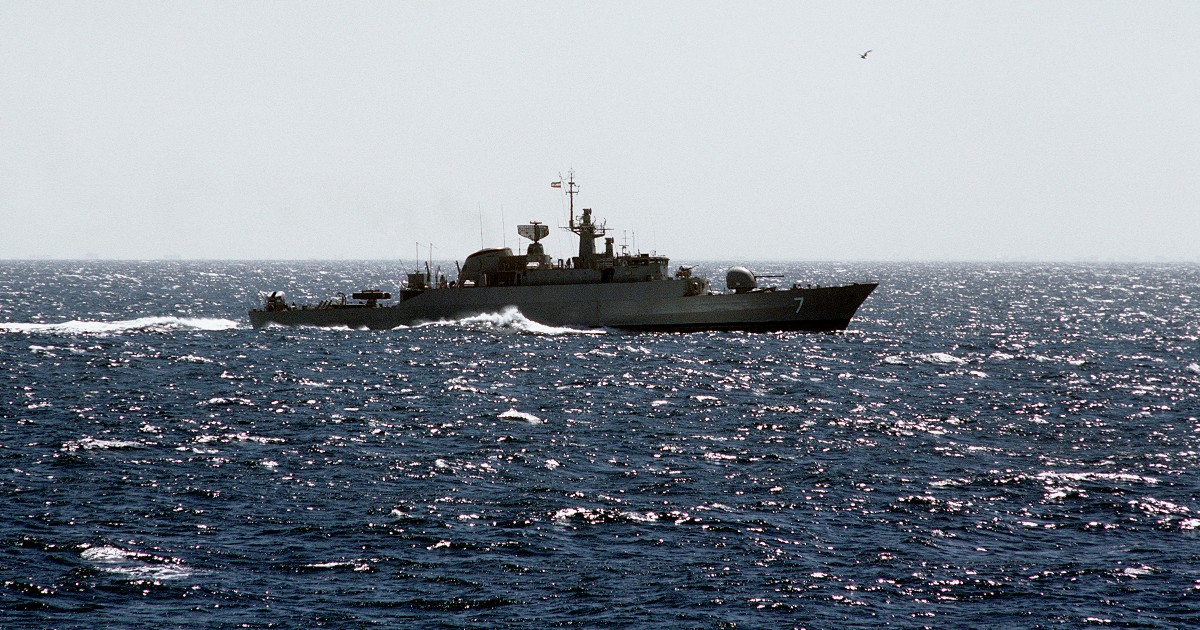
The Iranian Armed Forces announced on Monday their successful prevention of access by U.S. and Israeli destroyers to the Strait of Hormuz. This was achieved through what they described as a "swift and decisive warning" by their Naval Force, an escalation that has not been confirmed by Washington and comes shortly after the U.S. military launched its "Operation Liberty."
"Through a swift and decisive warning from the Army's Naval Force, we prevented U.S.-Zionist enemy destroyers from entering the Strait of Hormuz," stated a release from the Iranian Army's public relations, as reported by the Tasnim news agency, which is linked to the Revolutionary Guard.
At the same time, the Revolutionary Guard released a map outlining the areas of the strait under Iranian control: to the east, a line stretches from Mount Mubarak in Iran to the city of Fujairah in the United Arab Emirates; to the west, from Iran's Qeshm Island to the UAE city of Umm al Quwain.
Major General Ali Abdolahi, commander of the Khatam al-Anbiya Unified Operations Command, further intensified the threats: "We warn that any foreign armed force, particularly the aggressive U.S. military, will be targeted if they attempt to approach or enter the Strait of Hormuz."
Abdolahi also urged commercial and oil vessels to coordinate with Iranian forces before transiting the area, cautioning that failure to do so could compromise their security.
Tensions soared a day after President Donald Trump announced "Operation Liberty," a mission deploying over 100 aircraft, destroyers, drones, and 15,000 troops to escort approximately 900 merchant ships with some 20,000 crew members stranded in the strait since the conflict began. Trump justified the mission as a humanitarian gesture following requests from "countries around the world."
The head of Iran's National Security Commission, Ebrahim Azizi, warned that "any U.S. interference in the new maritime regime of the Strait of Hormuz will be considered a ceasefire violation," adding that "the Strait of Hormuz and the Persian Gulf will not be governed by Trump's delusional statements."
The conflict traces back to "Operation Epic Fury," the joint U.S.-Israeli air offensive launched on February 28, 2026, which destroyed Iran's key nuclear facilities and eliminated Supreme Leader Ali Khamenei along with 49 top military officials.
In retaliation, Iran blocked the Strait of Hormuz—through which 20% of the world's oil passes—causing Brent crude prices to skyrocket from $67 to over $126 per barrel. A fragile ceasefire was established on April 8, but diplomatic talks in Islamabad collapsed after 21 hours without resolution, led by Vice President JD Vance.
Last Friday, Iran submitted a 14-point peace plan in three phases to the U.S. via Pakistani mediators, proposing the gradual reopening of Hormuz and assurances of non-aggression. Washington has responded, but Tehran is still assessing the counterproposal, according to Foreign Ministry spokesman Ismail Bagaei.
Concurrently, Iran is negotiating with Oman to create a safe transit mechanism and has proposed a toll system for the strait, which Muscat has publicly rejected, arguing that Hormuz is a natural passageway rather than an artificial canal like Suez or Panama.
Abdolahi warned that U.S. actions to "alter the current situation will only further complicate matters and endanger the security of vessels in the area," as "Operation Liberty" commenced on Monday without either side showing signs of backing down.
Key Issues in the Strait of Hormuz Conflict
What is the significance of the Strait of Hormuz?
The Strait of Hormuz is a strategically crucial waterway, with about 20% of the world's petroleum passing through it. Control over the strait can significantly impact global oil prices and international maritime traffic.
How did the conflict with Iran escalate?
The conflict escalated following "Operation Epic Fury," a joint U.S.-Israeli offensive in 2026 that targeted Iran's nuclear facilities and resulted in the death of key Iranian leaders, prompting Iran to block the Strait of Hormuz in retaliation.
What is "Operation Liberty"?
"Operation Liberty" is a U.S. military mission involving a large deployment of aircraft, drones, destroyers, and troops aimed at ensuring the safety of merchant vessels stranded in the Strait of Hormuz due to the ongoing conflict.