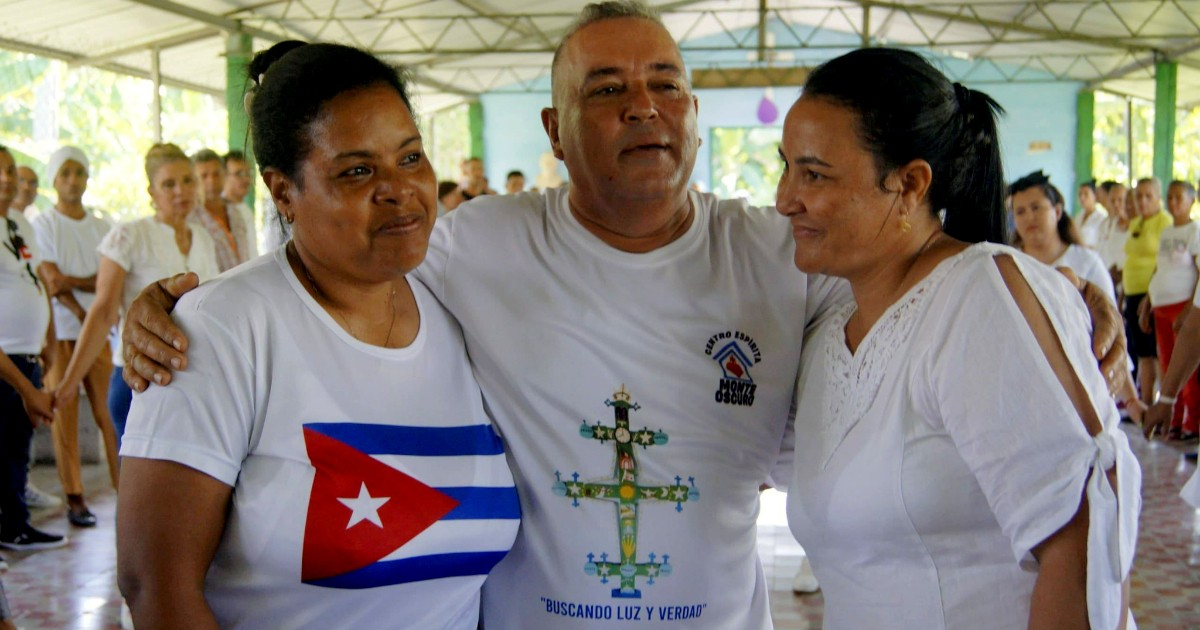
Yudelkis Ortiz Barceló, the leading figure of the Communist Party in Granma, alongside Yanetsy Terry Gutiérrez, the province's governor, visited the "Seeking Light and Truth" Spiritual Center in Monte Oscuro, Bayamo this past Monday. Their mission was to declare the alignment of Cuban spiritualist communities with the regime amidst rising tensions with the United States.
Abel Prieto, a cultural advisor to the Cuban presidency and former Minister of Culture, shared a photograph from the visit on Facebook, stating, "I am certain that Cuban spiritualists stand united in defense of peace, sovereignty, and our socialism."
Ortiz Barceló also took to Facebook, posting images of the gathering with the slogan "Peace for Cuba!!!" and the hashtag #WithTheStrengthOfUnity. She emphasized that "regardless of beliefs, we are united by the thought and desire for love, peace for our country, and a rejection of war."
Mobilization Amid Growing Tensions
This visit comes as part of a broader campaign of total mobilization by the regime. Last Sunday, leader Miguel Díaz-Canel warned of the "imminence of a military aggression" from the United States. He invoked the doctrine of "War of All the People" and declared that "every Cuban has a rifle."
Recently, the regime showcased the delivery of an alleged 6.2 million signatures from the "My Signature for the Homeland" campaign to Raúl Castro and Díaz-Canel, an operation that critics denounced as propaganda involving coerced participation.
The Ideological Contradiction
The use of spiritualism presents a deep-seated ideological contradiction. The official doctrine of the Communist Party of Cuba, Marxism-Leninism, views religion as the "opium of the people." The regime upheld state atheism for decades, discriminating against believers until the PCC's IV Congress in 1991.
This is not the first time Prieto has led such initiatives. In August 2025, he visited the Quisicuaba Project to celebrate the "patriotism and loyalty to the revolution" of Cuban spiritualists. This project pledged to "save the revolution and socialism" through spiritualist practices.
A History of Propaganda
The spiritual center, founded by Salustiano Olivera Sánchez and boasting 115 years of history, practices a syncretic form of spiritualism from the Cauto Valley. This tradition blends Kardecist, African, and Creole elements, deeply rooted in Eastern Cuba.
The participation of Ortiz Barceló and Terry Gutiérrez is especially notable due to their documented past. Both have been known for showcasing forced retractions of citizens on social media. In November 2025, they displayed an elderly woman, Francisca, who was coerced into thanking the regime after losing her bed in a hurricane. In March 2025, they showed protester Mayelín Carrasco expressing regret for her actions after being detained in Río Cauto.
In May 2025, the PCC head in Granma criticized social media for allowing "freedom to hate" in response to protests in Jiguaní over blackouts, shortages, and lack of water.
The same official who suppressed protests over the crisis now appears in a spiritualist center advocating "love" and "peace." The regime presents this as national unity, yet it follows the same propagandistic logic of rallying all societal sectors under external pressure.
Understanding the Role of Spiritualism in Cuban Politics
Why is the Cuban regime involving spiritualists in political matters?
The Cuban regime is involving spiritualists to create an image of national unity and support across various societal elements, especially amid increasing tensions with the United States.
How does Marxism-Leninism view religion?
Marxism-Leninism traditionally views religion as "the opium of the people," which is why the Cuban regime historically maintained state atheism until the early 1990s.