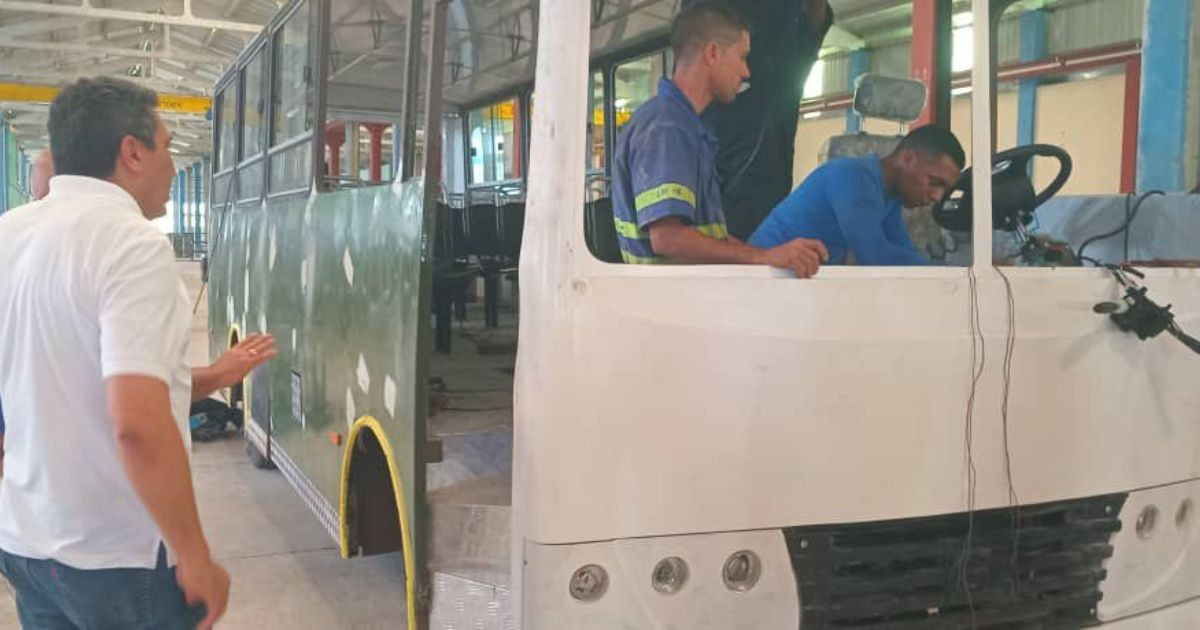
As Cuba grapples with one of its most severe energy crises, the Ministry of Transport's recent announcement about "upgrading" the transportation system in Sancti Spíritus with electric vehicles seems more like a mockery to the Cuban people than a genuine solution.
Minister Eduardo Rodríguez Dávila made a visit to the province to promote projects involving electric transportation, as reported by the Ministry of Transport on social media.
While touring the Francisco Aguiar Rodríguez Military Industrial Company, Rodríguez Dávila expressed interest in the production of a new batch of 40 eco-friendly vehicles intended for passenger transport. This initiative is funded by the Public Transport Development Fund.
Currently, the production line is assembling 15 of these electric vehicles. Additionally, the EMI is working on a prototype combustion bus using an imported chassis, with plans to produce 12 units for transportation services.
Innovations and Challenges in Transportation
Rodríguez Dávila also urged the adaptation of 10 electric tricycles for waste collection in the main city and the development of an electrified Diana bus prototype to assess its technical feasibility.
"We must advance in setting up solar-powered charging stations and continue to modernize transportation means," the minister emphasized during his visit.
He added, "Electric cars offer an alternative not only due to fuel constraints but also in the use of lubricants."
Electricity Deficit and Transportation Woes
The irony is stark: on May 2, Cuba faced an electricity shortfall of 1,415 megawatts, with a generation capacity of merely 1,735 MW against a demand of 3,150 MW, just two days before the ministerial visit.
Out of the country's 16 thermoelectric units, six were out of commission, and the Russian fuel, expected to last until the end of April, was already depleted with no immediate replenishment in sight.
Moreover, Cuba requires eight fuel shipments per month but has only received one since December 2025, as admitted by the Energy Minister.
Sancti Spíritus: A Testbed for Electric Initiatives
The conventional transportation crisis is equally dire: of 558 interprovincial buses, less than 40% are operational, and the government acknowledged in January 2026 that public transportation meets only 42% of its planned targets.
In Ciego de Ávila, only two out of 135 bus routes are functioning, and the province's seven railway routes are stalled due to fuel shortages.
Sancti Spíritus has led the way in this initiative, with the first five eco-friendly vehicles hitting the roads in June 2024, and the nation's first solar-powered charging station inaugurated at the EMI in November 2025 as an experimental infrastructure.
However, this charging network remains minimal and experimental, while blackouts simultaneously affect up to 46% of the island, and transport in Cuba continues to deteriorate without the government's promises translating into real solutions for the populace.
Understanding Cuba's Energy and Transportation Crisis
Why is Cuba facing an energy crisis?
Cuba's energy crisis is primarily due to a significant shortfall in electricity generation capacity against the country's demand, compounded by outdated infrastructure and a lack of fuel resources.
How is the transportation system affected by the energy crisis?
The energy crisis has severely impacted the transportation system, with a majority of interprovincial buses and railway routes out of service due to fuel shortages and operational challenges.