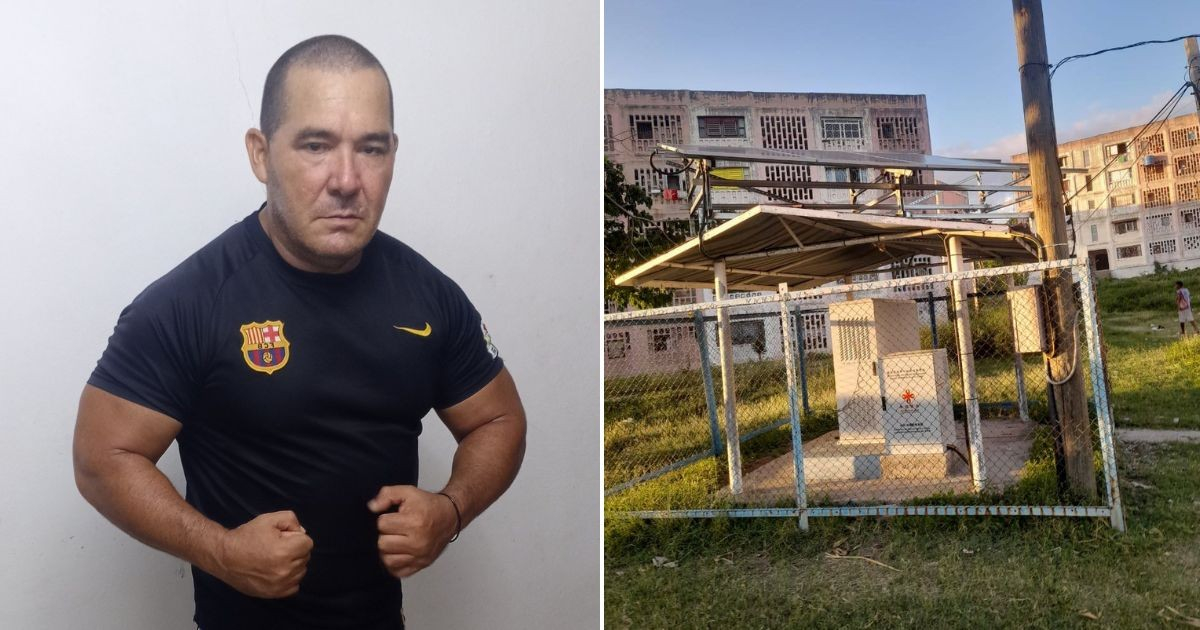
A solar panel was stolen last Friday, coinciding with International Workers' Day, from the Integral Cabinet micro 9-2 in Santiago de Cuba. This act rendered the photovoltaic system, which an ETECSA team had installed to ensure telecommunications during blackouts, completely inoperative. The incident was reported on Facebook by engineer Luis Enrique Torres Almarales.
Torres Almarales, associated with ETECSA in Santiago de Cuba, expressed his outrage on social media, demanding a minimum of 30 years in prison for those responsible, alongside forced labor in marabú field cleaning and planting.
"On May 1st, a solar panel was stolen from the Integral Cabinet micro 9-2, disabling the photovoltaic system our team worked hard to install," the engineer lamented.
The theft interrupted a system capable of providing fixed-telephone and Nauta Home access for over 10 hours at night, serving more than 560 users.
"Enough with the impunity. While some of us work hard, others profit off public resources," Torres Almarales remarked, labeling the event as sabotage against energy solutions during one of Cuba's toughest periods.
The engineer was explicit in his proposed punishment: "There should be a minimum of 30 years for those who attempt to sabotage energy solutions during such difficult times for the country. Let them work cleaning marabú fields and planting them, so they at least pay, and deter others from daring to do the same."
This theft is part of a broader wave of infrastructure thefts plaguing Cuba, particularly in the eastern region, where cable, transformer dielectric oil, and generator fuel thefts have been rampant.
In Santiago de Cuba, on April 11th, a man died and another suffered severe burns while attempting to steal dielectric oil from a transformer in Songo La Maya, highlighting the severity of the situation.
The Cuban regime has responded with harsher penalties. Issued in May 2025, the Supreme People's Court's Decree 475 classifies these acts as sabotage against the national electro-energy system, with penalties ranging from seven to 30 years, life imprisonment, or even the death penalty.
Official presenter Humberto López publicly threatened capital punishment for those who damage or steal components of the national electricity system, as stated on April 11th.
Despite the stricter penalties, all individuals tried for electrical sabotage between January 2025 and the first quarter of 2026 received sentences exceeding 10 years, according to the Supreme People's Court, but thefts persist.
Torres Almarales concluded his post with a direct appeal: "We are in a very complex situation, and they are causing further distress among the people. The loss of values, crime, and theft have gone too far. We must declare an all-out war, zero tolerance, and tough measures are needed. Enough with words; we need concrete actions."
FAQs on Solar Panel Theft in Santiago de Cuba
What was the significance of the stolen solar panel in Santiago de Cuba?
The stolen solar panel was crucial for maintaining telecommunications services during blackouts, impacting over 560 users by providing fixed-telephone and Nauta Home access for more than 10 hours at night.
How has the Cuban government responded to thefts of electrical infrastructure?
The Cuban government has issued Decree 475, classifying these acts as sabotage against the national electro-energy system, with penalties ranging from seven to 30 years, life imprisonment, or even the death penalty.