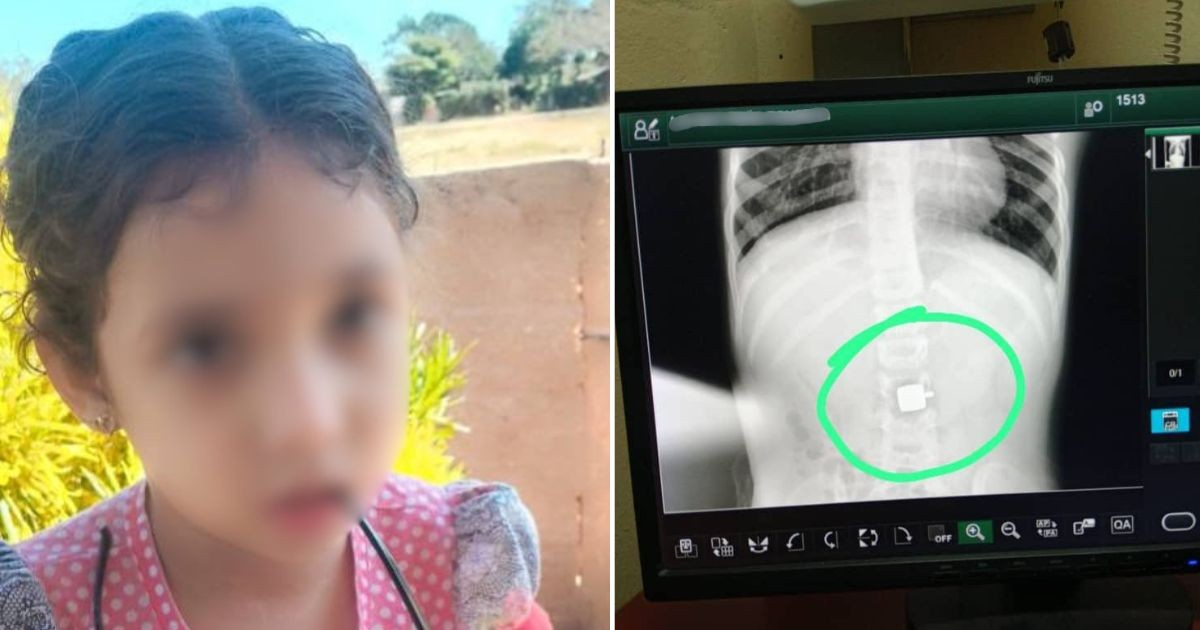
In Matanzas, a young girl named Lisnayi, who has cerebral palsy, experienced a terrifying moment when she accidentally swallowed the pendant from her mother's necklace. This incident was shared by Cuban activist and writer Guillermo Rodríguez Sánchez, who is widely known on social media as Guillermo Rodsan.
According to Rodsan's account, Lisnayi's mother was holding her when the child unexpectedly yanked the chain, causing it to break. Unfortunately, the pendant fell into Lisnayi's mouth, and she swallowed it immediately.
The family quickly rushed her to the emergency room, where X-rays confirmed the presence of the foreign object in her digestive tract. The images clearly depicted a square-shaped item lodged in her abdomen.
Thankfully, surgery was not necessary. Rodsan expressed relief as he described how the pendant naturally passed through Lisnayi's system after a few days: "It just required a couple of days of monitoring until the golden 'nugget' came out."
Safety Precautions for Families with Children with Disabilities
Rodsan used this incident as a warning to other families with children who have cerebral palsy, emphasizing the importance of avoiding jewelry or small items that children might grab. "These children tend to reach for everything within their grasp," he noted, highlighting the risk of accidental ingestion, which can lead to serious medical emergencies.
From a medical standpoint, while 80% of ingested foreign objects pass through a child’s digestive system without issues, the remaining 20% can become lodged in the esophagus, posing a risk of perforation, particularly if the object is metallic.
In Lisnayi's case, the pendant traveled through her system without causing harm.
The Broader Context of Institutional Neglect
Originally from Ciego de Ávila, Lisnayi's family relocated to Matanzas a few months ago. Thanks to the supportive network Rodsan has established online, they received essential appliances and supplies, including a refrigerator, washing machine, rechargeable fan, kitchen equipment, over 250,000 Cuban pesos in food, 100,000 pesos in cash, plus toys and clothing, all of which they brought along when they moved.
Lisnayi's situation is part of a larger issue facing many Cuban families. Children with cerebral palsy often suffer from institutional neglect in Cuba, with chronic medication shortages, limited access to specialized education, and a heavy reliance on community support networks.
Activists like Rodsan have stepped in to fill this void, directing donations to vulnerable families with children with disabilities across the island, in the face of a government that has turned its back on them.
Similar accounts reveal a troubling pattern: Cuban mothers report that the Ministry of Education denies basic services to their children with disabilities, leaving families with children with cerebral palsy to struggle alone against widespread hardship.
Rodsan concluded his post with gratitude, recognizing that this frightening incident, while serious, had the best possible outcome: "A scare that could have been worse, but it was just that—a scare."
Understanding the Risks and Support for Families with Children with Disabilities
What precautions can families take to prevent accidents like Lisnayi's?
Families should avoid allowing children with cerebral palsy to play with or be near small objects or jewelry that could be easily swallowed. It's important to keep such items out of reach to prevent accidental ingestion.
How do activists like Guillermo Rodsan help families in Cuba?
Activists like Guillermo Rodsan provide crucial support by organizing and distributing donations of essential goods, monetary aid, and supplies to vulnerable families with children with disabilities, compensating for the lack of institutional support.
What challenges do families with disabled children face in Cuba?
Families with disabled children in Cuba often encounter obstacles such as medication shortages, limited access to specialized educational facilities, and a lack of government support, forcing them to rely heavily on community networks for assistance.