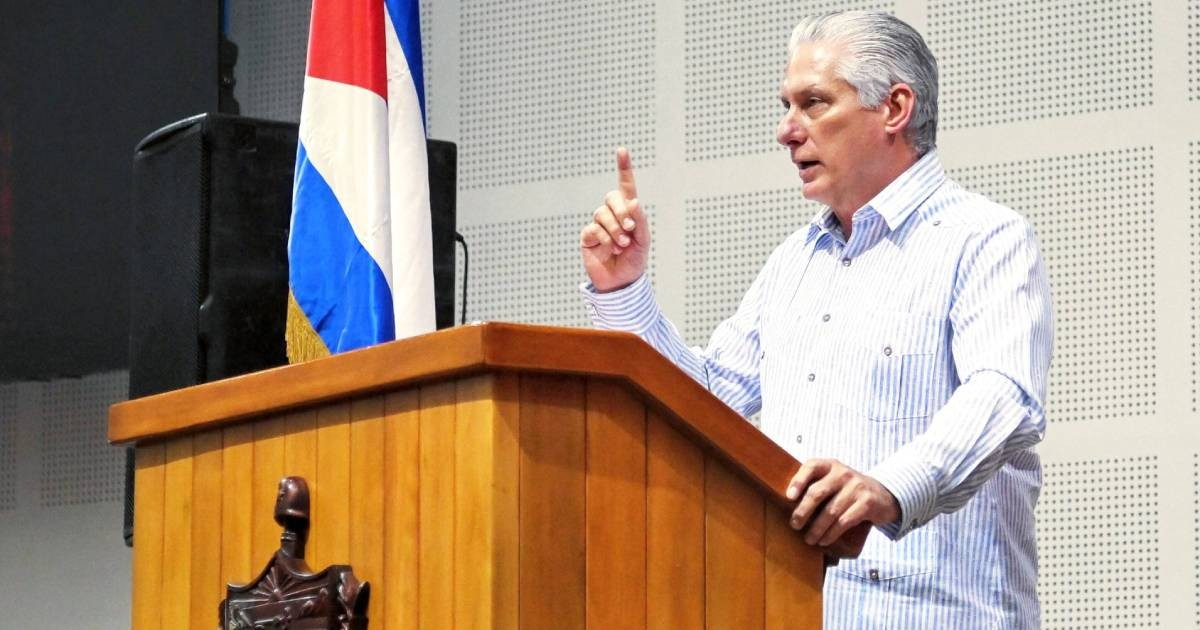
On Saturday, Miguel Díaz-Canel alerted delegates from 36 countries about the looming threat of a United States military strike against Cuba. In his speech at the International Solidarity with Cuba Conference held at the Havana Convention Palace, he invoked the "War of All the People" doctrine, stating that "every Cuban has a rifle" and an assigned defense position.
Díaz-Canel's remarks came a day after Donald Trump signed a new executive order targeting Cuba's dictatorship by expanding immediate sanctions on energy, defense, mining, and financial services sectors. On the same day, Trump declared in Florida that the U.S. would "take Cuba almost immediately" and threatened to position the USS Abraham Lincoln aircraft carrier within 100 yards of Cuban shores.
Díaz-Canel characterized the situation as a "multidimensional aggression," noting that the Cuban regime has been strategizing defense plans for months in anticipation of Trump's return to power.
"There's the immediacy of a military attack, and it's not something we want or desire. Cuba is a nation of peace. Yet, every day, the U.S. government speaks of war and escalates its threatening rhetoric towards Cuba," he stated.
To highlight Cuban resilience, he recalled the 32 Cuban escorts who lost their lives in Venezuela during the U.S. operation that captured Nicolás Maduro on January 3, 2026. According to Díaz-Canel, these fighters resisted elite U.S. forces for over 45 minutes, despite the operation being planned for 100 minutes.
"Imagine what could happen if Cuba faces a military invasion, where the example of those 32 would be multiplied by millions of Cubans," he said.
The leader referred to the "War of All the People" doctrine, developed by Fidel Castro during the Reagan administration's invasion threats when the USSR did not ensure direct military intervention.
"Under this defensive doctrine, every Cuban has a rifle. Every Cuban has a position in defense and a mission to fulfill in defense of the homeland, the revolution, and socialism," he declared.
Díaz-Canel also exposed the severity of the energy crisis: Cuba went four months without fuel until a Russian ship improved the electrical situation for the past 15 days, but warned, "that oil is running out soon, and we don't know when more fuel will arrive in Cuba."
The executive order signed on May 1 adds to Executive Order 14380 from January 29, 2026, which declared Cuba an "unusual and extraordinary threat" and imposed an energy embargo that reduced Cuban oil imports by 80% to 90%, causing power outages of up to 25 hours a day in over 55% of the territory.
The regime also boasted of collecting over 6 million signatures in the "My Signature for the Homeland" campaign, though independent sources questioned both the numbers and actual participation in the May Day parades, citing coercion and forced attendance.
Foreign Minister Bruno Rodríguez Parrilla also intensified the rhetoric by rejecting the sanctions: "The Homeland, the Revolution, and Socialism are defended with ideas and with arms. We will not be intimidated."
Díaz-Canel concluded his address with a direct warning: "We are not afraid of war, and there will be neither surprise nor defeat here," in a speech that is not his first to warn of a potential armed conflict with Washington.
Understanding U.S.-Cuba Tensions
What triggered Díaz-Canel's warning about a U.S. military threat?
Díaz-Canel's warning was triggered by recent actions from the U.S., including a new executive order signed by Donald Trump that expands sanctions against Cuba, as well as Trump's statements about taking immediate action against the island.
How has the energy embargo impacted Cuba?
The energy embargo has severely affected Cuba by drastically reducing oil imports by 80% to 90%, leading to power outages of up to 25 hours a day in more than half of the country.
What is the "War of All the People" doctrine?
The "War of All the People" doctrine is a defensive strategy developed by Fidel Castro during the 1980s to prepare for potential U.S. invasions. It emphasizes that every Cuban citizen is armed and has a designated role in defending the nation.