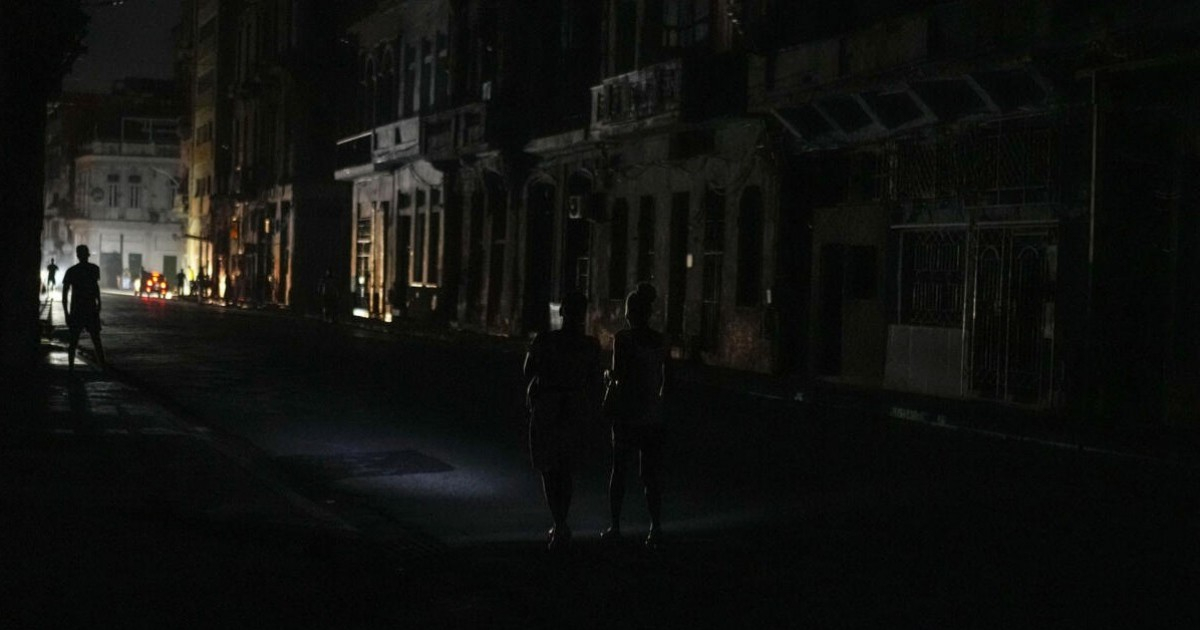
On this Sunday morning, Cuba wakes up to another day plagued by severe power outages.
The National Electric System (SEN) is struggling as per the official report from the Unión Eléctrica (UNE). At 6:00 am, the available capacity was a mere 1,700 MW, while the demand soared to 2,700 MW, causing 989 MW to be out of service at that time.
By midday, it was expected that 800 MW would still be affected.
The situation worsens as the evening approaches: during the peak hours, UNE forecasts an available capacity of 1,760 MW against a demand of 3,200 MW. This results in a staggering deficit of 1,440 MW, leaving nearly half the country without power during the highest consumption hours.
Saturday's scenario was equally grim.
The UNE noted that service disruptions due to capacity deficits persisted throughout the day and night. The maximum outage was recorded at 1,742 MW at 8:30 pm, higher than planned due to unexpected demand and the failure to bring Fuel Moa online.
Havana's Electric Company reported a six-hour and fifteen-minute service interruption in the capital on Saturday, peaking at 325 MW at 8:30 pm. Emergency measures required shutting down circuits amounting to 95 MW, with service not resuming until 4:45 am on Sunday.
The company warns that power cuts can occur unexpectedly, as they depend on SEN's availability. This means outages could return at any moment.
Significant disruptions include malfunctions in two units at the Lidio Ramón Pérez and Antonio Maceo power plants, alongside maintenance work on units at the Mariel, Renté, and Nuevitas stations.
Additionally, 462 MW are offline due to thermal generation constraints. The only planned reinforcement for the evening is the Regla barge, offering a scant 60 MW.
Despite the government's installation of 54 solar parks, contributing 4,708 MWh on Saturday with a peak of 710 MW at noon, their impact drops to zero during high-demand nighttime hours, highlighting the inadequacy of this solution for the structural crisis.
While Havana endures hours-long outages, eastern provinces like Granma and Holguín suffer blackouts lasting up to 24 hours daily.
The fuel shortage exacerbates the collapse. Cuba requires eight oil tankers monthly, but from December 2025 to April, only one arrived, and the Russian tanker Kolodkin's cargo was depleted by the end of that month.
The nation produces a mere 40,000 barrels of oil daily, falling short of the 90,000 to 110,000 needed.
The humanitarian impact is severe: 96,000 Cubans await surgery, including over 11,000 children, and 16,000 cancer patients are deprived of radiotherapy due to the outages.
In response, Foreign Minister Bruno Rodríguez dismissed claims of Cuba being an "ineffective state," blaming the crisis on external "siege."
Meanwhile, UNE's own data reveals a structural deficit fluctuating between 1,400 and 1,945 MW in recent months, with the system collapsing entirely on seven occasions over the last 18 months.
Cuba's Power Outage Crisis: Key Questions and Answers
What is causing the power outages in Cuba?
The power outages are primarily due to a significant deficit in the National Electric System's capacity, compounded by fuel shortages and structural issues within the energy infrastructure.
How are the power outages affecting daily life in Cuba?
The outages are severely impacting daily life, leaving nearly half the population without electricity during peak hours, disrupting healthcare services, and causing delays in critical surgeries and treatments.
What measures are being taken to address the power crisis?
Efforts include maintenance on power plants and the addition of limited capacity from a barge, but these are insufficient to resolve the underlying structural and supply issues.