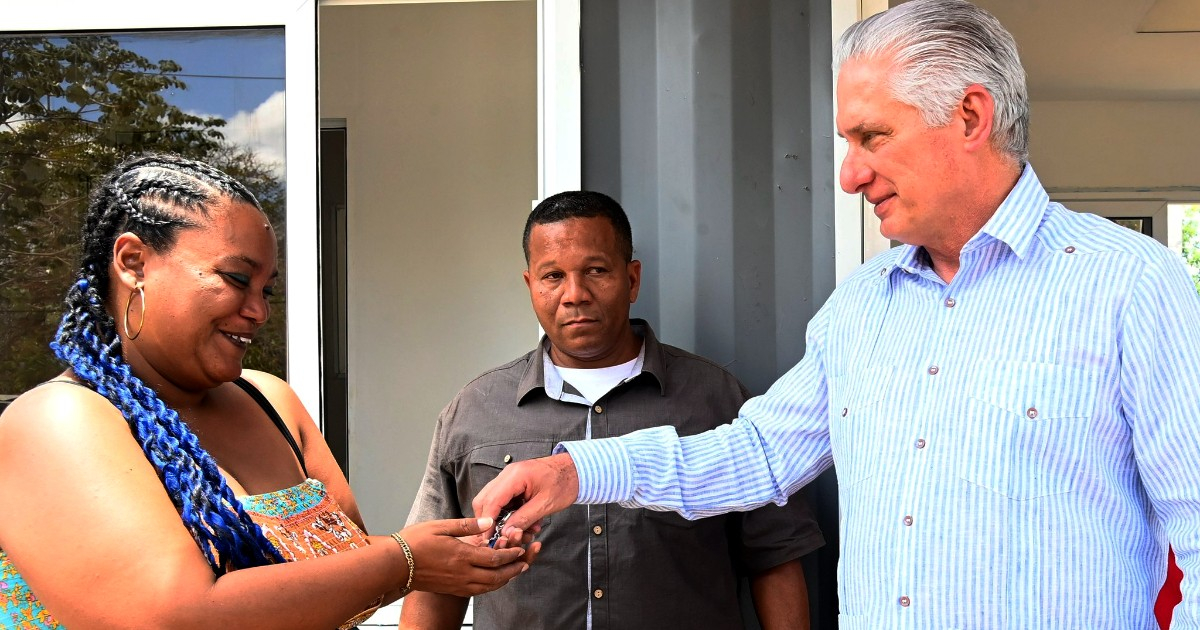
On Saturday, Cuban President Miguel Díaz-Canel and Prime Minister Manuel Marrero Cruz were present for the launch of the initial two modular homes, ingeniously crafted from recycled shipping containers, in the Nuevo Vedado neighborhood of Havana. This event was touted by state media as a "creative solution" to the severe housing crisis plaguing the island.
The new homes were awarded to Alina Hinojosa Cardona, a mother of two teenagers who had been living in overcrowded conditions, and Nerelys Madan Catalá, who had spent over 13 years in a shelter with her child and elderly mother.
The ceremony was attended by several high-ranking officials, including Interior Minister General Lázaro Alberto Álvarez Casas, Central Committee Organization Secretary Roberto Morales Ojeda, and Secretary of the Council of Ministers General José Amado Ricardo Guerra.
Origins and Challenges of the Container Housing Program
Prime Minister Marrero Cruz explained that the housing initiative was proposed by Ramiro Valdés Menéndez, who suggested repurposing containers used to transport parts for solar panel parks from China. Despite the diverse designs, both homes were constructed in just one month using surplus materials from tourism investments and military-developed technologies. Marrero Cruz admitted that the program's progress is slower than desired, acknowledging the potential for quicker execution.
The Stark Reality of Cuba's Housing Crisis
The backdrop of this event is a daunting housing deficit that the Cuban regime has failed to address. The official shortage stands at 806,000 homes, but some estimates put this number as high as 929,000, encompassing both new builds and required renovations.
In 2024, Cuba managed to construct only 7,427 homes, with cement production operating at a mere 10% capacity. By the first quarter of 2025, the housing plan was only 12.4% fulfilled, with just 1,344 units completed out of the 10,795 planned. Approximately 35% of Cuba's housing stock is in poor or substandard condition, and in Havana alone, around 1,000 buildings collapse annually.
The Discrepancy Between Propaganda and Reality
In light of such a systemic failure, the ceremonial delivery of just two homes in the capital starkly contrasts with the regime's rhetoric, highlighting the enormous gap between official propaganda and the real scope of the issue. Up until April 2026, the program had produced a mere 133 units across the nation.
This initiative is not cost-free; each unit's price tag is about one million Cuban pesos, equivalent to over ten years of an average salary, which recipients must finance through credit. Residents in El Cerro and Guantánamo have reported issues such as leaks, electrical problems, defective plumbing, and inadequate thermal insulation in these new homes.
Delilah Díaz Fernández, the General Director of Housing at the Ministry of Construction, stated that more than 2,000 containers have been allocated for this purpose, with about 700 currently being converted in workshops, and a total of over 8,000 units available. "The program has significant potential and is here to stay," she asserted.
In November 2025, the Cuban government admitted the failure of its housing program and has since turned to alternative solutions, unable to meet the annual target of 50,000 homes promised since 2018—a goal that remains unachieved after more than six decades of communist rule.
Concluding the event, Marrero Cruz expressed commitment to the initiative: "The design and construction of these two homes motivate us to continue with this program," he declared, despite the ever-growing housing deficit exceeding 800,000 homes.
Exploring Cuba's Housing Shortage and Solutions
What is the current housing deficit in Cuba?
The official housing deficit in Cuba is reported to be 806,000 homes, but some estimates suggest it could be as high as 929,000 units, including both new constructions and necessary renovations.
How many homes did Cuba construct in 2024?
In 2024, Cuba constructed 7,427 homes, a number hindered by the cement production operating at just 10% of its potential capacity.
What are the issues reported by residents of the new container homes?
Residents have reported problems such as leaks, electrical failures, faulty plumbing, and poor thermal insulation in the newly delivered container homes.