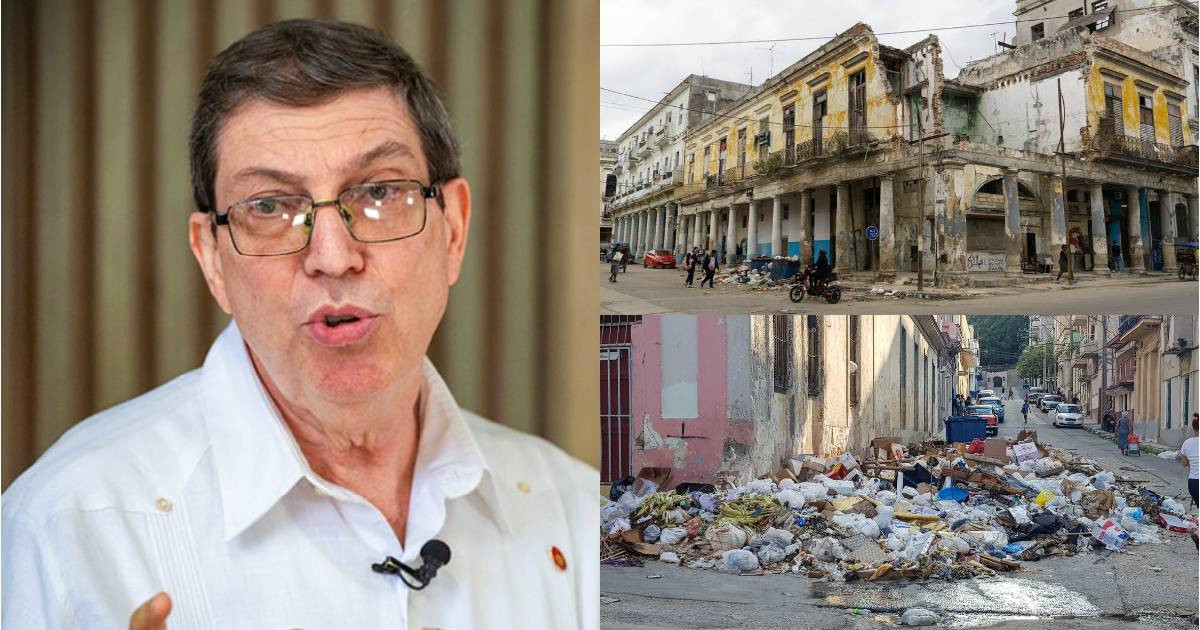
On Saturday, Cuban Foreign Minister Bruno Rodríguez Parrilla asserted that “Cuba is a besieged state, Cuba is an attacked state, not an ineffective state,” amidst new U.S. sanctions and threats of military escalation.
Rodríguez made this declaration during his speech at the International Solidarity Meeting with Cuba titled "For a World Without Blockade: Active Solidarity in Fidel's Centennial," held at the Palace of Conventions in Havana.
The Cuban diplomat contends that portraying Cuba as a failed state is "one of the main narratives that imperialism has tried to implant in people's minds." However, the everyday realities faced by Cubans paint a different picture, often highlighting institutional neglect of citizen complaints regarding malfunctioning services and the cumbersome, inefficient bureaucratic machinery.
U.S. Accusations and Official Cuban Response
Throughout 2026, President Donald Trump labeled Cuba a "failed state" or "failed nation" on at least three occasions, including February 3rd, when he signed Executive Order 14380, cutting Cuban crude imports by 80% to 90%.
On April 16, during the 65th anniversary of the Bay of Pigs invasion, Cuban leader Miguel Díaz-Canel reiterated a similar stance. "Cuba is not a failed state. Cuba is a besieged state," he stated at that time.
Rodríguez now echoes this sentiment with a slight semantic twist, yet the deteriorating living conditions in Cuba, such as extended blackouts and delayed surgeries, tell a different tale. The regime frequently blames the embargo as the primary cause of Cuba's issues, a narrative that has been part of the official discourse since 1991, used to deflect responsibility from decades of failed economic policies under communism.
Economic Struggles and International Relations
Since the executive order in January, Cuba has operated for four consecutive months without importing a single drop of fuel, relying solely on domestic production that meets only 40% of its needs. This has resulted in blackouts lasting 30 to 40 hours in some areas and a backlog of more than 96,000 pending surgeries, including over 11,000 for children.
The Economist Intelligence Unit projects a 7.2% economic contraction for Cuba in 2026, the most severe since the Special Period in the 1990s. In October 2025, during Hurricane Melissa, Díaz-Canel's denial of Cuba being a "failed state" was met with stark criticism on social media, where people declared, "Cuba is not a failed state; it is a deceased country."
In January, a foreign journalist described Havana as a city with garbage piling up on street corners, crumbling buildings, and families cooking with wood and charcoal.
Energy Crisis and Diplomatic Exchanges
In his speech, Rodríguez quoted Trump verbatim, saying, "Talking about a place called Cuba, of which we will take control almost immediately," and labeled the energy blockade as "an act of war equivalent to a naval blockade, as defined in international law."
The Foreign Minister confirmed ongoing exchanges with Washington but was adamant that "the political and economic order of Cuba is not part of that exchange in any way."
The meeting brought together 766 delegates from 152 organizations across 36 countries, occurring a day after Trump signed a new executive order imposing sanctions on individuals linked to the Cuban regime in energy, defense, metals, finance, and security sectors.
The only energy relief received by the island in months was a Russian donation of 730,000 barrels of oil — enough for a mere ten days of consumption — which Díaz-Canel described as "symbolic."
As the regime continues to insist that Cuba is an "attacked" rather than "ineffective" state, the increasing threats from Trump and the rapidly declining living standards on the island place the Cuban people at the heart of a tension that no official rhetoric can disguise.
Understanding the Cuban Economic and Political Situation
What is the impact of U.S. sanctions on Cuba?
U.S. sanctions have significantly impacted Cuba's economy by limiting its ability to import essential goods, including crude oil, which has exacerbated the country's energy crisis and led to extended blackouts.
How does the Cuban government respond to accusations of being a failed state?
The Cuban government rejects the label of a failed state, asserting instead that it is a besieged and attacked state. This narrative is used to deflect criticism and blame the U.S. embargo for the country's challenges.