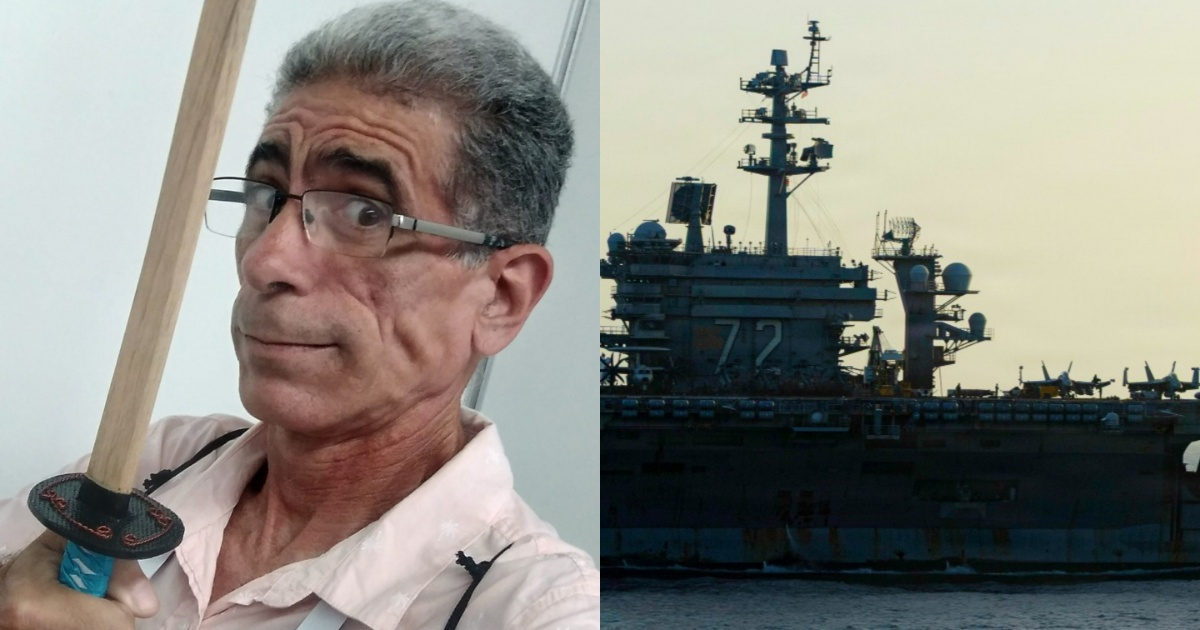
Francisco Rodríguez Cruz, also known as "Paquito de Cuba" and vice president of the Union of Cuban Journalists (UPEC), found himself at the center of controversy after he posted two mocking messages on Saturday about President Donald Trump's threat to send an aircraft carrier to Cuban shores. The irony was not lost on users who noticed that, as he wrote these posts, he was aboard an American Airlines flight heading to Miami.
The uproar started when Trump, during a private dinner in West Palm Beach, Florida, proclaimed that the United States would "take control of Cuba almost immediately" following military operations in Iran. He depicted a scenario where the USS Abraham Lincoln would approach within 100 yards of Cuba's coast to force the regime's surrender. On the same day, Trump signed a new executive order expanding sanctions against Cuba.
In response, Rodríguez Cruz took to Facebook with two posts. The first read, "Let him park his aircraft carrier 100 meters off the coast; Cubans will cannibalize it and sell it in parts..." The second post declared, "I'm on my way to Mar-A-Lago to tell him where he can stick his aircraft carrier..."
The issue arose with the selfie accompanying the second post: it showed the state journalist at an airport with a flight monitor in the background displaying American Airlines flight AA 2706 bound for Miami on May 2 at 11:47 AM.
This incident highlighted the contradiction of a regime spokesperson mocking Trump's military threat while simultaneously boarding a flight to the country he purportedly challenged.
The backlash was swift, with a flood of criticism in the comments of both posts. Users were quick to point out the hypocrisy of an anti-imperialist regime figure making such proclamations from the departure lounge en route to Miami.
This is not the first time Paquito de Cuba has sparked outrage with such contradictions. In December 2025, he traveled to Venezuela and shared celebratory content while Cuba was grappling with a severe economic crisis, claiming that Maduro was "winning the fight" against the United States.
In March 2025, he mocked the closure of Radio Martí, stating that Trump's measures increased "the unemployment rate among counter-revolutionaries by 20%." In July of the same year, he publicly claimed inflation was decreasing, despite the rising prices faced by the Cuban population.
Cuba's state media has a history of ridiculing American aircraft carriers. In February 2026, the state newspaper Girón referred to the USS Gerald R. Ford as a "facade of imperial power," and the Escambray newspaper echoed these taunts in March of that year, maintaining the regime's editorial stance in response to each escalation from Washington.
Meanwhile, Cuban Foreign Minister Bruno Rodríguez Parrilla declared that Cuba "will not be intimidated" by the aircraft carrier threat, and President Miguel Díaz-Canel asserted that "no aggressor" would subdue the island. On the other hand, Yotuel Romero, co-author of "Patria y Vida," summed up Trump's words on Facebook with two words: "IT'S OVER."
Trump's statements are part of a maximum pressure campaign that includes over 240 sanctions imposed since January 2025 and Cuba's re-addition to the list of State Sponsors of Terrorism on January 20, 2026. This situation has left Cuban Americans feeling anxious and uncertain about what may unfold in the coming months.
Understanding the U.S.-Cuba Tensions
What prompted Trump's threat to send an aircraft carrier to Cuba?
Trump's threat was part of a broader strategy to exert pressure on Cuba following military operations in Iran, aiming to force the island's regime into submission.
How did Francisco Rodríguez Cruz respond to Trump's declarations?
Rodríguez Cruz mocked Trump's aircraft carrier threat on Facebook, suggesting Cubans would dismantle it, despite traveling to Miami at the time.
What impact have Trump's sanctions had on Cuba?
The sanctions have increased economic pressure on Cuba, contributing to uncertainty and hardship for its population, as well as fear among Cuban Americans about the future.