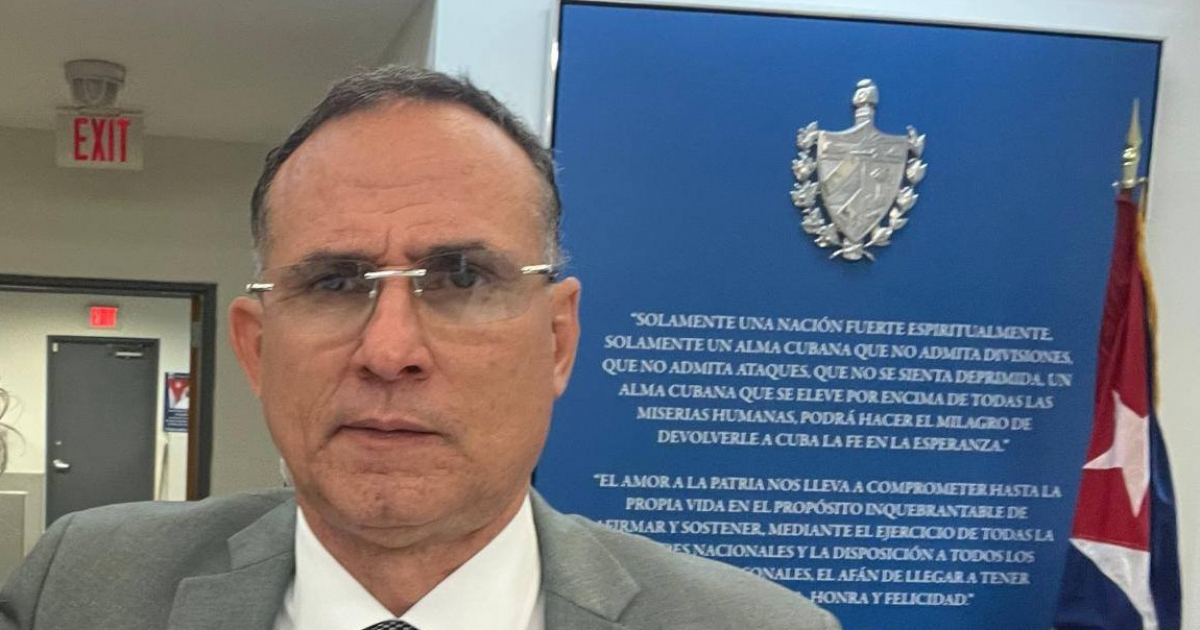
Cuban opposition leader José Daniel Ferrer expressed on Saturday his belief that the Cuban regime will not capitulate to the military pressure from the aircraft carrier promised by Donald Trump. Speaking at Madrid-Barajas Airport, Ferrer openly called for direct military intervention to end the dictatorship.
Ferrer was responding to queries about whether the regime would give up if Trump followed through on his promise to dispatch the USS Abraham Lincoln to the Cuban coastline. Trump made this announcement on May 1st during a Forum Club dinner in West Palm Beach, where he stated that the U.S. would "take Cuba almost immediately" after concluding operations in Iran.
"They won't surrender just by seeing or feeling the carrier nearby. It's not because they're brave; it's because absolute power has driven them insane to the point where they believe something will save them at the last moment—like Maduro or Khamenei," Ferrer declared.
Taking a stronger stance, Ferrer advocated for decisive military action: "They will need a dose of Tomahawk to come to their senses. The precise dose of Tomahawk with two or three GBU-57A/B MOP will make them understand that their story has ended forever and that the Cuban people must be free."
Ferrer arrived in Madrid to embark on a month-long tour across more than ten European countries alongside Javier Larrondo of Prisoners Defenders. Their mission is to align Europe with the Cuban people's demands: freeing political prisoners and liberating Cuba.
Upon accessing the internet at the airport and reading Trump's statements, Ferrer admitted he was startled: "I was so alarmed that I thought I should book a return ticket to the United States, to Miami, to the Americas. I need to be as close as possible to Havana."
He decided to proceed with the tour after realizing that Trump had conditioned any action on Cuba to first resolving issues with Iran: "I read further, and Donald Trump says once they finish with Iran, so I think I can at least start my European tour."
Ferrer justified his pro-intervention stance with a medical metaphor: "Those who, out of hatred for chemotherapy, prefer the deadly cancer will tell you they'd rather see innocent Cubans continue to die than send the criminals causing so much death and suffering to join Maduro or Khamenei. I prefer the chemotherapy and radiotherapy to eliminate the cancer."
These statements come during a time of heightened pressure from Washington on Havana. On May 1st, Trump signed a new executive order extending sanctions against Cuban officials in the energy, defense, mining, and financial sectors and imposing secondary sanctions on foreign banks working with the regime.
Since January 2026, the Trump administration has imposed over 240 sanctions and intercepted at least seven oil tankers bound for Cuba, slashing energy imports by 80% to 90% and causing blackouts of up to 25 hours daily in more than 55% of the territory.
The regime reacted defiantly. Díaz-Canel declared, "No aggressor, no matter how powerful, will find surrender in Cuba." Meanwhile, Foreign Minister Bruno Rodríguez stated that Cuba "will not be intimidated" and labeled the sanctions as "illegal and abusive."
Ferrer, who was forcibly exiled to Miami in October 2025 after over four years in Mar Verde Prison in Santiago de Cuba, concluded with a hopeful remark about his tour: "Let's hope our mission gets interrupted. Let's hope we have to return immediately."
Understanding the Cuban Regime's Stance
Why does José Daniel Ferrer believe the Cuban regime won't surrender?
Ferrer believes the regime is driven to madness by absolute power and relies on the hope that something will save them at the last moment, similar to the situations of Maduro and Khamenei.
What is José Daniel Ferrer's proposed solution to the Cuban crisis?
Ferrer advocates for a direct and forceful military intervention, suggesting the use of Tomahawk missiles to make the regime understand their end and liberate the Cuban people.
How has the Trump administration increased pressure on Cuba?
The Trump administration has imposed over 240 sanctions, intercepted oil shipments, and extended sanctions against Cuban officials, significantly reducing energy imports and causing widespread blackouts.