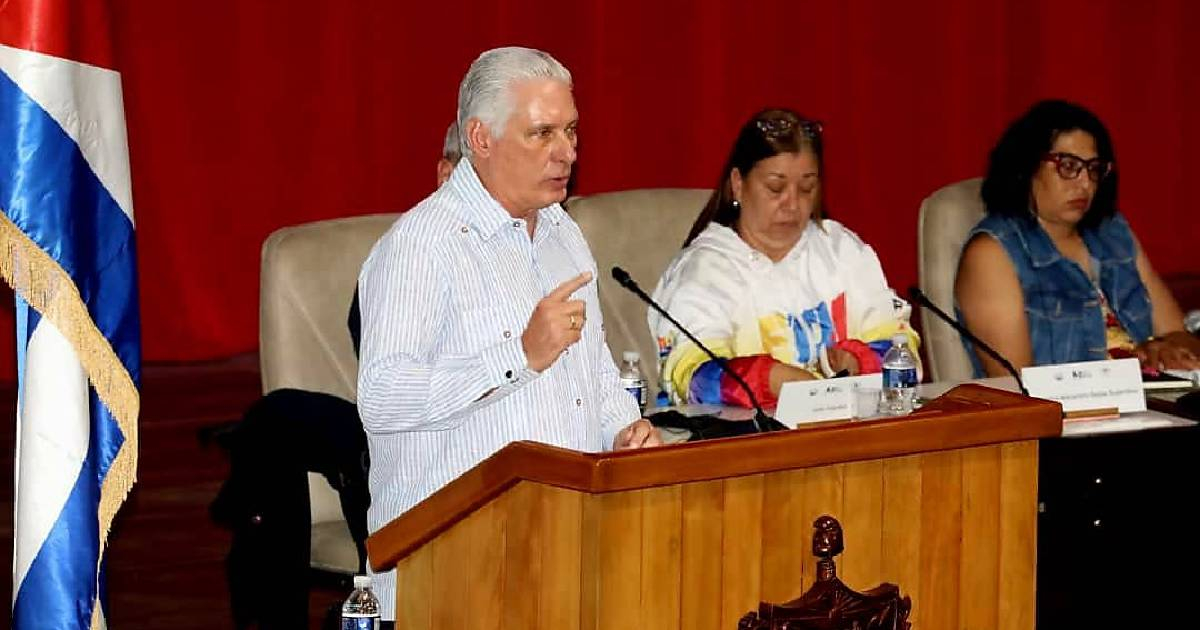
The Cuban Communist Party issued a bold statement on Saturday via its official account on the social media platform X, responding defiantly to threats from President Donald Trump. The party declared that "there will be no surrender in Cuba," emphasizing the island's commitment to defending its dignity, sovereignty, independence, and the right to self-determination of its people.
The statement, quoting Miguel Díaz-Canel, was shared with hashtags #LaPatriaSeDefiende and #CubaNoEstáSola, alongside images purportedly from an international solidarity event with Cuba. These images featured flags from various countries and banners displaying slogans like "Hands Off Cuba" and "Solidarity Does Not Stop."
Trump's Threats and Military Posturing
This declaration was a direct response to escalating threats from the Trump administration. On Friday, during a private dinner at the Forum Club in West Palm Beach, Florida, Trump threatened to deploy the aircraft carrier USS Abraham Lincoln just 100 meters off the Cuban coast to coerce the regime into surrendering.
Trump, describing his plan, said, "Upon our return from Iran, we'll send one of our aircraft carriers, perhaps the Abraham Lincoln, have it approach and stop a hundred meters from shore, and they will reply: thank you, we surrender."
He noted that this action would follow the conclusion of military operations against Iran, referred to as Operation Epic Fury, which began on February 28, 2026.
Increased Sanctions and Responses from Cuban Leaders
That same Friday, Trump signed a new executive order intensifying sanctions against Cuba. This order imposed secondary measures on banks and foreign entities involved in sanctioned Cuban transactions, warning of potential account closures on Wall Street.
Díaz-Canel accused the United States of "moral poverty," describing the measures as a "brutal genocidal blockade," while Foreign Minister Bruno Rodríguez called them an "illegal and abusive collective punishment."
"No aggressor, no matter how powerful, will find surrender in Cuba," Díaz-Canel asserted, echoing a stance reiterated by Foreign Minister Rodríguez.
May Day March and National Campaign
The statement came a day after the May Day parade, held under the slogan "The Homeland is Defended," with marches from the Plaza de la Revolución to the Anti-Imperialist Tribune in front of the U.S. Embassy in Havana.
During the event, Díaz-Canel introduced the "My Signature for the Homeland" campaign, claiming 6,230,973 Cuban signatures opposing U.S. sanctions.
Since January 2026, the Trump administration has imposed over 240 sanctions on Cuba, reinstated the island on the list of State Sponsors of Terrorism on January 20, and intercepted at least seven oil tankers, cutting 80 to 90% of Cuba's energy imports.
Secretary of State Marco Rubio warned on April 27 that "Cuba has only two outcomes: neither good," while in March, Trump told CNN that "Cuba will fall quite soon."
Understanding the Escalation Between the U.S. and Cuba
What triggered the recent threats from the Trump administration towards Cuba?
Recent threats from the Trump administration were triggered by a series of political and military maneuvers, including military operations in Iran, followed by a renewed focus on exerting pressure on Cuba through heightened sanctions and military threats.
How has Cuba responded to the increased sanctions?
Cuba has responded to the increased sanctions by reinforcing its stance on sovereignty and independence, with leaders like Díaz-Canel condemning the U.S. actions as a "brutal genocidal blockade" and rallying national and international support against the measures.
What are the implications of the new executive order signed by Trump?
The new executive order signed by Trump expands sanctions against Cuba, targeting foreign banks and entities involved in Cuban transactions, and threatens the closure of accounts on Wall Street, increasing economic pressure on the island.