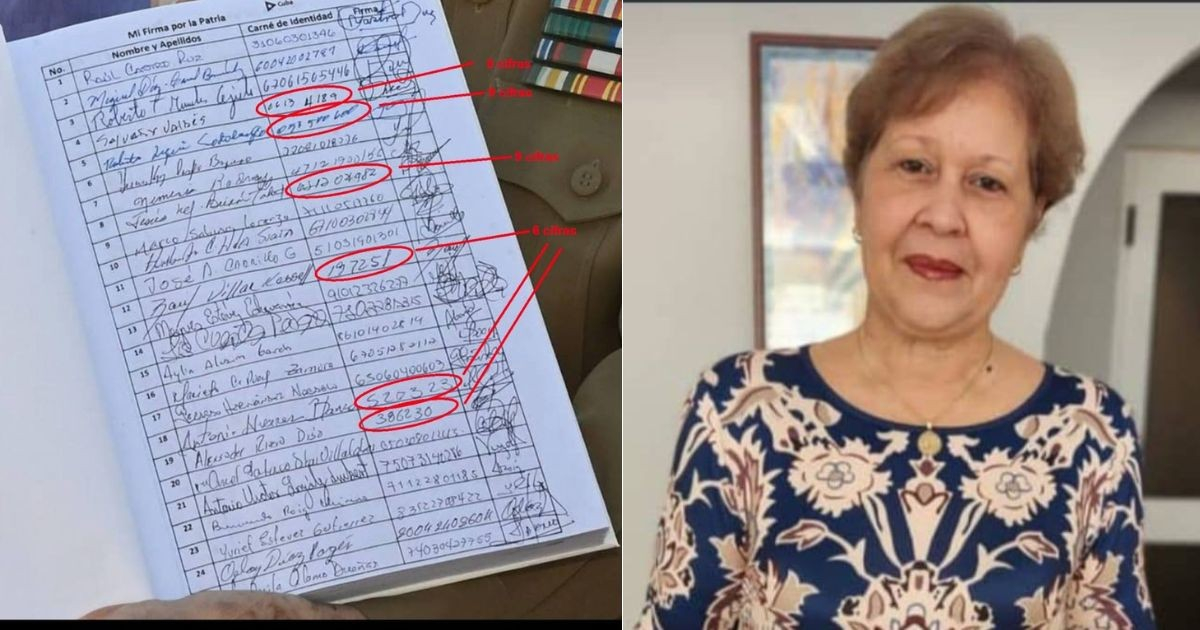
Historian and activist Alina Bárbara López Hernández delivered a sharp critique on her Facebook page, challenging the authenticity of the official figures from the "Mi Firma por la Patria" campaign. According to the Cuban regime, it collected over six million signatures in just a fortnight.
The government publicized the official count—6,230,973 signatures—during a May Day event in front of the U.S. Embassy in Havana, where the signature books were symbolically handed over to Raúl Castro and Miguel Díaz-Canel. Foreign Minister Bruno Rodríguez Parrilla even claimed that 81% of Cuba's population had signed, suggesting near-total participation by the island's adult population.
An Impossible Number?
López doesn't deny that some signatures were voluntarily given but argues that coercion played a role. Her analysis aims to demonstrate the mathematical impossibility of the declared number.
López states, "I will emphasize the impossibility of the huge number declared yesterday: 6,230,973." She points out that in 2002, during a similar campaign to declare socialism "irreversible" in the Constitution, the regime reported 8,188,198 signatures. The difference of just 1,957,225 signatures raises suspicion, she asserts.
Demographic Decline and Political Unrest
The situation in 2026 is vastly different from that of 2002. Cuba's population has dwindled from over 11 million to approximately 9.7 million according to official estimates, with independent figures suggesting a population between 8.6 and 8.8 million. Since 2021, more than 1.5 million Cubans have emigrated, and in 2024, there were 128,098 deaths compared to only 71,358 births.
"Since 2002, Cuba's population has alarmingly decreased, not only due to the massive exodus of recent years, which surpassed 1.5 million emigrants but also due to increased mortality and declining birth rates. For over five years, more people have died in our country than have been born," López notes.
Coupled with the demographic crisis is the political collapse. "The consensus the Cuban government enjoyed in 2002 is far greater than today. Over the past six years, dissent has grown, as evidenced by the social protests since 2020," López highlights, referring to events such as the July 11, 2021, demonstrations and the 2024 protests. The campaign, organized by the Communist Party, was presented as a grassroots initiative, though pressure was reported in workplaces, schools, and through the Committees for the Defense of the Revolution.
Documented Irregularities
López also highlights specific irregularities. She received accounts from individuals who were asked to sign twice: "One person told me they signed at home at the request of a local delegate and then again at their workplace, despite stating they had already signed." Three others admitted to using fake ID numbers to invalidate their signatures.
This claim is visually supported by a photo published on the official "Presidencia Cuba" page, where Raúl Castro is seen opening the first signature book. At least six ID numbers in the image have fewer than the required 11 digits, including that of Vice President Salvador Valdés Mesa, whose ID appears with only eight digits.
"What's astonishing is that one of the incomplete numbers belongs to Vice President Salvador Valdés Mesa, highlighting the lack of seriousness in that act. If even the leaders didn't take it seriously, imagine the rest of the people," López concludes.
The activist predicts the campaign will lead to political outcomes akin to those of 2002, when signature collection resulted in the constitutional declaration of socialism's irreversibility: "This will have a sequel, just as it did in 2002. I have an idea of what they might do next." She promised to publish an article in the coming days with her analysis of potential developments.
Analyzing the Signature Campaign in Cuba
Why does Alina Bárbara López question the signature count?
López questions the signature count because she believes the figure of 6,230,973 is mathematically impossible given the current demographics and political climate in Cuba. She also points out irregularities in the process.
What are the demographic challenges mentioned in the analysis?
The analysis notes a significant population decline due to high emigration rates, increased mortality, and a continued drop in birth rates, leading to fewer people living in Cuba now compared to 2002.