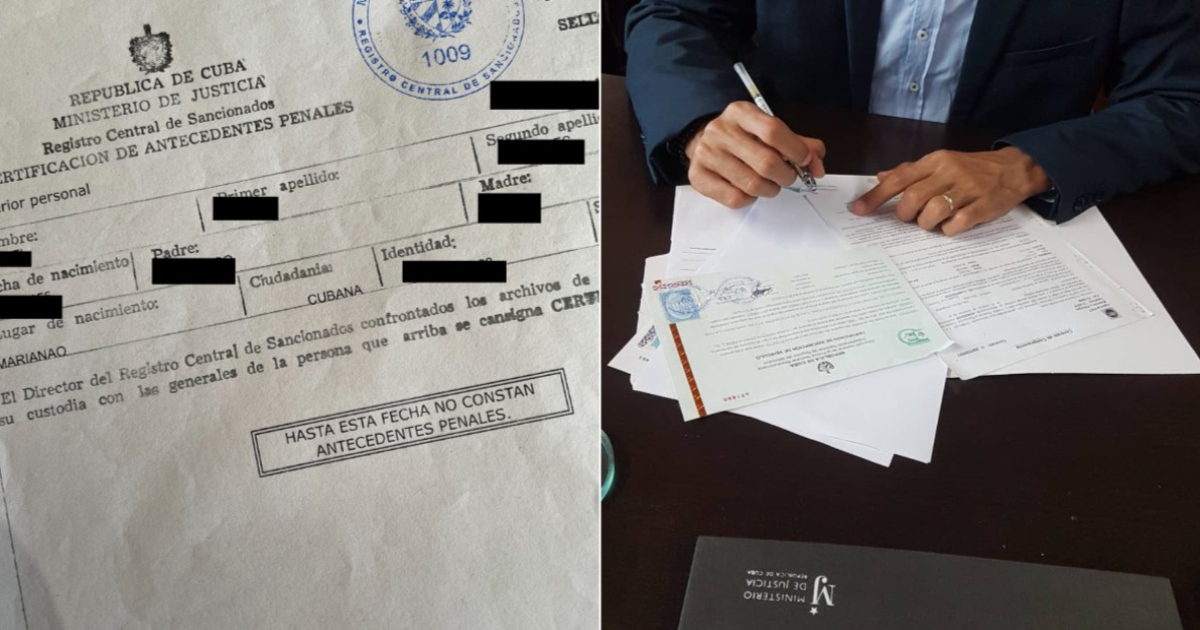
In Cuba, the current fee structure for document legalization highlights a stark contrast, with expatriates paying up to 25 times more than permanent residents on the island. This disparity was detailed in the latest update from Directorio Cubano on Friday.
The charges are settled through revenue stamps and differ based on the type of document and the applicant's residency status. These fees were established by the Ministry of Justice's Resolution 486/2025, which was published in the Official Gazette on December 27, 2025, replacing Resolution 171/2022.
Fees for Documents Intended for Foreign Use
For academic documents, notarial deeds, and copies of court rulings meant for international use, permanent residents pay 40 Cuban pesos (CUP), while non-residents are charged 1,000 CUP.
Other official certifications, such as those from the Civil Registry, identity cards, the Registry of Sanctioned Persons, the Historical Archive, the Archbishop's Office, employment records, or professional qualifications, require residents to pay 20 CUP and non-residents 500 CUP.
This pricing scheme has faced substantial criticism. In January 2026, the organization Cubalex described it as an "economic apartheid" and "legalization of inequality," arguing it institutionalizes unequal access to legal services and aligns with a state-driven agenda to obtain foreign currency.
Specialized Legal Services and Certification Fees
Collective law firms also handle documents intended for foreign use. Citizenship and legal capacity certifications cost 10 CUP for residents and 250 CUP for expatriates.
The least expensive certifications are those for criminal records, birth, marriage, death, or other official records, costing five CUP for residents and 125 CUP for non-residents.
These processes have stirred growing discontent among expatriates, who criticize the exorbitant costs and logistical challenges of managing these tasks from abroad.
Validation of Foreign Documents in Cuba
For documents issued by accredited diplomatic or consular officials in Cuba requiring validation, the fee is 20 CUP for residents and 500 CUP for non-residents. This same rate applies to documents issued abroad and subsequently certified by Cuban consular authorities.
A significant change is that documents directly issued by Cuban diplomatic or consular officials no longer require additional legalization by the Ministry of Justice.
Payment Methods for Legalization Fees
Fees can be paid using physical revenue stamps available at Cuban post offices. Digital payment options are also available through Transfermóvil, as enabled by the Ministry of Justice's Resolution 4 of 2023, or by purchasing digital stamps at post office locations with a receipt.
However, it's advisable to confirm whether the destination country accepts digital formats, as some procedures still mandate the use of physical stamps.
In 2024, over 1,500,000 documents were legalized in Cuba, underscoring the high demand fueled by the extensive Cuban emigration in recent years.
Since February 3, 2025, the Ministry of Justice has been responsible for legalization functions, a role previously held by the Ministry of Foreign Affairs, following the Council of Ministers' Agreement 10034.
Understanding Document Legalization in Cuba
Why is there a fee difference for document legalization between residents and non-residents in Cuba?
The fee difference is part of a strategy to gather foreign currency, reflecting a state policy aimed at economic gain from expatriates.
What are the payment options for document legalization in Cuba?
Payments can be made using physical revenue stamps or digitally via Transfermóvil. It's important to check if the destination country accepts digital formats.
Who is responsible for document legalization in Cuba?
As of February 2025, the Ministry of Justice handles the legalization of documents, a duty previously managed by the Ministry of Foreign Affairs.