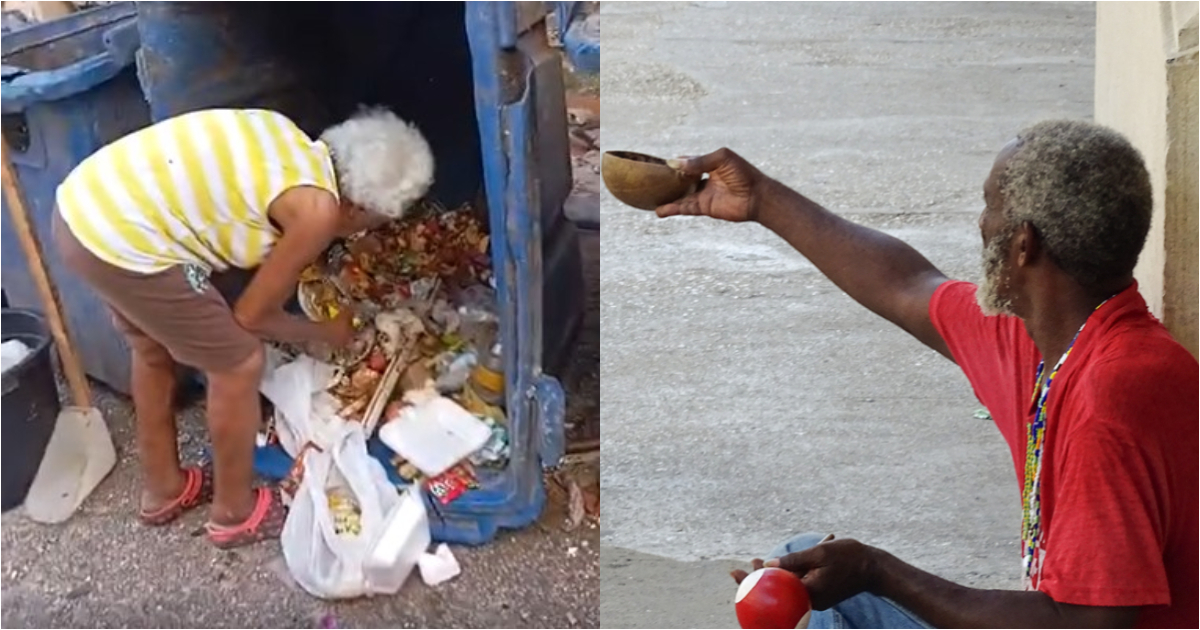
An essay released this Friday by Cuban scholar Lorenzo Vega-Montoto on the platform CubaxCuba raises one of the most unsettling questions for Cubans aged sixty to eighty: what exactly did they spend their lives building, and why does that question, like many dangerous ones in Cuba, remain silent?
Vega-Montoto, a Doctor of Chemical Sciences and Principal Investigator at the Idaho National Laboratory, dedicates his work to his parents and "a generation that sang, believed, and was abandoned." The essay, titled "The Glory That Was Never Returned," offers a scathing critique of the betrayal the regime inflicted on those who built it.
"There is a way of losing one's life that doesn't appear in obituaries," the author observes. "It's the slow, accumulated loss of years given to something that turned out not to be what it promised. It is waking up at seventy in a country without electricity, without medicine, without the children who left by raft, plane, or worse, are imprisoned."
The Role of Nueva Trova Music
The essay centers on Nueva Trova music—Silvio Rodríguez, Pablo Milanés, and Noel Nicola—as the emotional conduit that sealed the pact between that generation and the revolution. The songs, Vega-Montoto argues, were not mere entertainment but a sort of liturgy: they forged an implicit contract where if one dedicated their life to the collective, the collective would support them. "That assumption was the most costly lie that generation paid for," he asserts.
The scholar cites Silvio Rodríguez's line in "Playa Girón"—"if someone steals food and then gives their life, what should be done?"—as "the most honest question one can ask of a revolution," posed in 1975 and never answered by those in power. He also recalls Pablo Milanés's verse in "Cuando te encontré": "It is better to sink into the sea than to betray the glory lived." For Vega-Montoto, this line isn't poetry but an emotional signature of a generation that willingly shackled itself out of love, and which the regime exploited for decades.
The High Cost of Belief
"This is the most refined scam produced by 20th century Latin America," he writes. "Fidel Castro was not a leader who served his people. He was an extraordinary individual—one must grant him that adjective to understand the magnitude of the theft—who made his people believe that serving him was serving themselves." All that collective sacrifice, he concludes, "was contributed to the symbolic and historical capital of a man who died surrounded by the honors of over ninety states, leaving his country without soap."
The generation that once taught literacy, farmed, and fought in wars on other continents now receives a meager pension of 4,000 Cuban pesos, less than nine dollars at the informal exchange rate, while basic food necessities demand at least 30,000 pesos monthly. A survey by the Independent Union Association of Cuba of 506 retirees revealed that 99% claim their pension doesn't cover food, housing, or medication. The country suffers blackouts lasting up to twenty hours daily, with a power generation deficit reaching 1,881 megawatts in March 2026.
The Legacy of Abandonment
According to Vega-Montoto, this neglect isn't accidental. "A system that can't produce real wealth needs its oldest members to die quickly and silently," he writes. "Those elders have memories. They recall what was promised, what was given. And if that gap is articulated, if voiced aloud, it is politically devastating." Thus, he concludes, "the system prefers that generation to consume their nostalgia privately. To sing the old songs inwardly. To perish before their testimony becomes inconvenient."
The essay also questions whether that generation can reconcile with their past. Vega-Montoto distinguishes between those who can't accept the betrayal—because doing so would dismantle the only structure of meaning that supports their personal history—and those who have mourned it. Among the latter, he mentions those who watched Pablo Milanés break with the regime and understood that this wasn't a betrayal of his work but its most logical consequence. Milanés supported the protests of July 11, 2021, and passed away in Madrid in November 2022.
Over a million Cubans have left the island since 2021, leaving the elderly behind. Foreign press coverage has highlighted the abandonment of the elderly in Cuba as one of the most visible symptoms of the humanitarian collapse the island faces after 67 years of dictatorship.
"The possible reconciliation, the only honest one, is not with the Revolution. It is with oneself," writes Vega-Montoto in conclusion. He finishes with the sentence that encapsulates the entire argument: "That generation wasn't defeated by imperialism. It was robbed by its own Revolution. And that, still, awaits being said aloud."
Cuban Generational Reflections and Challenges
What question does Lorenzo Vega-Montoto's essay raise for older Cubans?
The essay prompts older Cubans to question what they have spent their lives building and why such questions remain unspoken in Cuba.
How does Vega-Montoto describe the impact of Nueva Trova music on the Cuban revolution?
He describes Nueva Trova music as an emotional conduit that solidified the pact between the generation and the revolution, serving as a liturgy rather than mere entertainment.
What does Vega-Montoto suggest about Fidel Castro's leadership?
Vega-Montoto suggests that Fidel Castro was not a leader who served his people, but rather an extraordinary individual who convinced his people that serving him was equivalent to serving themselves.